| ||||||||||||||||||||||||||||||||||||||

Mon 2026-06-08
Fri 2026-06-05
Thu 2026-06-04
Wed 2026-06-03
Tue 2026-06-02
Mon 2026-06-01
Sun 2026-05-31
Guidelines for Respectful Use of AI Sat 2026-05-30
Fri 2026-05-29
Search
Archives
2024
12 11 10 09 08 07 06 05 04 03 02 01
2023
2022
2021
2020
2019
2018
2017
2016
2015
2014
2013
2012
2011
2010
2009
2008
2007
2006
2005
2004
2003
One good site
MDN
Nelson Minar
Blog licensed under a Creative Commons License
|
 World of Warcraft has an
interesting feature: customizable
UI. Downloadable mods like Cosmos,
CTmod,
GypsyMod,
and
Telo's
AddOns
let you add new UI elements to the screen like extra hotkeys, item
databases, buff timers, etc. The WoW client is even
scriptable
in Lua, allowing some fairly complex
things.
World of Warcraft has an
interesting feature: customizable
UI. Downloadable mods like Cosmos,
CTmod,
GypsyMod,
and
Telo's
AddOns
let you add new UI elements to the screen like extra hotkeys, item
databases, buff timers, etc. The WoW client is even
scriptable
in Lua, allowing some fairly complex
things.
I've always been fascinated by the duality of client/server games. The primary user experience is the graphical client but the reality is the protocol underneath. It's like seeing the code beneath the Matrix. Back in the good ol' days of Netrek a popular hack was to show your opponent's position with more precision than intended, even when they were cloaked. The data was there in the client, so why not display it and gain an edge? The security problems intrinsic to interface hacking have never been fully solved. At least modern games no longer trust the client. A big problem is macros like fishing bots; leave your character online with a script running and come back a day later to lots of ill-gotten wealth. You can even auction off the results for real money on eBay, except that Blizzard is trying to stop that.  I'll be damned; I actually hit a copy protected CD. Blue Train, by John Coltrane. I can't rip
it to MP3. Why copy protect this particular jazz classic? Beats the
hell out of me, but since I can't rip it to MP3 back it goes to
Amazon. It's insane that it'd be easier for me to steal this
album then buy it legitimately.
I'll be damned; I actually hit a copy protected CD. Blue Train, by John Coltrane. I can't rip
it to MP3. Why copy protect this particular jazz classic? Beats the
hell out of me, but since I can't rip it to MP3 back it goes to
Amazon. It's insane that it'd be easier for me to steal this
album then buy it legitimately.
While setting up my
new machine I
made a list of all the software I installed. I did this awhile back
for the Mac, too.
This is dumb, a message from dmesg:
Warning only 896MB will be used.
Use a HIGHMEM enabled kernel.
896MB LOWMEM available.
Yes, in addition to the old 64M limit and the awkward 4G limit, Linux also has a 896M limit. Why? Beats the hell out of me, but the solution is to rebuild your kernel with the magic CONFIG_NOHIGHMEM parameter where you have three choices: less than 1G, 1-4G, or more than 4G. I'm sure this has something to do with some hideous aspect of the PC architecture. I really don't care. Couldn't the kernel just figure this out for itself? Ah, but then we wouldn't be l33t linux haqrs. 
 For the first time in five years I bought a whole new PC. I've always
cobbled together machines from parts. But I've been increasingly
dissatisfied with what I could do; the machine always ended up loud
and hot.
For the first time in five years I bought a whole new PC. I've always
cobbled together machines from parts. But I've been increasingly
dissatisfied with what I could do; the machine always ended up loud
and hot.
This time around I bought a gaming machine from EndPCNoise.com, an online retailer specializing in quiet PC components. And this machine is sweet. High end ATI X800 video card, excellent disk and CPU, etc. And it's so quiet I thought it wasn't working when I first turned it on. The server locked in my closet 10 feet away from me is louder than the new machine sitting next to me.
There's an
excellent
article in today's NYT about Slab City, a lawless place deep
in the California
desert where retired people have set up their own TAZ. It's like
Burning Man only more depressing.
Slab City is not so sinister as it is a strange, forlorn quarter of
America. It is a town that is not really a town, a former training
grounds with nothing left but the concrete slabs where the barracks
stood. Gen. George S. Patton trained troops here. Pilots of the Enola
Gay practiced their atomic mission, dropping dummy bombs into the sea.
The land belongs to the state, but the state, like the law, does not bother, and so the Slabs have become a place to park free. More than 3,000 elderly people settle in for the winter, in a pattern that dates back at least 20 years. They are mostly single, divorced or widowed - a whole generation on the road, independent, alone. In this place, to be 55 years old is to be young.  Ken and I are food tourists, and so one of our goals in New Zealand
was to go to the best restaurants we could find. We did quite well,
too. The bigger cities have a surprisingly sophisticated cuisine,
borrowing heavily from European traditions but adapting it a bit,
in particular highlighting seafood in simple preparation. We had
excellent dinners in Wellington and Queenstown. Particularly
Queenstown, where the tourist industry supports world class
restaurants like Wai and
The Bunker.
Ken and I are food tourists, and so one of our goals in New Zealand
was to go to the best restaurants we could find. We did quite well,
too. The bigger cities have a surprisingly sophisticated cuisine,
borrowing heavily from European traditions but adapting it a bit,
in particular highlighting seafood in simple preparation. We had
excellent dinners in Wellington and Queenstown. Particularly
Queenstown, where the tourist industry supports world class
restaurants like Wai and
The Bunker.
I complained earlier about restaurants in New Zealand. That's not really fair; we had a lot of great dinners. Alas, NZ lacks a long tradition of upscale dining, so sometimes you find good food with poor service, or mediocre food masquerading as a fine restaurant. I love ordinary food, too, just eating at fine restaurants would be tiresome. The Kiwi take on the hamburger is good. A serious sandwich where the meat is secondary to the stacks of crisp tomatoes, lettuce, salad dressing, and a surprisingly good addition: beets. I also really appreciated the humble meat pie, a simple snack turned into something special with good pastry and flavourful gravy. And NZ has my new favourite coffee drink, the flat white, sort of like a cappucino but with rich cream instead of milk foam. Finally, New Zealand's serious farm business means that local ingredients are excellent. Terrific fish, of course, although not a lot of variety. Nice tiny Nelson bay scallops, served with the roe. Local specialties like golden kumara, a mild flavourful sweet potato; feijoa, a funky fruit; manuka honey, tasty as well as medicinal; and muttonbird (titi), an oily fishy bird no one seems to actually eat. But the most impressive foodstuff was the best lamb I've ever had. Tasty juicy baby sheep.  One of my favourite bands, Pink Martini, just
released their second album.
Hang on Little Tomato comes seven years
after their fantastic debut album
Sympathique, neatly extending their cool
lounge style beyond the standards to new material they've written themselves.
One of my favourite bands, Pink Martini, just
released their second album.
Hang on Little Tomato comes seven years
after their fantastic debut album
Sympathique, neatly extending their cool
lounge style beyond the standards to new material they've written themselves.
I cringe to call the music "lounge", since that implies a sort of faux-clever cynical hipster sound. Nothing against the US Esquivel set, but part of what's lovely about Pink Martini is they play their music with sincerity, and are enjoyed straight ahead, without irony. They're calling themselves a little orchestra, that seems about right. They're also first class musicians playing a lovely style of music that's mostly abandoned. But listen for yourself. Click the Pink Martini radio link on this page. On Sympathique I recommend "Amado Mio" or "Andalucia" for a quick flavour.
I have a friend who uses
pobox.com for spam
filtering and mail forwarding. I have a lot of respect for pobox;
they're one of the oldest commercial services on the net (1995) and
they didn't do anything stupid during the Internet boom.
Alas, my friend stopped getting email from me.
X-Pobox-Antispam: Looks like broadband returned DENY:And as their online docs say: Looks for signs that a message came from a DSL or cable modem user, directly. Most DSL or cable modem users should send mail through their ISPs' outgoing mail servers. This is by far our most effective condition, catching upwards of 20%% of all the mail caught by Spam Protection. To make sure it is active on your account, go set up Spam Protection, and set "I correspond with people who run their own MXes on broadband lines." to "NO".Alas, my friend's account was defaulted to "No" without notification a few weeks back and he stopped getting my mail. No bounces, just silently dropped. This filter is an example of the end of SMTP. Internet email was designed so that any one computer could send mail to any other computer. Compared to centralized mail systems (think Compuserve) this is a radical design. Alas, in the era of spam zombie machines it's not working any more. Pretty soon we're all going to have to route our email through ISP-approved mail servers. Pobox seems to be doing a simple whitelist of their own. The real switch will be wide deployment of a system like DomainKeys, where ISPs use DNS and digital signatures to indicate "this IP address is a legitimate mail sender". Every other IP address (like mine) will then be suspect.
Matt says
he doesn't like the self-service checkouts in grocery stores. I don't
like them either. Partly for the reason he states: I miss the
human interaction with the clerk. But mostly I found the experience
intimidating.
I couldn't figure out how to get the machine to scan my groceries right. And the checkout stand had some nonobvious thing where it was weighing items, so when I rested something I hadn't checked out yet on the bagging platform The Voice told me I was wrong, "please clear the bagging area". The Voice was quite intimidating, loud and forceful, an unfriendly schoolmarm. And all the while I was checking out I was afraid I'd do something wrong and be considered a shoplifter. It seems like the technology was all about preventing people from stealing items rather than helping them check out. Buying groceries shouldn't be an intimidating experience. I'm sure I could get used to self-service checkout, but I don't want to.
Thanks to Ask MetaFilter
I finally reread a story that made a big impression on me twenty years
ago, Catacomb
by Henry Melton. It appeared
in 1985 in issue 97 of Dragon
Magazine and was the first time I ever read about the idea of an
online multiplayer game. It describes the adventures of a young woman
in a virtual world where she seeks fabulous treasure, falls victim to
a thief, and ends up making a friend.
YOU HAVE BEEN RENDERED UNCONSCIOUS ON A POISONED DART.
YOU ARE L0GGED OFF CATACOMB FOR 00:30 MINIMUM.
YOUR ACCOUNT BALANCE IS:
$     0.78 FOR TODAY
$    12.40 FOR THE GAME
$     7.50 TREASURE BONUS {RESERVED}
Some of the story details are interesting. Our hero types her commands
in like an old text adventure, but the world she experiences is rich
detail: sounds, images, even smells. And the story does a great job of
presaging some of the nuances that later arose in online games: player
vs player combat, morality in-game vs the real world, the power of
social connections online, what happens to your character when you're
offline. (For context: MUDs started in
1978, True
Names dates from 1981).
But the most fun part of the story is the link between treasure in-game and real world money. The idea you could make a living playing the game, either as a heroic adventurer or a thief who preyed on heroic adventurers. We're not quite there with online games yet, but we're close. There's the unofficial economies in MMORPGs, mostly realized via eBay, and a few niche games like Project Entropia. I think players making money in online games will inevitably hit the mainstream. Ah, thanks to Majcher I now know that Cory is way ahead of me with his story Anda's Game.
One thing I really like about
my 12" Apple
Powerbook is the beautiful hardware design. Clean, simple, works
the way you want. I'm particularly impressed with the latch that
holds the lid closed.
When the laptop is open the latch is not visible; just two smooth
slots. But when you close the laptop it shuts quickly and securely.
And it opens cleanly too.
 Some industrial designer must have spent six months getting this exactly right. Balancing the spring force against the magnet just so. Choosing a spring that wouldn't wear out over time. Figuring out what manufacturing tolerances were necessary to do this reliably, then figuring out how to build it on an assembly line. Expensive design, but the result is worth it.
What would you expect this code to print?
Calendar c = new GregorianCalendar(2004, 12, 30);
System.out.println(c.getTime());
Well of course, it prints Sun Jan 30 00:00:00 PST 2005Because as everyone knows, we number days starting at 1 but months starting at 0. And because 12 isn't a valid month if you count from 0, clearly you want Java to silently round up to the next year rather than, say, throw an exception. Yes, in Java 2004-12-30 means 2005-01-30. And don't go looking for some obvious method, say Calendar.getMonth(). No, what you really meant was Calendar.get(Calendar.MONTH).
This program posts news to thousands of machines throughout the entire
civilized world. Your message will cost the net
hundreds if not
thousands of dollars to send everywhere. Please be sure you know what
you are doing. Are you absolutely sure that you want to do this? [y /
n]
My poor little Windows machine died. It was fine, then one morning it
was dead. Turn it off and back on, power comes on, fans spin, but
nothing; no beeps from the BIOS, no video, no keyboard lights. Dead.
I was about ready to get a new computer anyway, but I was hoping to do it in a more gentle fashion. Like get some of the files off the old machine. But I can't just plug the old drives into another computer. I used RAID 0 striping with the Promise 20276 RAID controller on my A7V333 motherboard. So the data on the drive isn't in a standard format, it's in some weirdo proprietary layout. Short of finding a working motherboard with this RAID controller on it, do I have any hope of getting the data off the drive? Email me if you know! I'd be willing to buy a $30 PCI card just to get the data off, but I don't really want to set up a whole new motherboard. I wonder if someone's written a software emulator of the Promise RAID layout? I'll never use hardware RAID again for a home computer.
Everytime I travel outside the US I'm appreciative of the new
perspective on my home country.
I heard a lot of anti-Bush commentary from folks in New Zealand.
Mostly baffled, like "how could such an idiot have been reelected"?
And some wry amusement, like the
NZ Herald
publishing
ridiculous
photos from
We're Not Sorry.
I was surprised to hear Bush criticism from hosts at small B&Bs;
weren't they risking offending their American guests? Maybe they
figured that of the 20%
of Americans who hold passports, the large
majority didn't vote Bush.
The other thing I've learned the past few years of travelling is the US no longer welcomes visitors. I already mentioned the extra security measures for US bound flights. There's also the extra rules for "congregating near toilets" on flights, and the immigration forms which you have to fill out perfectly in pen or else get a replacement, and our new fingerprinting of visitors. Welcome! I met one British couple who flew from England to NZ the long way, east, just so they didn't have to pass through LAX and US immigration. Can you blame them? Coincidentally, today's NYT has two excellent op/ed pieces on the US turning its back on foreigners: one talking about the drop in foreign students, the other a very dismaying story about getting a US visa in Nigeria.
Arrived home safe and sound after 24 hours of travel starting in
Dunedin. Coming back into Fortress America gets more unpleasant each
trip; this time a thirty minute secondary security screening for all
US bound flights that made our flight fifteen minutes late. But at
least SFO immigration, customs, and agriculture inspection was swift
and polite.
Lots to say about the trip. New Zealand is very pleasant, and comfortable, and relaxing. And beautiful. Restaurants aren't so terrific but the quality of the local wine and the friendliness of the people more than makes up for it. Compare this to this. Interesting differences, yes? I completely agree with Bruce. First, does anyone really believe that the TSA needs all "72 airlines[' ...] June 2004 domestic passenger flight records" in order to test their system? Assuming the system were verifiable, a sample of real data would be sufficient. Second, how will they know the difference between a successful test and a failed test? Did they catch a set of actual terrorists through other means in June 2004, so that they have a group of expected true positive matches? Seems unlikely, given the publicity that each minor incident has raised. No, the purpose of the TSA test is not to verify their system -- such verification isn't possible, and if it were, all 72 airlines would not need to participate for a valid test sample. The real test the TSA is running is whether or not the airlines will comply, and how badly the public will freak out. The airlines have complied -- test 1 passed. So, onto test 2. This would be a great time to write your congresspeople and freak out.
Hello from Nelson! It's beautiful here, as it is through almost all of
New Zealand. We had a rough start of it in Auckland - kind of a dreary
town. But Wellington, Nelson, and Queenstown are all great.
Driving on the left is surprisingly easy to get used to. The tricky part is the turn signal, on the opposite side of the wheel. You can tell the Americans because they run their windshield wipers everytime they try to turn in an intersection. Matt Haughey is getting beaten up in the comments of his post about ad banners coming to TiVo, but he's absolutely right to complain about TiVo's move. This is a big deal, yet another chapter (along with the recent TiVo-to-Go and Macrovision moves, and others in the past) in the "two masters" problem for TiVo. TiVo's original pitch was that it transformed television viewing for the audience -- here are the set of features that you want to make it "TV your way." Most prominent among these features was ad-skipping -- certainly the reason I bought a TiVo. Ad banners during ad-skipping are, at the very least, an odd choice, and they dilute and poison the "TV your way" message. Matt's detractors have claimed that sophisticated TiVo users will be able to get around the new feature with the undocumented 30-second skip command, but they miss the point. Jeff Bezos apparently likes to say that Amazon always tries to "delight the user" with the site's features; similarly, Steve Jobs talks about "lickable" user interfaces. Don Norman's recent book "Emotional Design" talks in depth about the emotional reactions great products give us. TiVo is still usable with banner ads, and it may still be possible for power users to avoid them altogether, but by any interpretation, a person who bought a TiVo to skip ads will not be delighted to see banner ads in their place. They will be annoyed. Open source projects are often spurred by developers trying to "scratch an itch" they personally feel. TiVo has just spread Acme itching powder all over their product. With competition from above in the form of cable company DVRs, and from below in open source DVRs, is that really the right move? Do they expect the revenue from their banner ads to cover the potential lost revenue from users who come to distrust their motives? TiVo is still thinking like a small company that has no option but bare survival. They should start thinking like a fighter. If they don't fight for their users, they will wind up fighting with their users, and that's a fight they'll lose.  I'm off for a couple of weeks vacation to New Zealand. Marc has
graciously agreed to guestblog for me. He did a
great job last time, I'm looking forward to seeing what he writes!
I'm off for a couple of weeks vacation to New Zealand. Marc has
graciously agreed to guestblog for me. He did a
great job last time, I'm looking forward to seeing what he writes!
I'll be offline relaxing and travelling up and down the country. I'm amazed to learn it's only three time zones away from California.
I run my blog from a small Internet link so I keep a close eye on the
bandwidth. I was surprised to find tens of thousands of downloads for
an image I had on my blog. Turns out some not-very-thoughtful person
at a message board site had decided to offer my image URL as a little
chat room icon they could use. And so it gets loaded, over and over
again, by people who have nothing to do with my blog. Grr.
I've renamed the image but the irony is the uncacheable 404 response I'm sending now probably will be more expensive than just sending the image. They only render the image at a tiny 10x10 so I can't even do something mean like replace the image with a big nasty note.
My polite email got a swift response and they
removed the image. Apparently this forum allows users to enter
arbitrary image URLs; weird. Anyway, what a nuisance. Transclusion is
complicated.
Every time I successfully drive 45 minutes into work on a rainy day, I
feel like I've cheated death.
 It's not easy to view NTSC video input on a Windows box, but
thanks to Ask
MetaFilter I figured out how. Here's what you need:
It's not easy to view NTSC video input on a Windows box, but
thanks to Ask
MetaFilter I figured out how. Here's what you need:
It's amazing how complicated this is. It's a lot of data: I'm surprised my PC can record full motion video to hard drive. And the NTSC input is in an awful format. The interlacing is the worst of it, here's a nice visual explanation. There's a neat program called DScaler that tries to deinterlace the video before displaying. That gives a much sharper still picture but in regions of high motion you get awful judder. I gave up on it. Progressive scan HDTV is the only rational thing.  We've reached a point where video games can
recreate real cities. I first noticed this with
Spiderman
2; I played it for 20 minutes and suddenly thought "wait a minute
this is New York!". I recognized it from the virtual street layout.
We've reached a point where video games can
recreate real cities. I first noticed this with
Spiderman
2; I played it for 20 minutes and suddenly thought "wait a minute
this is New York!". I recognized it from the virtual street layout.
My favourite thing in Grand Theft Auto: San Andreas is the virtual place. The street layouts are heavily abbreviated, but it still feels like Los Angeles and San Francisco (haven't been to Las Vegas yet). And the landmarks are well duplicated, to the point where I learned what the Watts Towers looked like first in the game and only later in real life. GTA: SA goes beyond just landmarks to create the virtual place. Different neighbourhoods have different people with different dialogue: vapid blondes on Rodeo Drive, tough gangstas in East Los Santos, swimsuits on the beach. Different areas have different cars: lowriders in Hispanic neighbourhoods, big ol' trucks in rural areas tuned to country music. Even the street furniture and generic house templates change: ranch homes and box apartments in Los Santos, Dolger Homes in San Fiero. It all comes together to make the virtual environment feel real. So much so that when I could finally go to San Fiero, the first thing I did was drive around until I found the Castro ("Queens"). And I knew I was there because there were rainbow flags, gay clone men spouting campy dialogue, cute little sports cars, and stores named "The Barber's Pole" and "Gaze Glasses". I was home.  I just closed my City of Heroes account. I was initially
disappointed by the game, then grew to like
it, now I'm bored again.
I hadn't even played it in several weeks
and won't
for several weeks more, so I quit. That's $15 / month I'm no longer
blowing.
I just closed my City of Heroes account. I was initially
disappointed by the game, then grew to like
it, now I'm bored again.
I hadn't even played it in several weeks
and won't
for several weeks more, so I quit. That's $15 / month I'm no longer
blowing.
It's weird quitting a MMOG. I feel like I'm killing my character, the one I invested so much time in creating, building up, and being. Goodbye, Dr. Jellylove. Truth is there's a lot of quality games out there and I don't have much time to play them. I'm a fiend for innovative gameplay and get bored quickly with games. CoH has really dull gameplay, repetitive boring missions, and it's not going to get better anytime soon. Not for me. It's still a cool game, worth checking out if you're curious.
I love infographics, and election time is a bonanza.
So much power is what you choose to highlight in the image.
BoingBoing has a
post about an alternative view of the election returns,
emphasizing the closeness of the election. The design and image are by
Jeff
Culver.

See also this county by
county map of the election results, again with the purple
colouring that emphasizes how close the vote is.
 I poked my head out of my hole this morning and saw a
giant shadow.
That means we're in for four more years of winter. And since it's too
early in the day to start drinking, I need a good dose of Friday
Flash to ease the pain.
I poked my head out of my hole this morning and saw a
giant shadow.
That means we're in for four more years of winter. And since it's too
early in the day to start drinking, I need a good dose of Friday
Flash to ease the pain.
Flash Flash Revolution is an oldie but goodie. It's an adaptation of the dancing game Dance Dance Revolution for the Web. And while it lacks the actual dancing, it's got the rhythm and the music. I play this game about once every six months and am always glad to see the site and game getting better and better. I'm impressed at how tight the timing is: being off 20ms really kills a rhythm game. I didn't know Flash could do this right. I always play the same song ("Terror From Beyond"), and even after six months my muscle memory still works.
Don't know where to vote today? Go to
smartvoter.org.
 I've been playing at GTA: San Andreas over the weekend. Damn, it's
good.
Really
good. And huge. 150 hours huge.
I've been playing at GTA: San Andreas over the weekend. Damn, it's
good.
Really
good. And huge. 150 hours huge.
The backstory and world is amazing. The crazy radio stations. The funny characters. The beautifully drawn environment. The voice acting. The diversity of vehicles. The over-the-top writing. The setting. Despite lots of flaws the gameplay is great. Amazing how quickly I take the open endedness for granted. GTA: SA also brings in something new, a diversity of gameplay modes and minigames. Lots of borrowing from other games: so far I've seen PaRappa/DDR, Sims: Hot Date, Hitman, rail shooters, Gyruss, Max Payne, Track and Field, and of course the usual GTA style drivin'. It's like they said "let's make this game diverse" and went to the well of 25 years of gameplay ideas. The game is quite firmly adult. Your friends all smoke pot, which is apparently OK, but you're out to kill the crack dealers. Lots of killing and pimping, of course. And I've never heard the word "fuck" so much in a game. It's all part of painting the 90s ghetto hood scene. Combined with the excellent voice acting, good story, and great gameplay, it makes for a landmark game. What's next? Grand Theft Auto: Tokyo 2010?  Logitech's wireless controllers for
XBox
and
PS2
are good hardware.
Logitech's wireless controllers for
XBox
and
PS2
are good hardware.
Cordless controllers are essential for the lounging-on-couch gaming experience. And the Logitech hardware is quality. Sturdy, responsive, long battery life. Game controllers are complex: two analog joysticks, six or more force sensitive buttons, a couple of vibrating motors. Quality pays off. But what's best about these controllers is they aren't infrared, they're 2.4GHz radio. That means no line of site required, 50 foot range, and the reliability is rock solid. Radio is so much better than IR I'm suprised all quality audio/video gear doesn't use it. Maybe it's the battery life.
For the longest time now I've been
filtering my spam,
but still storing it into folders. The theory was I'd examine those folders
and make sure nothing valuable slipped through.
Of course that never happened, and instead I'd just go delete
megabytes of crap every few days.
Yesterday I changed my mail setup to just automatically delete spam. And worms. And bounces from spam forged in my name. No longer storing it, just delete it. The psychological difference is enormous. My mailbox feels much lighter. I no longer have the pressure of "1000 unread messages in folder spam". Then again if you need to mail me a Windows executable I won't ever see it. I archive absolutely all my mail, including spam. But I never even look at the archive files, so it's no big deal. Last I checked, ⅔ of my mail was spam.
If you're on a technical mailing list and you need some help getting
your program to work, ask your question. But if you're someone I've
never heard of before and you say "this is an urgent question", I'm
going to ignore you. See also esr's essay
"How To Ask Questions The
Smart Way".
Saddam Hussein did a better job keeping dangerous
explosives out of the hands of terrorists than George Bush.
Or as we learn in today's
NYT, 380 tons of very dangerous explosives have gone
missing in Iraq. Despite the fact that we knew about them and were
explicitly asked by the International Atomic Energy Agency to safeguard this particular cache.

The bomb that brought down Pan Am Flight 103 over Lockerbie, Scotland,
in 1988 used less than a pound of the same type of material, and
larger amounts were apparently used in the bombing of a housing
complex in November 2003 in Riyadh, Saudi Arabia, and the blasts in a
Moscow apartment complex in September 1999 that killed nearly 300
people. The explosives could also be used to trigger a nuclear
weapon...
But shhh! George Bush is making us safer by invading Iraq. Despite the
fact that Iraq was in no way a threat to the US. At least, it wasn't a threat until we
destroyed the country and turned it into a haven for terrorists.
Great article
in the NYT today about how the GOP plans to steal the election in
Ohio. They've signed up 3600 people to be "poll watchers", hanging out
in heavily Democratic districts and challenge whether specific voters
have the right to vote. They may or may not catch a few people
improperly registered, but that's not the point. The point is to make
voting in Democratic districts really upleasant.
"Our concern is Republicans will be challenging in large numbers for
the purpose of slowing down voting, because challenging takes a long
time,'' said David Sullivan, the voter protection coordinator for the
national Democratic Party in Ohio. "And creating long lines causes our
people to leave without voting.''
As usual, the Democrats are now trying to match the Republicans for
dirty tricks but aren't doing as good a job at it. They've got 2000
poll watchers of their own in Ohio.
In the rare event your erection lasts for more than four hours, seek
immediate medical attention.
Britney Spears does not appear in this film.
I'm travelling, I'm in a
Hyatt in San
Diego. Here's what it costs me to make a phone call:
The Philips Key 010 key ring
camera is bad hardware. Clever product: a camera so tiny (3.5" x
1.2" x 0.8") you always have it in your pocket, but higher resolution
(1600x1200) than a camera phone. For $125 at
Amazon you also get 128 megs of storage and a good Lithium polymer
battery. Sure, it has no screen, but with room for 500 photos just
shoot, shoot, shoot.
 I bought this after reading a review on Engadget. The gadget factor is good: USB interface, simple UI. But the photo quality is just useless.
Jeremy likes
his. His expectations were lower.
 I have a 4 year old Tivo series 1. I see no reason to upgrade,
particularly since I repaired
the hard drive. But last week it mysteriously stopped changing to any channel with the number 6 in it.
I have a 4 year old Tivo series 1. I see no reason to upgrade,
particularly since I repaired
the hard drive. But last week it mysteriously stopped changing to any channel with the number 6 in it.
The TiVo has an awful IR interface to change channels on the General Instrument cable box. I have to use the cable box thanks to Comcast's evil channel encryption. But the cable box has no channel changing interface, so we're stuck with emulating the remote control IR codes. For four years this has worked fine with the TiVo set to IR code 00093. Last week the number 6 stopped working. This isn't general IR flakiness, it was specific to the number 6. So after hunting around a bit I find that now I have to use IR code 10006 instead. And it works. I feel like The Prisoner. Arbitrary meaningless punishment.
Update: thanks to the fabulous
PVRBlog
I now know this is a
known
issue. Amazing. Why did this just change?
Todd says it's a cable
box firmware update. Maybe when I got HBO last week. Don't you love technology?
 I really like my 12" Apple Powerbook. All I use it for is a web
browser and VT100 emulator. But the hardware is lovely and the font
rendering is beautiful. One problem, the VGA port. No matter what I
did, I couldn't run more than 800x600 with the VGA plugged in.
I really like my 12" Apple Powerbook. All I use it for is a web
browser and VT100 emulator. But the hardware is lovely and the font
rendering is beautiful. One problem, the VGA port. No matter what I
did, I couldn't run more than 800x600 with the VGA plugged in.
I finally figured it out. The Apple video hardware detects the resolutions that the VGA display can handle. If you plug the miniDVI dongle into the laptop with no monitor or projector plugged in to the dongle, the laptop can't detect any resolutions and so drops to 800x600. If you plug the monitor or projector into the dongle first, then plug in the dongle, the laptop will detect resolutions correctly. Or you can force it to redetect by selecting the "detect displays" option in the control panel / menu bar. I still have this problem where it only detects 1280x1024 on the projectors I plug my laptop in, not 1024x768. But my LCD can only do 1024x768. That means if I want display mirroring, I'm forced to use 800x600. Grr. Apple's attempt to make things simple doesn't quite work. Anyone know of a way to override the resolutions? PS: what the hell was Apple thinking not putting a VGA port on their laptops? I hate the stupid dongle. The 12" laptop is the worst, it's not even a standard DVI port.  Man, sim games have gotten complex. Remember the original
SimCity? It was a lot of fun. It took a couple of hours to figure
out the simulation rules, but then you could do most anything with the
game. I got bored of it then.
Man, sim games have gotten complex. Remember the original
SimCity? It was a lot of fun. It took a couple of hours to figure
out the simulation rules, but then you could do most anything with the
game. I got bored of it then.
Contemporary simulation games are much more complex. The Sims 2 has an enormous amount of depth, complex social interactions and detailed dollhouse environments. And the Roller Coaster Tycoon 3 demo just blew my mind. Simulations of everything from your total park finances down to the details of what colour balloons your peeps are holding in their hands and how much extra for onions on the hot dogs. The problem with all this complexity is it can be opaque and frustrating. Good sim games expose details of the simulation without revealing too much of how it works. SimCity 4 failed for me; despite reading the strategy guide and various websites I never could figure out the correlation between choices I made and what happened to my city. The Sims 2 has a different take on this problem by making it basically OK to do anything. Yeah, it might be hard to make your Sim the smartest professor who gets the most woohoo, but you can have fun anyway just stumbling along and making him wet himself in front of guests. I can't tell from the RCT3 demo whether they've got the right balance of complexity and approachability, and the interface is awfully complex, about 100 screens. Sure is pretty though.  The story of Peter Molyneux
apologizing
about Fable
is getting a lot
of pickup.
Which is bizarre, because Fable is the most interesting RPG I've
played in years.
The story of Peter Molyneux
apologizing
about Fable
is getting a lot
of pickup.
Which is bizarre, because Fable is the most interesting RPG I've
played in years.
What's wonderful about Fable is that the innovations in gameplay make for a really compelling narrative experience. I feel like I'm the hero of a classic adventure story, not just visiting the nodes in an RPG story graph. Little touches like the townspeople calling out to you, your character getting older and more careworn, or the complex ways your personality changes in response to your actions. It's a real step forward. Molyneux is one of the most hyped game designers ever. Deservedly so, because his games are consistently innovative. Populous, Magic Carpet, Dungeon Keeper, Black & White; they're all huge achievments. Molyneux's apology is that Fable doesn't quite live up to the hype, that it only has 15 innovative features and not the 25 he promised. I can live with that.
During last night's debate, Bush bragged
"10 million people have registered to vote in Afghanistan in the
upcoming presidential election".
But there are
fewer than 10 million eligible
voters in Afghanistan. Democracy is so successful, folks are taking
two helpings! And the election has been "upcoming" for a long time, postponed
twice because there is no safety. Go Bush!
I've been reading a lot of REST vs SOAP falderall lately and it's
getting tiresome. Well, some of it is interesting, like looking
at whether
Bloglines is REST. Anyway, I thought I'd point out the cowman and
the farmer can be friends, at least when we both are discussing the
smell of the fertilizer. So, four dumb things about XML as a wire format for
distributed systems:
This
new JPEG vulnerability in Windows has me scared. I'm generally
pretty virus-immune: I don't read email on Windows, I've got Norton
AntiVirus on my Windows box, and I don't generally run unknown
programs. But I do look at a lot of JPEGs. And now there's at least
one JPEG virus in the
wild.
Windows Update is one of the great unheralded Microsoft technologies. It really works. Well, mostly. I downloaded the various JPEG fixes from them and thought I was safe until I ran GDI Scan, a deep scan tool that tries to find vulnerable versions of the DLL. And it found a vulnerable version, C:\WINDOWS\system32\gdiplus.dll. Now what do I do? I don't know where to get an update. Do I have to install Service Pack 2? Does that even fix the problem? I'm a software professional and I'm confused. What does the other 99% of the world do? At least Norton Antivirus blocks it. I downloaded a virus sample and Norton AntiVirus dedicted it as Roxe and wouldn't let me copy it to my Windows box.
Update 2004-10-01. The Washington Post has
a
story on this. And thanks to
Jon
Udell I learned about
this
forum post with instructions on how to run GDI Scan and how to
manually patch the broken DLL.
 Ken and I had a truly amazing dinner at
Campton
Place, the hotel / restaurant near Union Square in SF.
The new chef, Daniel
Humm, is very impressive. We don't have
Michelin here in the US,
but it compares well to the 4 or 5 fork / 1 star places I've
been in Europe. It's definitely among the best meals I could have in
San Francisco.
If you're looking for an excellent
dinner or maybe a romantic overnight you will do very well at Campton Place.
Ken and I had a truly amazing dinner at
Campton
Place, the hotel / restaurant near Union Square in SF.
The new chef, Daniel
Humm, is very impressive. We don't have
Michelin here in the US,
but it compares well to the 4 or 5 fork / 1 star places I've
been in Europe. It's definitely among the best meals I could have in
San Francisco.
If you're looking for an excellent
dinner or maybe a romantic overnight you will do very well at Campton Place.
We had the 10 course tasting meal along with the wine pairing. Every dish was quite rich with bold flavours and fantastic texture. The menu was also inventive, a variety of unique combinations. And what a variety! 10 courses is an underestimate. My menu has 13 items on it, and that's not counting a couple of pre-menu goodies. And on top of that the tasting menu was split, with Ken and I getting different items a few times. 20 separate items for a table is quite a feat for a chef to pull off. And for all that dinner was quite reasonably priced, $85 for the menu and another $60 for the excellent wine pairing. Not bad for one of the best meals you'll find in San Francisco. This chef is working hard: go and enjoy it! Here's our menu.  Tiny USB hard drives are good hardware. They've revolutionized data
storage and interface. Even the New York Times has caught
on to USB hard drives for carrying files around. But there's a lot
more the USB hard drive interface can do.
Tiny USB hard drives are good hardware. They've revolutionized data
storage and interface. Even the New York Times has caught
on to USB hard drives for carrying files around. But there's a lot
more the USB hard drive interface can do.
The key thing is you can plug a tiny device into your computer and copy files off of it with no special software. So my MP3 players just mount and let me drag my MP3s on. And both my real camera and my keychain camera let me download photos just by plugging it in. So simple, and I don't have to use some horrible software with a proprietary protocol. Some of these devices are even bootable; you could take your whole Linux environment with you. In the guts of these devices somewhere must be a $3 part, a USB controller that speaks the hard drive protocol. A good thing.
Kerry issued a major new speech yesterday morning criticizing the war
in Iraq in plain-spoken terms. The Bush campaign immediately answered,
and by the time you get to
today's
NYT article the story is half about what Kerry said, half about
how Bush answered. I counted: 15 inches about Kerry, 14
inches about Bush, 6 inches of context.
Mr. Bush's advisers watched the 10 a.m. speech on television at the
White House and set to work with him aboard Air Force One at noon to
insert a hard-hitting response into the president's remarks at a
campaign event in Derry, N.H.
Just like with
the war
record flap, the Bush campaign is controlling the debate around
Iraq. And it's
working.
Working with time in Python is
confusing.
There are three different standard types for representing time:
seconds since epoch, tuples, and the datetime
module. And there's common add-ons like mxDateTime
and database
times.
I was having a heck of a time parsing RFC 822 strings like you see in HTTP headers and email. The problem is timezones are not supported by strptime() or the tuple format. But the Web is my programmer:
def parseRFC822Time(t):
    return calendar.timegm(
      time.strptime(t, "%a, %d %b %Y %H:%M:%S %Z"))
The magic here is the calendar
module which has the timegm() function missing from the
time module.
Thanks to a couple of readers for pointing out
there's also a rfc822.parsedate() function.
 I may have found password software that does
what I want:
Roboform. It's a toolbar for IE
and Mozilla/Firefox that, among other things, stores passwords in a
3DES store and lets you back them up to HTML. It seems to work well,
with intense AI for figuring out what forms to fill. $30.
I may have found password software that does
what I want:
Roboform. It's a toolbar for IE
and Mozilla/Firefox that, among other things, stores passwords in a
3DES store and lets you back them up to HTML. It seems to work well,
with intense AI for figuring out what forms to fill. $30.
But boy is the usability inhumane. You can get a flavour for the design æsthetic by looking at the website, or revel in the screenshots of 15 different screens. Design is a good idea, but Roboform used up all its good ideas on features.  My partner
Ken
is a small plane pilot. One thing that makes flying un-fun is carrying
around and maintaining the stacks and stacks of
Jeppesen charts you need for
instrument flying.
Instead of carrying a full set of paper charts Ken's going digital,
with a laptop and a printer and a Toshiba e800
PocketPC. All of this is for PocketPlates, software that
prints charts and views them on a PDA screen.
My partner
Ken
is a small plane pilot. One thing that makes flying un-fun is carrying
around and maintaining the stacks and stacks of
Jeppesen charts you need for
instrument flying.
Instead of carrying a full set of paper charts Ken's going digital,
with a laptop and a printer and a Toshiba e800
PocketPC. All of this is for PocketPlates, software that
prints charts and views them on a PDA screen.
The only problem is the PocketPC OS is apparently locked in 240x320 resolution. This fancy Toshiba has a 480x640 screen, but the OS refuses to run at that resolution. Fortunately there's MyVGA, an open source hack that puts the PDA in 480x640 mode. Add in Undead Hack and some cosmetic fixes, and it's like your PDA really is high-res. Most apps work just fine in the full VGA mode, including PocketPlates. Now the charts look pretty good (if tiny). I wonder why this wasn't easier? Does the Windows on Pocket PC only officially support 240x320 resolution?   The New York Times has a
Diebold
love piece about voting machines. It's well written enough,
explaining various concerns with the technology in clear language. But
every concern is answered as if it's not a problem, and in the end
even I was wondering why Computer Geek Lunatics were harassing
Poor Diebold. My favourite bit, the last sentence:
The New York Times has a
Diebold
love piece about voting machines. It's well written enough,
explaining various concerns with the technology in clear language. But
every concern is answered as if it's not a problem, and in the end
even I was wondering why Computer Geek Lunatics were harassing
Poor Diebold. My favourite bit, the last sentence:
Critics say they can only hope that the problems will not be severe
enough to require recounts, since paper ballots will not exist.
Why the #$($*#*$ won't paper ballots exist? The article doesn't get
into that. Nor does it discuss
the Diebold
backdoor that lets you change the votes, nor the
ACM's emerging
position against electronic voting.
And it only briefly
touches on the long sorry operational history. Still, it was nice to
learn Diebold's gonna add some crypto to the communication links. Duh!
I generally like Guernsey's articles, but I think she relied too much on Diebold for this article.
I've gotten lots of suggestions for password keepers so far, thank you
so much! Alas, none
quite meet my needs.
I have way too many passwords for online accounts now. For dorky sites
I use low security passwords that I can remember, but for important
stuff I have random strings I can't remember. I probably have 30 of
those now. I keep them in an encrypted text file and cut/paste as needed.
I need something better. Can anyone recommend a good account name / password keeper? The UI is key, it has to integrate with a web browser well. Given a URL, I want it to tell me my account name and password. Filling out the login form is better, but not essential. The tool needs to be transparent. I need to trust the crypto it uses to protect my passwords. And I need some simple way to get a plain text dump of all passwords for backups. MSIE's built-in password thing isn't secure. The standalone tools I've seen all have lousy UIs. I like how Quicken's "PIN Vault" works, except it's not for browsers and it fails the transparency test. Know something good for MSIE or Firefox? Email me at nelson@monkey.org Please see the followup post
One thing people who hate SOAP say is that the XML for SOAP is
ugly. That used to be a problem because of rpc/encoded style. But thanks mostly
to WS-I the SOAP community has moved
on to the simpler document/literal.
The nice thing about doc/lit is that it's really just any ol' XML message with two SOAP tags wrapped around it. SOAP says very little about what's inside your message, just that it should have a namespace and it should be describable via XML Schema. Here's an example:
<?xml version='1.0' encoding='UTF-8'?>
The stuff in black is the app's data. The rest
is what you need to turn some random XML into a SOAP message. <soap:Envelope> xmlns:soap="http://schemas.xmlsoap.org/soap/envelope/" xmlns="http://example.com/myAppSchema"> <soap:Header> <username>nelson</username> <password>ossifrage</password> </soap:Header> <soap:Body> <purchase> <product>Soul Harvest</product> <isbn>0842329250</isbn> </purchase> </soap:Body> </soap:Envelope> Even those two SOAP tags might seem like too much, but they give you a couple things. The headers give you a transport-neutral way to add header metadata to a message, and SOAP Faults (not shown) give you a structured way to indicate detailed errors. If you're comfortable parsing XML, you're comfortable parsing doc/lit SOAP. But SOAP also offers the possibility of automatic data bindings (no parsing required) and WSDL (service description). Alas, those technologies still don't work so well in Perl, Python, or PHP where doc/lit support is weak. It does work pretty well in Java and .NET. 
I saw
Quentin Tarantino presents
Jet Li in
Yimou Zhang's "Hero" (aka
Ying xiong)
(trailer).
The director is one of the fantastic folks coming out of Beijing,
and you couldn't ask for a better cast. Alas, the film
didn't work for me nearly as well as the other recent art-fu hit,
Crouching
Tiger, Hidden Dragon. I prefer Zhang's other excellent films
(Raise
the Red Lantern,
Ju
Dou,
To
Live).
 The story is tiresome too; the Rashomon thing is only clever when the different views of the story reveal something about the character telling them. And the conclusion, with the Noble Hero sacrificing himself for the good of The State, is too creepy for me. Still, it's a good movie, worth your time to see.  I've finally put a license on my blog content:
Attribution-NonCommercial
2.0. I did this reluctantly; I prefer a bit of ambiguity and with
no license I end up with simple copyright protection which gives me a
lot of power. But people are starting to steal my content without
attribution: whether it's
Real
posting it on their site or robot aggregator sites that
republish my posts with their ads on them. So now it's clear
what's OK. And I'll be in
CC's cool
search engine, too.
I've finally put a license on my blog content:
Attribution-NonCommercial
2.0. I did this reluctantly; I prefer a bit of ambiguity and with
no license I end up with simple copyright protection which gives me a
lot of power. But people are starting to steal my content without
attribution: whether it's
Real
posting it on their site or robot aggregator sites that
republish my posts with their ads on them. So now it's clear
what's OK. And I'll be in
CC's cool
search engine, too.
Sir Bruce updated his
amazing
MMOG stats page sometime in the last month. It now contains a lot
of text explaining the data and where it comes from, along with some
commentary. Two things pop out at me:
I switched from Linux to Windows as my desktop shell back in 1999
because Netscape was awful and MSIE was good. Now it's 2004 and
Mozilla has gotten really good and MSIE is still, well, good. Here
are some persistent MSIE bugs that I really hate:
Python has a fancy CSV
module. But near as I can tell, despite all its support for
formats and headers and DictReaders it doesn't have a simple way to
say "give me my data in a list of dictionaries with headers as keys".
Here's the best I could do:
# Grab the headers first
headerReader = csv.reader(fp)
headers = headerReader.next()

# Now construct a second reader on the same
# file stream to get the actual data
dataReader = csv.DictReader(fp, headers)
for d in dataReader:
  print d
That feels spooky, but it works.
OK, I take back most of
what
I said about City of Heroes. A few of my blog readers wrote me to
say I should stick with the game, it gets better. And I did, and it
did, and now they've charged me $15 for the second month and it seems
OK.
CoH still suffers from the same level treadmill that all online games seem to. And the storytelling isn't that great. But it's really a pretty fun game. This is the first online game I've seen where playing together with strangers is actually entertaining. The game got more fun for me when I created a pure healer character, where the only way I can even play is to find other folks to play with. It's good amusement. I still wish the game had better support for story. The whole point of being a superhero is you're saving the world from bad guys. But in this game the bad guy supply is inexhaustible. Any time day or night if I walk down a street in Galaxy City I'm going to see a group of bad guys. And if I "arrest" them, walk away past the clipping region and walk back, there will be another group right there. Nothing changes. This is a difficult gameplay mechanic to avoid in MMOGs, but it's still dumb.
Why does San Francisco always smell like urine?
 Dylan found a music video that combines simple techno music with images of
oiled women in bikinis operating power tools. Somehow that reminded me
of one of my favourite movies of all time, Liquid Sky.
Dylan found a music video that combines simple techno music with images of
oiled women in bikinis operating power tools. Somehow that reminded me
of one of my favourite movies of all time, Liquid Sky.
The film is ostensibly about space aliens that come to New York to kill heroin users at the moment of orgasm to capture opiates in their brain. Or something. But really the movie is a beautiful and lyrical exposition of the New Wave scene, with amazing costumes, makeup, and soundtrack. Anne Carlisle makes an amazing dual appearance as both Margaret, the Connecticut girl turned bisexual punk model, and Jimmy, the nasty little queer boy model. It's kind of like the Warhol scene, only much cooler.
So I came to New York, where I learned to be beautiful was to be
androgynous. So I became androgynous, no less than David Bowie
himself.
I'm not saying it's a good movie. But it's great.
You must watch the Brini
Maxwell show on the Style network. It's an absolutely
fabulous home style and cooking show, in the genre of poor Martha
Stewart's show only much, much more fun.
 See a video sample or enjoy her tips on making art with pills. For yet more, see her LiveJournal fan community. Thanks to FJ!! for
pointing me to this show
I give the Bush campaign credit for their evil powers. There's a
debate about the war record of Bush and Kerry.
Whose service are we questioning?
Are we talking about the Texas Air National Guardsman who
flitted off to Alabama where no one can tell if he he really showed up
for duty and he even lost his pilot qualification before leaving early
to go back to school?
No, we're debating the record of the the man who went to Vietnam and was
awarded many medals for his leadership and service.
To win an election, the first thing you have to do is control the terms of the debate.
The giant new
Indian casino for the Bay Area
that was approved by the Governor who claimed to be anti-casino? Seems
like the
fix was in:
Maloof Sports and Entertainment — the management team hired to run
the new, Costco-size San Pablo Casino for the
Lytton Band of Pomo
Indians — hosted a party back in February that raised more than $1
million for Schwarzenegger's political coffers.
We're supposed to believe that he approved a giant new casino without
knowing who would run it and that by happy coincidence the managing
company just happened to be a major campaign contributer.
The governor's office claims Schwarzenegger didn't know the Maloof family was going to manage the casino until after the agreement had been reached.
One nice thing about Python is triple-quotes and string
substitution make writing templates really simple
page = '''
<html><head>
  <title>%(title)s</title>
</head><body>
<h1>%(title)s</h1>
The time is %(time)s.
</body></html>
'''

print page % { 'title': "Time of day",
               'time': time.asctime() }
The HTML is all by itself with only the simplest Python in the middle of it. And the substitutions are named, not positional, so it's self-documenting. You can substitute the same text more than once. And if you want to be clever, you can use locals() in place of the hand-crafted dictionary to directly substitute Python symbols.
People
often complain they don't want to learn Python because it uses
whitespace instead of braces to express program structure.
I used to whine about this too, used it as a lazy
excuse not to learn the language. Then I got over it and
tried
Python and found I loved it. Even the whitespace thing. Less line noise makes
code easier to read. And relying on whitespace eliminates a whole
class of C and Java bugs where the code doesn't do what it looks like
it does because the indentation doesn't match the brace structure.
So if the whitespace is scaring you off Python, put that issue aside for a week and try it out. If you use emacs, python-mode helps and is part of the default install.  My post about the
iPod and Real got lots of response. Some followup.
My post about the
iPod and Real got lots of response. Some followup.
First, a big raspberry to Real, who posted the full text of my blog post to their marketing site without permission or proper attribution. It's still there, although they've trimmed to a fair-use-sized quote. Second, a thank you to Aaron, who in email pointed out a flaw in my logic. I called the iPod a "jail for music" because Apple makes it hard to copy music out of the iPod. However, I also said "Real has succeeded in unlocking the door". That's not right; Real didn't make the iPod less of a jail. They just enabled another DRM format on the iPod. Not so exciting, really, although I still don't see it as a bad thing. Finally, a theory. I was truly puzzled why people were beating up Real and defending Apple when both parties seem enamoured of DRM technology. Then I got it. Basically, people like Apple more than Real. Even if iTunes has some DRM they've done it in a way that mostly doesn't annoy users (with some exceptions). By contrast Real has a long history history of annoying users with hostile software and proprietary awkward formats. Now their captive users are issuing some payback.
I'm puzzled by the backlash
against RealNetworks for figuring out how to get music onto the
iPod. Sure, I think Real makes crummy products too. But they've
opened up Apple's proprietary platform, increasing
choice for consumers and lowering
prices. How does the user lose?
My digital hipster friends have a bit of a double standard around the iPod. The same folks who decry RIAA strongarm tactics and make fun of proprietary music platforms are happy to pay an extra $100 for a fancy Walkman that doesn't let you use the software you want to copy music to it and doesn't let you copy music back out at all (without unauthorized hacks). The iPod is a beautiful piece of design. But it's a jail for music. Real has succeeded in unlocking the door. Why are people beating them up?
Jeremy
Zawodny picked up my post; his blog has an interesting thread
of comments about the issue.
 VideoLAN is good software. A
free media player that can play pretty much any format, without all
the nonsense, bad UI, and codec difficulties of Quicktime player and
Windows Media Player. Cross platform, too.
VideoLAN is good software. A
free media player that can play pretty much any format, without all
the nonsense, bad UI, and codec difficulties of Quicktime player and
Windows Media Player. Cross platform, too.
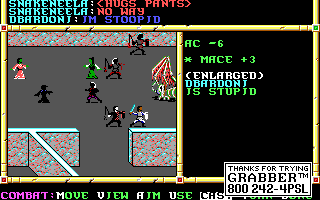
Neverwinter Nights, released in
2002, got a lot of excitement from RPG fans.
But did you know the original game
was released in 1991?
Same concept: online RPG play. Only on the then-private network
America Online. 500 players at once! The 2002 game even looks like the
1991 game, similar perspective.
  I TiVoed the rest of the Olympics opening ceremony today. I was
following along just fine, even through the dreary Björk
performance, when suddenly a man in white underwear
jogged
up the steps and lit
up a giant spliff. Didn't see that coming.
I TiVoed the rest of the Olympics opening ceremony today. I was
following along just fine, even through the dreary Björk
performance, when suddenly a man in white underwear
jogged
up the steps and lit
up a giant spliff. Didn't see that coming.
I hate InstallShield. It's
big: last I checked it added a meg to the install package. That may be
OK for a CD-ROM but it's unacceptable online. It's slow: it literally
takes minutes to install and uninstall a 100 meg program. How
hard is it to copy and delete files?! And it's funky: do you really
want to use an installer technology that has a freakin training program?
WISE isn't much better.
Installers should be simple. SuperPimp is good. Windows MSI Installer is OK too, but it requires the user already have the 1.7 meg environment installed. And Install Maker has gotten some traction by being simple and free.
I love the Olympic spectacle. But what is with the US uniforms? Brazil
had beautiful green jackets, Estonia had smart white suits, Palau had
cool sarongs. And the US had?
Ugly
gangster track suits. And they're not even made in the US: they're from Roots,
aka Brand Canada.
 I love the idea of remote islands.
Particularly those inhabited by Westerners like
Ascension Island or
Christmas Island.
Or
Pitcairn Island,
a 1.75 square mile island with
fewer
than 50 people on it. No
airstrip, no reliable
communcations,
not even a place to easily land a boat. But it has
a website!
Lots of them.
I love the idea of remote islands.
Particularly those inhabited by Westerners like
Ascension Island or
Christmas Island.
Or
Pitcairn Island,
a 1.75 square mile island with
fewer
than 50 people on it. No
airstrip, no reliable
communcations,
not even a place to easily land a boat. But it has
a website!
Lots of them.
I just finished reading Serpent in Paradise, the narrative of an Englishwoman who went to Pitcairn pursuing her fantasies of island paradise only to find cold loneliness as an outsider in a complex, tiny, isolated society. Everything she describes about the island — the gossip, the newspaper, the work, the language, the religion — all seems so alien. Good book. For a taste, read this short article by the same author. Pitcairn is in the news a lot now, the result of child rape charges against most of the adult men on the island. Lots of complications: arguments about British sovereignty, arguments about where the trial will be held, and of course the question of what punishment means in such a tiny community. The effect on the island could be horrible, and the prosecuters have their own issues. The islanders were just told they have to hand in their guns for safety. I'm going to New Zealand in November and am vaguely thinking of visiting Norfolk Island, population 1841. There've been two murders there in the past two years.  This
wacky story about a 22 year old SF political hopeful making a fake
video of his own decapitation got my attention again after being
posted on
MetaFilter. What's interesting is that the individual, Benjamin
Vanderford, has a (thin) presence on the net. Including:
This
wacky story about a 22 year old SF political hopeful making a fake
video of his own decapitation got my attention again after being
posted on
MetaFilter. What's interesting is that the individual, Benjamin
Vanderford, has a (thin) presence on the net. Including:
I just picked up a neat gizmo, a
Creative
MuVo TX.
It's a no-nonsense tiny flash-based MP3 player. 256 megs of music, not
much bigger than a lighter, 1.5 ounces (42 grams), $127 at Amazon.
See
this review
for details.
What I like best is how simple it is. The core is a USB flash storage unit. Just plug it into your computer and copy files over, no DRM or software nonsense (screw you, iPod). It doubles as a giant floppy disk. Then plug it into the AAA battery (10-14 hours of life) and the headphones and you've got a tiny music player. The device UI is nice and usable and the sound quality is good. The hardware does feel a bit flimsy, but what do you want at that weight?  I've played in a lot of betas, but I've never bought a massively
multiplayer online game. MMOGs are notorious
time sinks, and I don't like the idea of an ongoing subscription
for games. But I decided at random to get City of Heroes, a pretty
good MMOG. Alas, it's still boring.
I've played in a lot of betas, but I've never bought a massively
multiplayer online game. MMOGs are notorious
time sinks, and I don't like the idea of an ongoing subscription
for games. But I decided at random to get City of Heroes, a pretty
good MMOG. Alas, it's still boring.
There are some good things about CoH. The comic book genre is great: crazy and fun and not taking itself seriously. CoH doesn't license any other comic book IP, so the world is free from past association. And the character costume creation is fantastic, allowing an amazing variety of looks. But the game is hugely boring. It's the exact same level treadmill of every other MMOG I've seen: you're rewarded for time spent mindlessly clicking, not for any decisions you make. The game makes a bizarre design decision to have no items - no loot to find, no objects to show off, no opportunities to customize your appearance over time. The costume creation that's so wonderful at the game's startup is essentially unavailable after you've started *. The environments are boring too, no distinctive landscapes. The worst thing is that CoH totally squanders the chance to have interesting story-telling. The writing is non-existent: as far as I can tell the plot consists of "go here, kill these guys, read a paragraph of boilerplate". Over and over again. Single player RPGs like KoToR or Planescape: Torment tell compelling stories with depth and richness. I understand storytelling is harder in the chaotic genre of MMOGs but please, throw us a bone! CoH does have the virtues of being pretty and mindlessly amusing. But I don't have 10+ hours a week to commit and I have better uses for my $15 a month. I think we're a long way from a really rich MMOG experience.  Robert
Smigel
is one of the most brilliant people writing comedy for TV, and he's
about to get a DVD release.
The Best of Triumph the Insult Comic
Dog is due out August 10. You probably know Smigel's stuff:
The Ambiguously Gay
Duo, or
The video of Triumph
at the Star Wars opening, or the show that was too brilliant to
live: TV Funhouse.
All hysterically funny.
Robert
Smigel
is one of the most brilliant people writing comedy for TV, and he's
about to get a DVD release.
The Best of Triumph the Insult Comic
Dog is due out August 10. You probably know Smigel's stuff:
The Ambiguously Gay
Duo, or
The video of Triumph
at the Star Wars opening, or the show that was too brilliant to
live: TV Funhouse.
All hysterically funny.
PS: I love that the #2 result on an Amazon search for [triumph insult] is The History of the Decline and Fall of the Roman Empire. Just after the pooping dog puppet. As seen on MetaFilter.
The NYT has a well
written article about the great sport of demolition derbies.
Led by Suicide Steve Rossics, an affable gutter installer driving a
tough green 1973 Chevy Impala, the trio rolled through the gate in a
procession of cheeky defiance. "American Badass" was emblazoned across
one car, a 1978 Lincoln, from which flew a filthy American flag
duct-taped to a PVC pipe.
 I'm a huge fan of post-apocalyptic novels. End of civilization, everyone
dead, cities crumbling, a few scavengers all that's left of humanity. I like the
low-brow
stuff with mutants and gore, and I like the
middle-brow stuff with reflections on humanity.
I'm a huge fan of post-apocalyptic novels. End of civilization, everyone
dead, cities crumbling, a few scavengers all that's left of humanity. I like the
low-brow
stuff with mutants and gore, and I like the
middle-brow stuff with reflections on humanity.
So thanks to Mark for pointing me at Earth Abides, a 1949 novel where all but a handful of people die from a mystery disease. The book follows one man's attempt to rebuild something like a society. What I love is the melancholy tone of the loss of civilization. At first it's fat city, free food and cars and everything for the taking. But things slowly deteriorate: the power, the water, the cars. With less than 100 survivors in the whole Bay Area creating a society is tough, and reviving the trappings of civilization is impossible. The second half of the book is even sadder. The protagonist sets himself up as the leader of a small group of people and sets to having children. All well and good, but he's the only intellectual of the bunch. He valiantly tries to teach kids to read, preserves a library for them, tries to show them how technology works and what their heritage was. But it's a failure and the new society reverts back to simple hunting and superstition. All of our hero's knowledge is useless. I love the idea of the impermanence of civilization; Earth Abides describes it very well.  Thanks to Andy for pointing out
Juha's Knight
Rider dashboard project. A fan from Finland documents his twenty
year quest to faithfully redraw the dash display of K.I.T.T., the
famous talking car.
I love that his presentation is free of irony.
Thanks to Andy for pointing out
Juha's Knight
Rider dashboard project. A fan from Finland documents his twenty
year quest to faithfully redraw the dash display of K.I.T.T., the
famous talking car.
I love that his presentation is free of irony.
What is the point of all this?
Irony is a cheap and undemanding form of cultural commentary.
Sure, Knight Rider is cheesy and it's easy to get some
quick laughs
by making fun of it.
But it was also a really entertaining show.
I have fond boyhood memories of Knight Rider as well as Dukes of Hazzard. Why not
just enjoy that instead of belittling it with irony?
I wanted to finish what I had started. I have dozens of eternity projects that I usually have no time to work on. Whenever I manage to find a bit of spare time and if Im in the mood I will try to work on those projects. Drawing the ultimate reproduction of KITTs dash was one of those unfinished projects for fifteen years. Now it has been completed. John Waters' film Pecker is a brilliant commentary on the hollowness of irony; listen to his DVD commentary for his take on the curtain of irony that enshrouds New York. I try to be less ironic, but it's hard and I'm lazy.
In all of the NYT's
coverage of the 9/11
commission report, this article
about international policy seems
important and easily overlooked. It's
a summary of the report section titled
What
to do? A Global Strategy.
long-term success demands the use of all elements of national power:
diplomacy, intelligence, covert action, law enforcement, economic
policy, foreign aid, public diplomacy, and homeland defense. If we
favor one tool while neglecting others, we leave ourselves vulnerable
and weaken our national effort.
This is the concern that connects 9/11 to Iraq. Iraq wasn't a source
of terrorism, but we attacked it. And by pursuing a war
in Iraq, Bush has undermined our diplomatic and moral position. The
NYT article suggests this is one of the few places where the
9/11 report is critical of Bush policy:
Mr. Bush also maintains that Iraq had been a "central front'' in the
war on terror, a point that the report treats with stony silence.
Instead, it warns of what could happen if the American experiment in
Iraq goes bad, declaring, "If, for example, Iraq becomes a failed
state, it will go to the top of the list of places that are breeding
grounds for attacks against Americans at home.''
Hearts and minds are not won by unilateral unprovoked wars,
torturing prisoners,
and clumsy propaganda outlets.
Have you used
User-mode Linux?
Please email me.
I recently signed up for UML hosting and am
finding the performance is so slow and unpredictable that I'm not sure
I can use it.
I expected slow, but not this slow: my virtual CPU speed is about 10x slower than my 1000MHz Athlon. Clearly those other partitions are pretty busy. I'd naïvely assumed the system would be mostly idle. What surprises me more is the variability. On a normal unloaded Linux system 'time sleep 1' should return just over 1 second of real time, maybe 1.01 seconds. On my UML box, 5 times out of 100 a 'sleep 1' takes over 1.2 seconds! In other words, my whole OS has dropped out entirely for 200 milliseconds. Ugh! Is this typical or did I get unlucky with my UML provider? I may have just gotten unlucky; performance on another hosting service is significantly better. More details once I know more.  There's an excellent
opinion piece in the SF Chron today about how fear of terrorism
has changed
Washington DC. Open government and accessibility used to be considered
important democractic values in the US, but now everything is locked
away. Do we even recognize what's been lost?
There's an excellent
opinion piece in the SF Chron today about how fear of terrorism
has changed
Washington DC. Open government and accessibility used to be considered
important democractic values in the US, but now everything is locked
away. Do we even recognize what's been lost?
Today, much of this beguiling traditional democratic American openness
has been rudely swept away, possibly never to return. And the nation
once known as "the land of the free and the home of the brave" seems
both less free and less brave.
But one thing is certain: Washington today is a heavily armed, hunkered- down capital. The city on the Potomac appears to be a city under siege. Congress has allocated more than $600 million for increased security for the capital. Update 2004-07-19: Tom Bridge, who lives in
the DC area, has posted a rebuttal
to the SF Chron piece.
 The Ultima
series (1981 — 1994) is the most important series in the
development of computer role playing games. And it's getting easier to
play them again.
The Ultima
series (1981 — 1994) is the most important series in the
development of computer role playing games. And it's getting easier to
play them again.
Ultima I-III defined CRPGs, using tile based graphics and intricate worlds to immerse the player. Ultima IV was the huge leap forward, with a deep back story and a morality system that required you play carefully, not just kill and rob everything. Ultimas V and VI extended this formula into richly entertaining games. Ultima VII sets a landmark for non-linear gameplay. Ultima Underworld was one of the first 3d games, as pioneering as Wolfenstein 3D. Alas, Ultima IX broke my heart. If you're too young to know these games, there's a lot of info online. But reading is dull: buy the Ultima Collection and play to your heart's content. Except, well, PC technology has changed a lot and running the old games is nearly impossible. Enter preservation efforts. The most impressive is the Ultima Classics collection. "Sedryn Tyros" has collected the Ultima games and distributed them in a bundle along with DOSBox setups that make it easy to run the games. His supplement also includes original pre-PC versions of the early games, often better than the PC ports, along with the emulators you need to play them on a PC. Update: there's now a 1.3 release that combines the two. Alas, this collection is completely unauthorized and you'll have to scour your back alley's bittorrent site to find it. Another option is fan-made reconstructions of the game engines. The best is Exult for Ultima VII, a portable engine that runs the classic game on many platforms (including Xbox!). Just take the open source game engine, copy over the assets from your Ultima Collection CD, and you're in business. A lot of the first 20 years of movies are lost forever because no one preserved them. I fear the same thing is going to happen with games.
I'm really impressed with Windows Update. Microsoft does a great job
of getting patches out quickly to my home machine, easily installable.
But they have one really annoying bug: some part of the install
process often steals keyboard focus. I'm installing the last set of
six patches, which takes about 3 minutes, so I'm typing email. Halfway
through my typing bam my keyboard goes dead. Presumably
underneath the scenes some part of the installer mapped a window which
took focus, then didn't give it back. That's dumb.
Then again, they are getting better at pushing updates so they don't require reboots.
My first ever
webpage, started in January 1994, is still online.
It's of a genre that was very popular in the early web, a list of cool
links. Before search engines this kind of "home page" was the only
way we could find things on the net. Now we have
linkblogs and community sites.
I stopped maintaining this list in early 1997. I'm surprised how many links are useful and relevant but are still slightly obscure. Alas, many of the URIs have changed.
The Bush campaign's Orwellian technology of words is in full force now
around the word "pessimism". The
Hitler
ad warns "this is not the time for pessimism and rage". The Bush
campaign
claims
"Senator Edwards delivers his pessimism with a Southern drawl and a
smile".
The new Bush ad Pessimism
talks about Bush's "optimism" and then chides Kerry for talking about
the US economy, ending with the tag line "Pessimism never
created a job".
Unhappy that Bush tax cuts and military expenditures are destroying the US budget? Be an optimist! Worried that you have no job? Blame Kerry, that mean ol' pessimist, for complaining about the economy. Upset that we're in a war in Iraq under false pretenses? Blame the pessimists for confusing you with stories and congressional inquries. America Number 1! By taking this single word "pessimism" and using it to characterize the Democracts, the Bush campaign brilliantly defuses any criticism of the Bush presidency. Even better, it shifts the blame to the opposition who is calling attention to the problems. Use of single words is the purest technology of campaigning; the Republicans are brilliant at it.  Here's a nice surprise. Spiderman 2, the XBox
and PS2 game from
Treyarch, is remarkably good.
It's basically Grand Theft Auto with flying. Big city, lots of little
missions to do, and the real fun in the game is exploring the city.
Here's a nice surprise. Spiderman 2, the XBox
and PS2 game from
Treyarch, is remarkably good.
It's basically Grand Theft Auto with flying. Big city, lots of little
missions to do, and the real fun in the game is exploring the city.
The reviews are a bit scattered. I tend to agree with the more negative ones; the core game story requires too many repetitive missions. But who cares? What's amazing is the recreation of Manhattan you play in. The game experience is architectural. You'll be zipping around, then see a pretty skyscraper, then climb it for a breathtaking view of the virtual city. See another interesting building? Just jump off and swing over to it. Easy and very beautiful, particularly at sunset when the lighting is most dramatic.
Update: See the NYT on virtual Manhattan.
One of the cool things about kite aerial photography is that it has a
long
history, going back to 1882 or so. Kites are a cheap way to get
something up in the air.
  I spend far too much time in front of a computer.
In an attempt to have some hobby other than computer
geekdom, I've decided to try kite geekdom.
I fondly remembering flying
Saul's
power kites: 300lbs of lift
== exhilarating flight. I'm also
inspired by Kite Aerial
Photography.
I spend far too much time in front of a computer.
In an attempt to have some hobby other than computer
geekdom, I've decided to try kite geekdom.
I fondly remembering flying
Saul's
power kites: 300lbs of lift
== exhilarating flight. I'm also
inspired by Kite Aerial
Photography.
But that's all too hardcore so I set out today to learn some simple stunt kite flying. A bit of searching revealed that HighLine Kites is the Bay Area place to go to buy a kite. Tom sells kites out of his RV at the Berkeley Marina, a prime kite-flying spot. Lots of kite geeks. Tom's great, by the way. I liked the Prism kites website, so after spending some time with Tom's advice I'm the proud owner of a new E2. Modern kites are pretty amazing technology, full of graphite and mylar and exotic polymer line. Alas, the line was my downfall; I made a bone-headed mistake and tangled one of the lines while setting up and after a frustrating hour of attempting to untangle the fog rolled in and I gave up. (Hint: pulling on knots does not make them better). I'm untangled and ready to try again tomorrow. Update 2004-07-04: success, at Balboa Park. 
Since Nelson and I have both been grousing
about Mac OS X's Terminal.app, I did some more research.
Command-doubleclick will open an URL in Terminal.app, but only if the
URL is one line long. Here's a better solution:
Update: I updated the suggested "word" line after finding a few holes and resorting to reading RFC 2396. I omitted '!', "'", "(", and ")" because I think those would cause more parse errors than they would solve in this context.
One of the fun things we did in Germany is take a short
excursion on the
Harzer Schmalspur Bahn, a narrow
gauge railroad running through the
Harz
Mountains.
The
tourist
train is an hour and a half run up to
Brocken,
the highest point in the Harz mountains. The fun thing is you get to
take one of their restored steam
trains. It's not often you see a fleet of 25 steam trains working
every day. Other
tourists
liked the trains, too.

Today is Gay Pride in SF.
While I'm not much for the throngs downtown, I do have one
thing I'm gay proud of.
  Wow, the new
Bush/Hitler ad
(WMV)
is brilliant propaganda.
The overt message is to discredit
moveon.org and the Democrats by
claiming they improperly compare Bush to Hitler. But the ad happily
uses the juxtaposition of Hitler with
images of Gore, Dean, Gephardt, Kerry to implicitly connect the
Democrats to Nazis.
It's like Karl Rove was
taking notes when he watched
Oliver Stone's JFK.
Wow, the new
Bush/Hitler ad
(WMV)
is brilliant propaganda.
The overt message is to discredit
moveon.org and the Democrats by
claiming they improperly compare Bush to Hitler. But the ad happily
uses the juxtaposition of Hitler with
images of Gore, Dean, Gephardt, Kerry to implicitly connect the
Democrats to Nazis.
It's like Karl Rove was
taking notes when he watched
Oliver Stone's JFK.
The ad also neuters the appropriate outrage of the Democrats. Frankly, this is the time for pessimism and rage. But the ad turns that on its head. Mean ol' Kerry, wouldn't you rather vote for nice piano music Bush? And showing this video only on the web bypasses all sorts of pesky campaign laws. Because of the Hitler controversy this ad is now all over the mainstream media. It may be hypocritical, but it sure works.
I got a Mac laptop (12" powerbook), thought I'd try something different.
Unix with a non-X interface, you have to like that. My favourite thing
is the beautiful font renderer.
I asked some friends - Cory, Evan, Jason, Eric, and Raffi - for advice on what to install to make my Mac happy. Things I've found useful so far:
I just got a Mac laptop and turned it on to go through the setup
wizard for the first time. What is with this thing? It's asking me for
my mailing address, the size of company I work for, what industry I'm
in. And I have to answer these intrusive questions before I get
to use the computer I bought: there's no opt-out, no "skip this
question".
Isn't Apple supposed to be the friendly computer?  I may be three years behind the times, but
The Fast and the
Furious is a pretty great movie. Cool cars, tight editing, and the
kind of After School Special for Adults plot I love in action movies.
I may be three years behind the times, but
The Fast and the
Furious is a pretty great movie. Cool cars, tight editing, and the
kind of After School Special for Adults plot I love in action movies.
I'm impressed with Vin Diesel, too. I like action movie stars who do what they do well. His new Riddick Xbox game is great, does the video game tie-in better than anyone so far. Smart move forming Tigon Studios, his own game company. Maybe one day Vin will be governor.
Dresden was the
most surprising part of my trip, astonishingly beautiful.
I only knew about the firebombing,
followed by 40 years of communist architecture.
What I didn't know is that
the city is truly beautiful, with a
lovely
waterfront on the Elbe.
And
the old center of Dresden, the showpiece
palaces and
promenades,
has been
completely rebuilt with a very traditional restoration.
 Yesterday was the symbolic conclusion of the reconstruction, hoisting the cupola with a British-donated cross to crown the church. The cost is enormous: $175 million or more. Imagine the pride in this restoration, coming after reunification. Quick tourist tips for Dresden: the Bülow Residenz is a great hotel, with a terrific Michelin-starred restaurant. And take a steamship tour on the Elbe.
I fervently want Bush to not be president any more. The administration is truly
terrible.
It led our country to war on false pretenses,
deliberatly sabotaged the Constitution with its imprisonment policies,
and is systematically wrecking the US budget with irresponsible tax and expenditure
policies. Oh yeah, and there's the stated policy of
torturing prisoners and hiding them from the Red Cross. Nice. And
that's just the worst stuff - I won't even go into ANWAR, or gay
marriage, or ...
But I feel powerless, disenfranchised. Sure, I can vote against Bush. But does voting even count? I truly believe the 2000 election was stolen. I could try to influence politics, get involved in the campaign. But personal action is sort of pointless; most of my friends already hate Bush too (and the others, well, we agree to disagree). Political influence seems to be entirely about money, not belief. This is why I liked Dean. He made me believe that things could change. Kerry is uninspiring. MoveOn gives me some hope, but only a little.  I'm a food tourist. For finding restaurants in Europe, the
Michelin Guide Rouge is
information
perfection.
Complete data on a country's
good hotels and restaurants, the red guide is truly all you need.
I'm a food tourist. For finding restaurants in Europe, the
Michelin Guide Rouge is
information
perfection.
Complete data on a country's
good hotels and restaurants, the red guide is truly all you need.
Best as a book, it is also searchable online. The design is fantastically dense. The German guide, for instance, is 1500 onionskin pages in a handbook size. There's a bit of information about each town, including excellent small maps for bigger towns and a line or two about major tourist destinations. Each restaurant or hotel then gets about 8 lines wherein you will find packed the name, location, contact information, hours, prices, and a couple of descriptive lines of text. The most important thing is the listing's icons. Restaurants get 1 to 5 forks. But it's not just a 1-5 scale. If the forks are red then the place is a "pleasant restaurant", a uniquely comfortable dining room. Rare places have the valuable Michelin stars that indicate excellent service and comfort. And there's the "bib gourmand" for inexpensive places. That makes for four dimensions all for a quick scan. The editorial quality of the reviews is fantastic (despite some recent controversy). Anything that's even in the guide will be a good meal; to my American tastes 2 forks and up is a fine restaurant. These ratings are given by serious food people, much more useful than the crappy guidance from Fodor's or Frommer's. My most fervent wish is we could have a Red Guide for the USA. Alas, I think we just don't have the quality or culture to deserve it. Zagat is the closest we have, and it's just not the same maturity. And so peculiarly democratic!
Cory Doctorow's talk to Microsoft
Research about digital rights management is hot. It's the best
single description of all the failures of DRM I've ever read.
The time Cory has spent at the EFF has clearly honed his thinking.
DRM systems don't work
DRM systems are bad for society DRM systems are bad for business DRM systems are bad for artists DRM is a bad business-move for MSFT But talking to MSR is preaching to the choir. The people who really need convincing are the Windows OS product strategy team, in particular the folks behind the Next-Generation Secure Computing Base for Windows (aka Palladium). Microsoft has already made the decision to destroy general purpose computing in order to protect copyright owners' interests at the expense of users. With the DRM core baked deep into the hardware and Microsoft getting to sign a whole new set of licensing contracts, I fear the "don't work" and "bad business move" arguments will seem to have been overcome long enough for this hostile stuff to be status quo for awhile, setting everyone back.  Jet lag sucks. The only thing worse than falling asleep at 3pm is
waking up at 4am, exhausted, and not being able to sleep.
Jet lag sucks. The only thing worse than falling asleep at 3pm is
waking up at 4am, exhausted, and not being able to sleep.
Melatonin is a partial solution for jet lag. It's a pineal hormone that triggers sleepy time. The problem with jet lag is your ordinary circadian rhythm is on a 24 hour cycle, so until you adjust you're melatonin-deficient at your new local bedtime. But take a melatonin pill or two and bam, you're asleep. Without a sedative. Because of insane FDA laws melatonin is available without a prescription, but it has a very strong effect, at least on me. I don't make a habit of taking it regularly.
Hello everyone, I'm back! Many thanks
to Marc for writing the guestblog
while I was gone, lots of interesting things.

I have to say I found this
summary of the White House reaction to TIME
Magazine's article about Raven Rock, Dick Cheney's previously
"undisclosed location," pretty hilarious.
Let me just state for the record that if Apple were to
release a car stereo head unit, I would be first in line to buy
it. I would even replace my old, 2G iPod with a shiny new iPod at
whatever price they asked. Steering wheel controls would be nice, but
really all I need is a head unit with an iPod socket and nice
controls. Let's call it the iDash.
The car/iPod interface has been the worst part of the iPod experience -- getting the iPod music playing out of the car speakers is ridiculously hard, and just finding a place to rest the iPod while it plays is comic. I've tried using cassette adapters, which fake out the tape deck into playing iPod tunes, but they have consistently died on me, either fraying at the cable that dangles out of the deck or frying in the heat (just like a real cassette!). I've tried using mini FM transmitters like the Griffin iTrip, but the sound quality is terrible and finding a free radio channel in the Bay Area is impossible. (I had one for a while, until some anti-enterprising San Franciscans launched a pirate radio station on it.) I've tried removing the CD changer and using an RCA adapter to wire the iPod in directly, which, modulo the cables trailing from the trunk to the front, was great for sound and stability -- until the damn thing shorted out and took the turn signals, gas gauge, and brake lights with it, a $600 repair. Now I'm back to the cassette adapter, and I pack it into my bag every day as I head out of the car. What a pain. Too many head units don't provide auxiliary input, and all the solutions on the market are half-assed and clunky. A fantastic Apple head unit would be an amazing tool for the iPod, and would really change the car stereo experience. Microsoft wasted a bunch of money on car PCs a few years ago. Wouldn't it be funny if the iDash gave Apple a entry point to automotive computing?
Mark Frauenfelder blogged
today about the Iowa
Electronic Markets (IEM), a futures market run by the University
of Iowa for studying predictions of political elections and other
events. I love the idea of these markets and have been following them
closely. While the Policy
Analysis Market caught some well-deserved criticism last summer, I
didn't think it was a crazy idea, but that it was more poorly explained than
poorly conceived.
I was following the IEM during the Democratic Presidential primaries, and was disappointed with the results of what I saw. These markets are sometimes claimed to "predict the future," and rightly so in that they can expose upcoming events that are for whatever reason non-obvious by conventional wisdom. It was not obvious to me that Howard Dean would suffer such an upset in the Iowa Caucuses, placing behind Kerry and Edwards when all the polls were showing a different result. After the shoes had all fallen, I went back to the IEM to see if these futures markets -- based, after all, in Iowa -- had been able to predict what many of us had missed.
No one has claimed predictive markets are perfect, nor that they can forecast everything -- just that they tend to outperform other predictive measures. I'll be interested to see if this idea takes greater hold over time, and gains in effectiveness as it involves more participants.
It's interesting to read about Accenture and the award of the "Virtual
Border" contract from the Department of Homeland Security. This
Reuters article, like a recent NY Times
article on the same topic, talks about the attempts by the House
of Representatives to prevent Accenture receiving the contract, since
Accenture's corporate headquarters is not in the US -- it is in
Bermuda.
I do think this is an interesting and important issue, and I'm glad to see the House taking some action on it. Update: The article in Thursday's Times has a somewhat better explanation of the issue.
I had a fine time watching the new Harry Potter
movie last weekend -- you know it's a better movie when it
features a
tree with more personality than some of the characters in the
earlier episodes -- but was driven further down the road of hating
movie theaters, which once I loved.
Movie theaters are increasingly hostile environments. At this one showing, we had:
It would certainly be cheaper to buy the movie on DVD and own it forever, than to watch it once for nearly twice the price; the popcorn would be better, cheaper, and faster, and could be topped with real butter instead of "topping"; the water would be tastier, colder, and available for $1.49 per 100 cubic feet; and the talking would be sanctioned or actionable. Plus, no ads. It's no wonder home theater is booming.
How is it possible for this
article to make it into the New York Times a mere 11 days after this
article without making a connection between them? (Of course, the audience
is storming the projector on many more than just these two fronts.)
I've been reading a great book about World War II military
intelligence -- one of those nonfiction books that makes you think no
fiction writer will ever be up to the task. I was enjoying it as
"pure" history (is there any such thing?), but today realized that it
is incredibly useful for thinking about recent news regarding Ahmad
Chalabi and Iranian intelligence, and the search for weapons of
mass destruction (WMD) in Iraq generally.
 I'm going to be offline for a couple of weeks. While I'm gone my good
friend, cofounder, and coauthor
Marc Hedlund will
be stepping in and entertaining you via the fabulous guestblog. Enjoy!
I'm going to be offline for a couple of weeks. While I'm gone my good
friend, cofounder, and coauthor
Marc Hedlund will
be stepping in and entertaining you via the fabulous guestblog. Enjoy!
 I hate car stereos. They refuse to have a standard line-in jack,
so plugging in your MP3 player is a terrible hassle. I use a
tape adapter and it boils my blood to hear tape hiss and rattling
wheels. FM adapters are worse.
I hate car stereos. They refuse to have a standard line-in jack,
so plugging in your MP3 player is a terrible hassle. I use a
tape adapter and it boils my blood to hear tape hiss and rattling
wheels. FM adapters are worse.
I'm shopping for a new car and figured I should make having a reasonable MP3 solution part of the choice. I don't want to buy an aftermarket head unit; I live in San Francisco, things get stolen. I found several trunk mounted hard drive players that integrate in various ways. Do you know of something better?
 Deep geek post here just for the search engines. If you're playing
Knights of the Old Republic and you're on Tatooine and you try to
enter the Sand People Enclave and you're told
"your entire party has been killed" with no explanation, you've hit a
bug. Explanation below.
Deep geek post here just for the search engines. If you're playing
Knights of the Old Republic and you're on Tatooine and you try to
enter the Sand People Enclave and you're told
"your entire party has been killed" with no explanation, you've hit a
bug. Explanation below.
One of the hidden gems of E3 was the demo of
Unreal
Engine 3. Unreal is a series of first person shooters that have
beautiful graphics but not particularly subtle gameplay. They
license their engine to other companies that make
interesting
games.
 If you're into this sort of technology make a point of seeing the video. It's a 160 meg download. Thanks to Ryan for pointing this
out
The thing I like best about computer role playing games is
the story.
Alas, most CRPG writing is awful. But
Bioware
does well. They're the spiritual successor to Infocom.
CRPGs have another theme: the acquisition of stuff. You start out wimpy with a tiny little dagger and a loincloth. By the end of the game you're a bad-ass with +7 glowing long swords and titanium power armour. RPG-like games like Diablo make the acquisition of stuff the primary gameplay experience, like clothes shopping with more killing. Which brings me to my idea: how about a game where the goal is not to acquire stuff, but to get rid of it? You start out super powerful with all the geegaws and skullsplitters you could want. In your process of saving the world you learn these things have no power and you have to simplify to find true meaning and technique. It'd require a tricky game mechanic to make work. Maybe in getting rid of things you focus and customize your remaining stuff until you are left with one simple elegant possession which is the focus of your power.  The end of 24 this season was sucky.
Hey! Ho! Downward spiral in Iraq? Presidential speech failed to
reassure voters? US military officers torturing
prisoners? Executive branch morally bankrupt? Ignore all that, just
BOLO. What, you don't know BOLO? All the cool kids know: just ask the FBI:
"BOLO"--that's BuSpeak for "Be On the Look Out."

Asked about the timing of his new warnings about the suspects, Mr.
Ashcroft said, "We believe the public, like all of us, needs a
reminder."
I truly fear for US democracy.
The Newspaper of Record in the US has issued a
broad
retraction of many stories leading up to the Iraqi war.
[The problematic articles] depended at least in part on information from a circle of Iraqi
informants, defectors and exiles bent on "regime change" in Iraq ...
Complicating matters for
journalists, the accounts of these exiles were often eagerly confirmed
by United States officials convinced of the need to intervene in Iraq.
Administration officials now acknowledge that they sometimes fell for
misinformation from these exile sources. So did many news
organizations in particular, this one.
They take broad editorial
responsibility for this failure of reporting and cite
several articles based
on faulty information. Examples online.
This admission is astonishing. Usually it's a single reporter to blame; here the NYT as a whole is saying they got it wrong. This article is an important milestone in the US coming to terms with the fact that the war on Iraq was based on false pretenses.
Why do most programmers still work with 80 column wide screens?
Long variable names are a virtue; most of my Java code really
wants to be 120 columns wide.
Why don't programming languages let me put spaces in variable names? whyDoIHaveToDoThis or_this_crud, why can't I just put spaces in things?
for user id in user ids {
  if is valid user (user id) and
       is authorized user (user id) {
    show report(user id)
    user(user id).bill for report(one dollar)
  }
}
I think it's possible to define unambiguous syntax like the above. Not allowing spaces in identifiers may make the compiler's job easier.
But the days of worrying about compiler overhead are long long gone.
Update 2004-05-26: Bill Tozier emailed to say that
AppleScript does have spaces in some things, although he warns of
usability problems. Here's an
example:
tell application "Finder"
    set windowName to name of front window
    close front window
end tell
front window appears to be a single identifier with a space
in it. But then again, windowName is camelCase.
From: "Gerardo Weir" <jyyiarimnwzroj@aol.com>
The spam worked, I opened the URL. They claim to be an investment site,
just click on the site and transfer over some e-gold and poof, you get
121% return in 5 weeks.
To: neil@REDACTED.com, nelson@REDACTED.com Subject: Fuck YOU Date: Sat, 22 May 2004 18:23:38 -0500 if YOU WANNA TO LOST UR MONEY ---> INVEST US -->>> http://www.wecareaboutmoney.com/ I know there's a sucker born every minute, but who would fall for this stuff? The particularly remarkable thing is you have to have an e-gold account to even play. Wouldn't you think the few people who have e-gold accounts are likely smarter than to fall for this? Maybe their marks are scammers too and this is all about money laundering.
Since switching to use
an aggregator to read blogs my information gathering life has
improved. I can read more quickly, read more things,
and enjoy easily low-volume sites that have the occasional
high-value post.
But there's one problem with my aggregator lifestyle: it feels like work. Blog reading used to be fun goofing off, nipping off to BoingBoing for a few minutes. Now all my blog reading is compressed into 45 minutes in the morning before I drive to work. It's a morning chore. Worse, my aggregator keeps track of unread items. And that list gets bigger if I don't get around to it for a few days. Suddenly I have a giant backlog of random blog entries I have to read. Another workqueue.  The story of Brandon Mayfield is very bizarre. A Portland, Oregon
lawyer and a convert to Islam, he was arrested as a "material witness"
and then released. It's possible he was arrested
solely
on the basis of a fingerprint match that later turned out to be
faulty. This is not the way justice is supposed to work in the US.
The story of Brandon Mayfield is very bizarre. A Portland, Oregon
lawyer and a convert to Islam, he was arrested as a "material witness"
and then released. It's possible he was arrested
solely
on the basis of a fingerprint match that later turned out to be
faulty. This is not the way justice is supposed to work in the US.
I've been both horrified and fascinated by the conspiracy theories
surrounding the
Berg
beheading video. Kuro5hin has a reasonably level-headed
roundup
of discrepancies, found via jwz. See also
this MetaFilter thread.
I'm gonna go all meta, but what I find interesting is what the
speculation says about ourselves.
Today's NYT, a story about
fraud
in online job listings.
Ms. Haloulos would accept payment for the software company's domestic
sales, then take that cash out of her PayPal account and wire it, via
Western Union, to the software company's contacts in Ukraine. Ms.
Haloulos would keep 5 percent to 20 percent of the payment as
commission.
Unfortunately for the poor Ms. Haloulos, those payments turned out to
be fraudulent. "I feel like an idiot", she's quoted as saying.
Forgive me for being harsh, but, um, yeah. Your "job" consists of accepting credit card payments in a PayPal account, skimming 20%, and then wiring the cash to Ukraine? What did you think you were doing? Here's a hint: payment processing jobs do not involve an individual's private account. And another hint: Ukraine is essentially jurisdiction-free when it comes to the Internet.
I've been grooving on
Star
Wars: Knights of the Old Republic. It's a single player RPG set
way back in the Jedi past.
And unlike other Star Wars games this one doesn't suck: they make
great use of the franchise with
fun aliens,
worlds, lightsabers, lots of use of the Force.
  I finally watched
Kill Bill vol. 1.
What a tedious movie! I generally love obsessive geekishness and
formalism in making art, particularly movies.
But it's important that the movie also actually be about
something. That it have a point.
I finally watched
Kill Bill vol. 1.
What a tedious movie! I generally love obsessive geekishness and
formalism in making art, particularly movies.
But it's important that the movie also actually be about
something. That it have a point.
That's why I liked Jackie Brown so much: Tarantino could indulge his obsession to homage while actually telling a meaningful human story. You know what would be brilliant? A Dogme 95 Quentin Tarantino film. Have the filmgeek boy make a movie without all the lighting and editing tricks. Restriction is freedom.
This may not have been the best idea, but I found the
video of Nicholas
Berg on ogrish.com and
watched it. I suggest you think carefully before watching it yourself, it is
more disturbing than you might think.
The difference between the actual video and the limited images in today's papers is astonishing. The newspapers pictures look calm, quiet. The video is swift and horribly brutal. The most disturbing thing is hearing the murderers shout "Allahu Akbar" over and over again. I watched it because I think it's important to view the truth of things. I hate modesty censorship of news. But there are some things you may prefer not to see.
Update: this BBC article
is about the news media's attempts to explain the video
without actually showing it.
 When I was in high school the really cool outcast kids all smoked,
drove old VWs, and listened to Sonic Youth. I was mostly a nerd, but
sometime around my junior year I got a bit cooler and started listening
to KTRU and hanging out at
The
Axiom.
When I was in high school the really cool outcast kids all smoked,
drove old VWs, and listened to Sonic Youth. I was mostly a nerd, but
sometime around my junior year I got a bit cooler and started listening
to KTRU and hanging out at
The
Axiom.
But I never quite felt cool enough to listen to Sonic Youth. It was just a bit too raw and punk for my nerdishness. Now I'm an adult and my music doesn't identify me and I'm glad to say Sonic Youth still rocks. Sister, Evol, Dirty, even Washing Machine are all just great. I feel both alienated and hip. I continue to look for a copy of their first album. At this point I'm almost ready to rip an 18 year old cassette tape. The advertisement said the pleasure's everlasting.
The day the
Bin
Ladin Determined To Strike in US memo was launched, I looked at
the
redacted original and wondered how good the redaction really was.
You can see the size and even the shape of some of the words.
 The demonstration was at Eurocrypt. Le Monde seems to have the first news report (translation). More: Nicolas, Kos, Slashdot, an earlier deredacting attempt.
If you've bought a PC video card in the last year you owe it
to yourself to get Far Cry, at least
the demo. This is the first game to take real advantage of pixel
shaders and insane polygon counts to deliver fantastic graphics.
 Two glitches to be aware of. The copy protection is user-hostile. And on my GeForce Ti4200 the game crashes regularly unless I underclock the video card 5%. Weird thing is it doesn't seem to be heat related.  Tom Toles
comic on the
Bush response to Iraqi prisoner abuse is worth a
look.
Tom Toles
comic on the
Bush response to Iraqi prisoner abuse is worth a
look.
Negativland's 1987 song "Christianity is Stupid" was influential for me in high school. The overt anti-Jesus message wasn't
really the point, but rather the ridiculing and reuse of the blatant
propaganda chant "Christianity is stupid / Communism is good".

Distribution is via BitTorrent
As seen on MetaFilter
Super-cool science:
vibrated
shear thickening fluids. In particular, see
the movie.
 
The guys who run the MMORPG Star Wars Galaxies have posted a
fascinating
look at their artificial economy. Graphs showing money flowing in and
out, analysis of what it means.
Edward Castranova has some excellent
comments. MMORPGs are a unique economic laboratory.
I got to play with an
eInk
display today, fresh from Japan. Not the one pictured
at
engadget, but the same
idea.
It's cool. The most apparent thing is how bright the display is and how it looks good from any angle. Passive lighting is a good thing. The redraw rate is horrible and the algorithm is weird: does some sort of inverting of the screen. This all makes this generation of tech useless for most computing applications. But as an ebook, it's good.
When The Times opts for CD's rather than CDs, it's considered house
style. But if a shopkeeper mislays an apostrophe, the kind of people
who worry about whether anal-retentive has a hyphen are quick to
criticize.
I'm one of those kind of people and I'm also quick to criticize the Grey Lady's
"house style". CD's and
DVD's are bad enough, but how about the
typographic nightmare of G.I.'s and
C.E.O.'s? Talk about punctuation
proliferation! On the same Op-Ed page as the above article they get
it wrong, writing C.E.O's. Inconsistencies
left and right, who can keep these
rules straight anyway?
I can. The apostrophe rule is simple. An apostrophe never marks a plural. The rule about CEO vs. C.E.O. is less clear. The NYT style guide probably has a list of where you don't use dots. I think it's better to never use dots at all.  As seen on MetaFilter
I liked Tim's graph
of bloglines readers so I copied him.
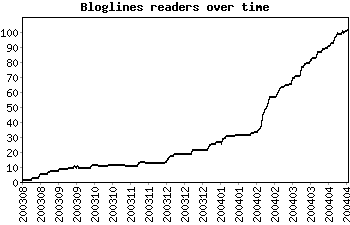 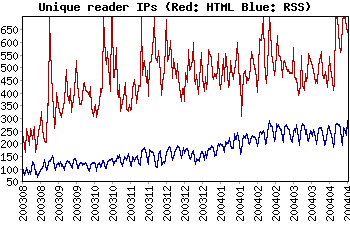 Python makes doing things like this such a joy. Here's my hack code. Ugly, but simple.
Update: the big jump in February Bloglines seems to
be correlated with when I turned on full RSS.
 I've been listening to
The Left Behind books, a
series of apocalyptic Christian novels. They're
huge
bestsellers but no one I know has read them.
More
San Francisco
bubble, I guess.
I've been listening to
The Left Behind books, a
series of apocalyptic Christian novels. They're
huge
bestsellers but no one I know has read them.
More
San Francisco
bubble, I guess.
The story is simple enough. The End Times are here, Christ has raptured the faithful, and the unfortunate folks left behind have to face Antichrist and the tribulations. What makes it work is the stories are told from a very ordinary point of view, individuals you can relate to. The books are basically potboilers with evangelical intent. The hero doesn't get the girl, he comes to Christ. They're entertaining. The stories are simple and well told. The language is plain but well chosen. The character names are great: "Nicolae Carpathia", "Rayford Steele". And you have to love titles like "Tribulation Force" and "Soul Harvest". (See Slacktivist for an alternate view.) Entertainment aside, the books' real intent is to convert. Not buying. I can't help but feel something sinister in this kind of proselytizing. The books aren't overtly offensive. But the head of the UN is the Antichrist, religious peace and unity is actually The Harlot of Revelations, there's a lot of excitement about 144,000 Jews converting to Christianity, and one of our hero's minor nemeses is an obvious lesbian who is made out to be a mean bitch "who wears sensible shoes". Not a worldview I choose. Maybe when millions of people disappear suddenly I'll believe this literalist form of Christianity. In the meantime, the books make for a fun commute. If I run out of the main series, there are enough auxilliary books to rival Star Trek.
Some stupid company is shipping ads with a new version of Flash.
So now on about 10 different websites when I go there to try to read
their content, I get this crap instead:
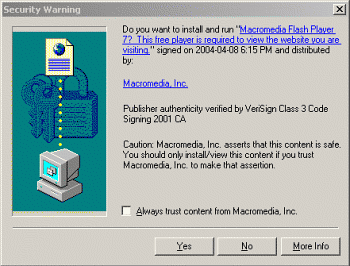 Advertising is OK when it works right. This is offensive.
Update: I finally gave up trying to get the
Flash upgrade direct from macromedia. I clicked "OK"
to install the upgrade from some Yahoo banner ad, only to be notified
I now have to reboot my computer. Yeah, right, I'm going to reboot so
I can look at some damn ad. I guess I'll continue getting annoyed
until I do reboot.
 The XBox hacker
scene has opened up the XBox and built a bunch of cool things.
One of the most interesting is
XBox media center, a
video/audio player. They
just entered a beta for 1.0!
The XBox hacker
scene has opened up the XBox and built a bunch of cool things.
One of the most interesting is
XBox media center, a
video/audio player. They
just entered a beta for 1.0!
What's really great is XBMC has Python embedded. It has standard Python2.3 and xbmc and xbmcgui modules for programming. There's a forum for development discussion, an official script download site, and some docs and scripts from a developer. I made text Python XBMC documentation from Alex's Word tutorial if you want a quick look at how it works. An XBox is just another PC, except it's cheap and designed for your living room. It's great that someone's finally made your living room TV scriptable. An old friend of mine from the 713 scene, Jason Asbahr, made Python for PlayStation 2 and GameCube.
This is all so clear to me, I wonder what the rest of the country thinks. Maybe I'm in some sort of weird bubble in San Francisco? Even so, young people coming back dead from Iraq seems hard to ignore.  Now that Neal Stephenson's
The Confusion is out
I have to say I never managed to finish
Quicksilver.
Now that Neal Stephenson's
The Confusion is out
I have to say I never managed to finish
Quicksilver.
Part of the issue is length: 944 is a lot of pages. But a lot of it is editing. The book is just too much. Too bloated. There are some really cool ideas in there, and some fun research, but it's buried deep in the 944 pages. I finally checked out entirely after the second book about Half Cocked Jack. I kept waiting for something relevant or interesting to happen and it didn't. I like Stephenson's writing. I thought The Diamond Age was brilliant and Snow Crash has a lot of interesting ideas in it. I even managed to get through Cryptonomicon, although it suffers from the same bloat as Quicksilver. Maybe he needs fierce editing? Maybe I need patience.
The New York Times
recently
reported about Sony playing catch-up to Apple in the
portable MP3 player market. That and a new
Squeezebox got me thinking;
I've spent about $1000 on MP3 hardware. And none of that has gone to a
traditional music or stereo manufacturer.
 Which is all a long-winded way of saying that the MP3 market is being owned by computer companies, not stereo companies. And it's nice, too. I love having 20 gigs of stuff in my car that I can sync to work. I love having 40 gigs of music on my stereo, letting me move from Górecki to Bach to Schönberg to Messiaen to Wendy Carlos without having to fumble for CDs. Isn't it amazing that companies like Sony missed it?  I've always looked on credit card "convenience checks" with suspicion.
It's a scam: they loan the mark money with predatory advertisements like "take that
vacation you could never afford", then charge them 19.9% interest to
pay the loan off.
I've always looked on credit card "convenience checks" with suspicion.
It's a scam: they loan the mark money with predatory advertisements like "take that
vacation you could never afford", then charge them 19.9% interest to
pay the loan off.
First USA just sent me an offer to write a check for over $15,000 at 4% fixed APR for the life of the balance. There are a few catches, but they aren't terrible:
My blog is normally a work-free zone, but I have all these Gmail
invitations to give out and no one to give them to.
Update: no more Gmail accounts, sorry.
 Five months after
getting
caught
in AT&T's
customer service
disaster, I
finally straightened out my bill and my account. Well, not entirely:
they still owe me one $80 refund but at this point I'm prepared to
write it off. Now, thanks to cio.com
I can read
the disaster story.
Five months after
getting
caught
in AT&T's
customer service
disaster, I
finally straightened out my bill and my account. Well, not entirely:
they still owe me one $80 refund but at this point I'm prepared to
write it off. Now, thanks to cio.com
I can read
the disaster story.
AT&T Wireless Self-Destructs
Long story short: CRM software upgrade + no fallback plan + number
portability + massive
layoffs + outsourcing + takeover rumours = major disaster.
The story of a botched CRM upgrade that cost the telco thousands of new customers and an estimated $100 million in lost revenue. Hard lessons learned. AT&T's only apology to me ever was two weeks' free on my contract. $15 compensation for about twelve hours of my time straightening out their mess. As seen on Slashdot
 Remember when it was exciting to get new email? Remember
when people ran
little
programs on
their desktops to notify them about incoming mail? Remember when
"You've got
mail" was an advertising campaign and a
crappy romantic comedy
for the times?
Remember when it was exciting to get new email? Remember
when people ran
little
programs on
their desktops to notify them about incoming mail? Remember when
"You've got
mail" was an advertising campaign and a
crappy romantic comedy
for the times?
I received 8800 emails last month at home.  Górecki's
Concerto
for Harpsichord and String Orchestra (op. 40) is astonishing
music.
The layering of harpsichord and a deep string orchestra
makes for some very complex texture that he accents with intricate rhythms. I
love the simple melodic structure of process music like this concerto but I
can't begin to sort out the harmonies here.
Górecki's
Concerto
for Harpsichord and String Orchestra (op. 40) is astonishing
music.
The layering of harpsichord and a deep string orchestra
makes for some very complex texture that he accents with intricate rhythms. I
love the simple melodic structure of process music like this concerto but I
can't begin to sort out the harmonies here.
If you've heard of Henryk Górecki it's probably because of the Dawn Upshaw recording of his Symphony No. 3 that achieved huge popular success a few years ago. Where that symphony is haunting and lyrical, this 1980 concerto is forceful and propulsive. Amazon has a sample of the recording I have, see track 5. The dizzying introduction gives a good flavour of the complexity of the piece. For minimalist music with relatively limited instrumentation there's a lot going on.  Thanks to the New York
Times I now know how much advantage there is in being a rich
Republican.
Thanks to the New York
Times I now know how much advantage there is in being a rich
Republican.
The Bushes paid 27.7 percent of their adjusted gross income in federal
income taxes. The Cheneys, whose income was much larger, paid 19
percent of their adjusted gross income, though when their income from
tax-exempt bonds is considered, the Cheneys' effective tax rate was
12.7 percent.
I'm paying about 25 percent of my AGI in federal taxes. My
income is a tiny fraction of these guys, and my mortgage deduction is
proportionally a lot larger. So why am I paying about the same
fraction of my income as the Bushes and a lot more than the Cheneys?
Man, I need to make a million bucks a year.  Thanks to François
my linkblog is
now in Hot Links,
the cool linkblog aggregator. Hit the 4+ page for a quick view
of what the linkblog world is thinking about.
Or look at me at
2+ to see what links I share with others.
Thanks to François
my linkblog is
now in Hot Links,
the cool linkblog aggregator. Hit the 4+ page for a quick view
of what the linkblog world is thinking about.
Or look at me at
2+ to see what links I share with others.
I love Hot Links because the design is good and the thumbnails are surprisingly useful. For another linkblog aggregator (more data, less design) see delicious. And of course daypop, Blogdex, and Technorati give a view of what's hot in blogs in general.
I've been blogging since
November, 2001 and began in
earnest in Februrary, 2003
thanks to Blosxom.
Below is a calendar-based visualization of the days I posted:
  I just ran into something interesting on BitTorrent: a full suite of
Tycoon
games there for the downloading. Only it's not quite what you
think: the downloads are time-limited trials. After 30-60 minutes you get
the opportunity to pay by credit card for the whole game.
I just ran into something interesting on BitTorrent: a full suite of
Tycoon
games there for the downloading. Only it's not quite what you
think: the downloads are time-limited trials. After 30-60 minutes you get
the opportunity to pay by credit card for the whole game.
Online distribution isn't anything new, but this is the first time I've seen it work so smoothly. Trymedia is the company behind this. Their ActiveMARK suite includes DRM, distribution, and payments. At $20 a game, maybe they'll make this work? A quick check suggests that a crack for the DRM is not widely known. Trymedia's survey suggests that folks who steal games by downloading them would be willing to pay for them if the terms are right. The main site for this distribution channel is Trygames. The games there are generally second tier and/or old. I don't know if Trymedia seeded the Tycoon bittorrents themselves or the publishers did. Atari/Infogrames, one of the main Tycoon publishers partnered with KaZaA to distribute ToEE awhile back.  Mayonnaise, the hydrogen of
condiments, is pretty freaky stuff. It's an
emulsion,
one liquid suspended in another. It's basically
a cup of oil
suspend as tiny droplets in a few tablespoons of lemon juice
and egg. That sounds backwards, but lecithin is a powerful emulsifying
agent. Mustard helps emulsify, too.
Mayonnaise, the hydrogen of
condiments, is pretty freaky stuff. It's an
emulsion,
one liquid suspended in another. It's basically
a cup of oil
suspend as tiny droplets in a few tablespoons of lemon juice
and egg. That sounds backwards, but lecithin is a powerful emulsifying
agent. Mustard helps emulsify, too.
Commercial mayonnaise is pretty good but homemade is supposed to be easy and better. I tried last night with a simple recipe and it didn't go so well. The first attempt was going perfectly up until I added the last bit of oil at which point the sauce broke. You go from having a silky suspension of oil in egg to chunky, greasy mess of egg suspended in oil. The second attempt was better but I got the flavouring wrong. All told it took me an hour. I can't imagine what it'd be like with a hand whisk.  Wow, it's bad. Really bad. Worse than you think. By reducing
William Hung
to a solely auditory phenomenon,
Inspiration leaches all the joy in his goofiness and
replaces it with sheer sonic horror. It's like listening to karaoke
only you're not drunk and you're not with your friends.
Wow, it's bad. Really bad. Worse than you think. By reducing
William Hung
to a solely auditory phenomenon,
Inspiration leaches all the joy in his goofiness and
replaces it with sheer sonic horror. It's like listening to karaoke
only you're not drunk and you're not with your friends.
Here. Listen for yourself. I believe I can fly (excerpt, ogg).  I really enjoyed this music composition
[Flash] composed entirely out of manipulated Windows system sounds.
davidissimo characterizes
this as techno, but the construction reminds me more of the
minimalist tape loop work of
Steve Reich. Either way it's
very clever.
I really enjoyed this music composition
[Flash] composed entirely out of manipulated Windows system sounds.
davidissimo characterizes
this as techno, but the construction reminds me more of the
minimalist tape loop work of
Steve Reich. Either way it's
very clever.
As seen on Waxy links
Twice a year as I set my clocks for daylight savings I wonder "isn't
it the future yet? Can't computers do this for me?" Then I remember
the complexity that is the unix timezone
database. 444k of datafiles (260k without comments) containing
facts like "Louisville, KY didn't observe daylight savings time in
1974."
This spring, daylight savings time changes at 45 different times around the world. No wonder it's so hard to know what time it is.
Today's SFChron has a useful feature on the
Top
100 Bay Area restaurants.
1550 Hyde •
A Cote •
Acquerello •
Amber India •
Antica Trattoria •
Aqua •
Aziza •
Bacar •
Bacco •
Bambuddha Lounge •
Baraka •
Bay Wolf •
Betelnut •
Bistro AIX •
Bistro Don Giovanni •
Bistro Jeanty •
Bix •
Bizou •
Bo's •
Bouchon, Yountville •
Boulevard •
Buckeye Road House •
Cafe Jacqueline •
Cafe Kati •
Cafe La Haye •
Campton Place •
Cesar •
Cetrella •
Charles Nob Hill •
Chez Nous •
Chez Panisse •
Chez Papa •
Chow •
Clementine •
Cucina •
Delfina •
Ebisu •
Farallon •
Farmhouse Inn •
Fifth Floor •
Firefly •
Fleur de Lys •
Fonda •
Foreign Cinema •
Fork •
Frantoio •
French Laundry •
Gary Danko •
Grasshopper •
Greens •
Hawthorne Lane •
House of Prime Rib •
Incanto •
Insalata's •
Isa •
Jai Yun •
Jardiniere •
Kabuto A&S •
Koi Palace •
Kokkari •
L'Amie Donia •
La Folie •
La Taqueria •
Lalime's •
Liberty Cafe •
Limon •
Luna Park •
Manresa •
Marche •
Market •
Martini House •
Masa's •
Matterhorn •
Mecca •
O Chame •
Oliveto •
Pesce •
Piperade •
Plouf •
PlumpJack Cafe •
Poggio •
Quince •
Rivoli •
Roxanne's •
Rubicon •
Sam's Grill •
Slow Club •
Sushi Ran •
Swan Oyster Depot •
Takara •
Tamarine •
Terra •
Thep Phanom •
Ton Kiang •
Town Hall •
Yank Sing •
Zax •
Zazu •
Zuni Cafe •
Zuzu
 Lurhq has a fascinating analysis of
phatbot, the latest Windows worm payload.
These zombie networks have
been around for a few years and are responsible for distributed denial
of service attacks and spam distribution. They have sophisticated
control networks.
Lurhq has a fascinating analysis of
phatbot, the latest Windows worm payload.
These zombie networks have
been around for a few years and are responsible for distributed denial
of service attacks and spam distribution. They have sophisticated
control networks.
Note the evolution of these bots:
Phatbot is actually a direct descendant of Agobot, with additional
code rolled in from other sources. These additions have made Phatbot a
more versatile and dangerous threat in the realm of Internet security.
Do they share source? Or binary hacks?
What's most interesting is this is the first big bot network that doesn't use IRC for the control channel. Instead it uses WASTE, bootstrapped by Gnutella. No encryption yet. We've come a long way since The Morris Worm (whose author is now an MIT professor). Stacheldraht was the first of the coordinated worms I learned about; amazing how much further it's come. We're still not quite to the 8 minute nightmare of Warhol worms, although Slammer was close. These things are so powerful, I just wish someone could use them for good. As seen on warmbrain
Thanks to Marc for pointing out how interesting this was  Sound isn't like light. You can close or avert your eyes but it's
nearly impossible to avoid an offensive sound. Here are some of the
offensive sounds in my recent life:
Sound isn't like light. You can close or avert your eyes but it's
nearly impossible to avoid an offensive sound. Here are some of the
offensive sounds in my recent life:
When I'm looking at a new open source project one of the first
questions I ask is "how good is this software?". Unless
you know something about the reputation of the author or the code it
can be remarkably difficult to tell whether something is good or crap.
Caveat codor.
This is another reason why unit tests are so important. They're like a badge of quality. The fact that there are tests at all is a good sign. Run them, do they pass? Scan through the test code; does the coverage look good? The tests are usually a handy API example, too.  Mark and his feed parser are famous enough that I figured it was good quality code. But seeing 1882 tests pass sure is reassuring and it's quite interesting to read the tests. For the bad side of this see the tests for pywebsvcs. Many of the tests don't work last I looked. It's not clear which tests are even useful. I don't mean to slag the pywebsvcs developers — they're doing great work — but I'd sure feel better about the code if it had a test suite I understood.  I was all excited to relax a bit this weekend playing
Far Cry,
a clever new first person shooter. I made a special trip to buy it on
the way home and everything.
But instead of installing the game
and enjoying virtual battle I first have to have a real-world battle
with my computer. Or, as the box says in tiny print:
I was all excited to relax a bit this weekend playing
Far Cry,
a clever new first person shooter. I made a special trip to buy it on
the way home and everything.
But instead of installing the game
and enjoying virtual battle I first have to have a real-world battle
with my computer. Or, as the box says in tiny print:
Notice: This game contains technology intended to prevent
copying that may conflict with some disc and virtual drives.
I use Alcohol 120% to create virtual CD drives. It's great for saving the trouble of finding the actual CD and it's able to emulate a bunch of the crap that copy protection schemes look for. Ubisoft has decided to punish their paying customers by refusing to run if you have Alcohol installed. It's almost enough to make me join the 12,938 other people who are downloading a fixed version of the game off of BitTorrent. I'm not even trying to run the game with an emulated CD; just having Alcohol installed is enough to break Far Cry. Fortunately the software engineers aren't any smarter than the decision makers at Ubisoft and upgrading from Alcohol 1.4.3 to 1.4.8 fixed my problem. But I had to waste an hour of my life figuring that out. Palladium, the uber-DRM system Microsoft is pushing, will make it impossible for me to work around crap like copy protection. With "Trusted Computing" Ubisoft will have more power over what my computer does than I will. See also this
customer discussion
Valuable listening: Terry Gross
interviews
the man whose job it was to protect America from terrorists. Clarke says
George W. Bush ignored his urging to protect the US from Al Qaeda
in favour of attacking Iraq. There's a lot
of discussion of Clarke's book now, hear
the center of the argument direct from the source.
KALW is having a very unintrusive pledge drive now. If you listen to KALW, why not donate?
Looking for a nice weekend vacation in the wine country of California?
Forget Napa; too crowded. Sonoma County is a good alternative;
more rustic than Napa, more laid back. But still
quite cultured and beautiful with great wine.
I spent most of the weekend in Healdsburg, CA, about an hour and a half north of San Francisco just off 101. It's a cute little town with an upscale tourist infrastructure but still relaxed. The Hotel Healdsburg was pleasant (but not perfect). The real highlight was Charlie Palmer's Dry Creek Kitchen, a fantastic restaurant concentrating deeply on local food and wine. Healdsburg is full of good looking restaurants: Bistro Ralph, Madrona Manor, Zin, etc.  The best wine of the weekend was at the restaurant sommelier's recommendation, a Hafner Vineyard's 1993 Alexander Valley Cabernet. The elegance of a proper aged Bordeaux at a price that wasn't wacko. Alas, the housing prices are wacko: nice homes in Healdsburg are $700,000 and up, and a little 1800 square foot vacation home in the hills with a few acres of land is $1.5M or so. So much for the fantasy of a weekend place.  As I sit here listening to a bootleg rip of the soundtrack for
Rez I
find myself pining to play it again. Rez is
one of those games that is hugely exciting to anyone who's ever seen
it, yet such a commercial failure that it never got proper
distribution and has no hope of living on. Worse, it's in the
netherzone between obsolete hardware and contemporary
emulator capabilities, so unless you have a PS2 or the actual Dreamcast with the funky grey
market disc to let you
play PAL games you can't play it.
As I sit here listening to a bootleg rip of the soundtrack for
Rez I
find myself pining to play it again. Rez is
one of those games that is hugely exciting to anyone who's ever seen
it, yet such a commercial failure that it never got proper
distribution and has no hope of living on. Worse, it's in the
netherzone between obsolete hardware and contemporary
emulator capabilities, so unless you have a PS2 or the actual Dreamcast with the funky grey
market disc to let you
play PAL games you can't play it.
The gameplay itself is unremarkable, a simple linear shooter. But the hallucinogenic graphics and fantastic mellow techno soundtrack make this a fantastically engrossing game. The cleverest thing is the way that reactive sounds (shots fired, explosions) are looped in sync into the soundtrack. The graphics are astoundingly beautiful and innovative and the trance vibrator is rumoured to please all the senses. My favourite thing about Rez is the way the game is like a journey, a relaxing trip that has a bit of challenge but isn't too demanding. I wish there were more games like that.
I'm thinking about getting some proper web hosting via
User-mode Linux.
UML is a cheap virtual server system, like IBM VM or VMWare only lower
tech. Each user has their own virtual system image with full root
access, but it's only $20/month instead of $50/month or more. Also
known as Virtual Private Server (vps). The downside is you share CPU
and RAM, although the numbers below are worst-case scenarios.
Here's what $20/month gets you on a few hosting sites:
The months after Christmas are the doldrums of the PC game industry,
but we're just about to emerge in the light. Three things I'm looking
forward to:
Kim Stanley Robinson has a
thoughtful
article in today's NYT about the interplay between
science fiction and science in our conception of Mars. From the
humanistic civilizations of earth 20th century writings to Robinson's
own
terraforming
trilogy, Mars science informs scifi writers which in turn
inspires science.

Habeas thought they had a clever idea:
copyright a little
haiku, consider any mail that has the haiku to be not spam, then
sue any spammer who violates their copyright.
What a dumb idea! The problem is spamassassin treats this mark as strong evidence of not-spam (-8.0: +5.0 required to be spam). So of course a bunch of spammers are including it to slip past spam filters. My carefully tuned spam filters started failing recently because of this. Sure, some day maybe a copyright lawsuit will bring some relief, but that's years away. I'm not the only one with this problem: Anders Jacobsen, no such weblog, truerwords, uncle dirtae, etc. The problem is that spam is an arms race: as soon as the spam filters impolement a technique the spammers find an exploit. 'Test for this magic string' is awfully easy to exploit. Solution? score HABEAS_SWE 0.0.
Update 2004-03-15: a
spamassassin developer
contacted me. They are working on a fix that sounds good.
In today's NYT,
an
article about people speculating on the Martha Stewart verdict.
Apparently they guessed wrong. The interesting part of this story is
how the NYSE specialist intervened to slow trading in
MSO; the more automated
markets just let the price fluctuate wildly on rumours.
Compare to the story on spraying NASDAQ.
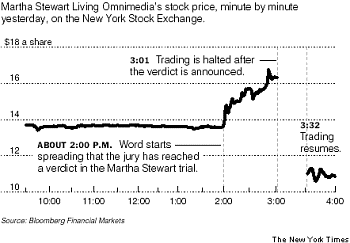
Following on the
controversy around the Grey Album,
a shadowy group of people have released the
Jay-Z Construction
Set that includes all you need to make your own remixes.
It has the original Black Album, the vocal tracks,
14 remix albums, and all the
old
school samples and
high-larious clipart you need to build your own project.
 As seen on MetaFilter
Jose Padilla met with his
lawyers for the first time since being locked up without charges in
June 2002. His lawyers, Andrew Patel and Donna Newman, met for about
three hours at the Navy brig in Charleston with Mr. Padilla, who is
accused of plotting with Al Qaeda to detonate a radioactive "dirty
bomb." Mr. Patel said they mainly gave Mr. Padilla news of his family
and did not discuss his case because the government was closely
monitoring the meeting.
Does this sound like America?
The blog world today is
full
of
links
to
Edward Tufte's sparklines,
a design element to display time series data in text. Read
the
article, it's interesting.
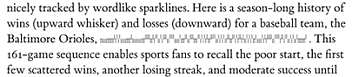 I occasionally worship at the Church of Tufte and have taken a lot of inspiration from his emphasis on simple and clean design. But many of his ideas seem awfully hard to apply well. A particular frustration is that many of Tufte's design elements rely heavily on 1200dpi multi-colour printing on fine paper. That's great, but these days all of my design is for 100dpi computer screens. Tufte has written amazing and comprehensible books that have had a good influence on everyday design. But often when people cite Tufte it's just "oooh, pretty" without really thinking about where the ideas are applicable.
Now that I regularly
use an aggregator I've found they're great for personal
blogs but not for everything.
Many sites just have lousy feeds:
Daily Python URL and
Fucked Company (via
newsisfree)
are both content-free.
Gametab also doesn't syndicate
enough content; kind of a special case since Gametab is itself
an aggregator.
Yahoo's
most emailed contains too much
new stuff and isn't sorted: I only want the top 10 items a day.
The more vexing problem are Slashdot and Metafilter. The aggregator experience is impoverished. The strong design is lost in an aggregator. And the comments that make both sites so interesting don't come through at all. I'm loving the linkblogs. If you want the linkblog experience without the setup try the aggregators Hot Links or del.icio.us. I prefer following linkblogs from just a few folks, it's more personal.
The San Francisco Bay Area is building a 400 mile network of trails
around the bay. The Bay Trail
project started in 1987 thanks to Bill Lockyer's
SB100.

One of the microgames in WarioWare is
funky
fountain, a bidet simulation. "The object" is a cute
little starfish flower.
  Fresh Air has a
review
today of remastered versions of the Jefferson Airplane albums.
It looks like there isn't a box set.
Amazon makes it remarkably difficult to find them, here they are at
$13.98 each:
Fresh Air has a
review
today of remastered versions of the Jefferson Airplane albums.
It looks like there isn't a box set.
Amazon makes it remarkably difficult to find them, here they are at
$13.98 each:
A couple of the blogs I
read have gone grey today in a
show of support for the Grey Album.
But because I read these blogs in an RSS reader, the only way I know this is because they said so. Their posts are rendered in the same uniform black-on-white-with-no-graphics that everything else is. RSS readers are convenient, but they sure are visually dull. The Grey Album is really great. Matt has it for download.
Update: OK, so several folks have noticed my trick of
colouring this RSS entry. It's not a complete solution: for instance,
this text should be green but it's not in RSS. More in a week
or two after some experimentation.
It's way harder than it should be to have a CGI script do something
asynchronously in Apache. The root of the problem is that it's not
enough to fork a child, you have to close stdin, stdout, and stderr.
Only you can't really close them, you have to reassign them.
import sys, os, time

print "Content-Type: text/plain\n\n",
print "Script started"

if os.fork() == 0:
    # Reassign stdin, stdout, stderr for child
    # so Apache will ignore it
    si = file('/dev/null', 'r')
    so = file('/dev/null', 'a+')
    se = file('/dev/null', 'a+', 0)
    os.dup2(si.fileno(), sys.stdin.fileno())
    os.dup2(so.fileno(), sys.stdout.fileno())
    os.dup2(se.fileno(), sys.stderr.fileno())
    # Do whatever you want asynchronously
    time.sleep(2)
    os.execv('/bin/sleep', ['sleep', '5'])

print "Process was forked"
This is explained pretty well
in
Perl and in
Python. It's a shame that sys.stdin.close() doesn't work.
I still haven't seen a good explanation for why Apache doesn't send partial output from a CGI: Apache says it doesn't buffer and neither does python -u. Grr. Ah ha, mod_gzip does buffer, unsurprisingly. Thanks to Marc for research help
After two days of using an RSS
aggregator I have seen the light.
My
RSS feed now contains full entries, not short ones, reversing
an earlier
decision. Truncated feeds are so obnoxious in an aggregator I had
to change immediately. My apologies to my long suffering readers.
I still don't like the blandness and detachment of RSS readers. Oh, and my RSS 0.91 feed isn't going to validate. I'll be switching to Atom soon and deprecating RSS.  After months of resistance I set up a news aggregator today:
FeedDemon.
I also checked out
sharpreader,
newzcrawler, and
awasu. I picked FeedDemon because
its UI was the easiest to use after 3 minutes' evaluation.
After months of resistance I set up a news aggregator today:
FeedDemon.
I also checked out
sharpreader,
newzcrawler, and
awasu. I picked FeedDemon because
its UI was the easiest to use after 3 minutes' evaluation.
Some essential features:
I like a few things about FeedDemon:
One thing I've learned is finding syndication feeds is harder than it should be. Autodiscovery helps but NewzCrawler was the only aggregator with it built into MSIE where I need it. The worst thing is folks who publish 9 different syndication formats. I don't want to have to choose, I just want good bits. I'm still unhappy with one thing: the visual blandness of an aggregator. Everyone's blog looks the same! It's no better than eight months ago. We need a way to rationally apply CSS to Atom. It's a hard problem.
While Bush has been successful in nation destruction, his failure to
bring any sort of security to Iraq or Afghanistan certainly echoes his famous
contempt for nation building.
Afghanistan is
so insecure they probably won't hold an election this year, two
years after the US took over their government. And check out this map:
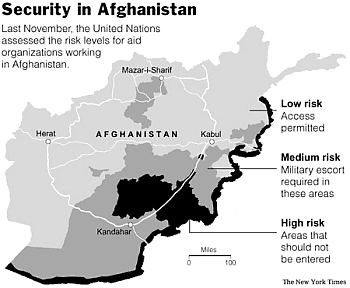 Iraq started out better with an educated wealthy populace and no cold war battle history. But fourteen years of US sanctions and two US wars has destroyed a lot of the infrastructure, even its hospitals. And the security situation is only getting worse, averaging 1.5 coalition casualties a month and over 10,000 civilian casualties. The targeting of Iraqi civilian police is particularly unsettling, a determined campaign to prevent law and order. The moral consequences of destroying countries and not rebuilding them is bad enough. But the practical consequences are worse. The Bush administration's foreign policy is undermining US security.
They're marrying homos in San Francisco and there's no stopping them!
The SF Chron has a good roundup about it:
how
it happened (blame Bush),
the political
advantage for the mayor, the political
history, and the
marriage mill scene. See also this
firsthand account.

amniotic fluid
•
aqueous humour
•
bile
•
blood
•
cerebrospinal fluid
•
colostrum
•
lymph
•
milk
•
mucous
•
saliva
•
sebum
•
semen
•
sweat
•
synovial fluid
•
tears
•
urine
•
vaginal secretion
•
vitreous humour
This post is dedicated to
Karl
Many mailing lists obscure users' email addresses in their
archives. I'm
nelson@xxxxxxxxxx
in a lot of archives.
The theory is this protects users from spammers. This is dumb. Spammers
already have my address. All this mangling succeeds in doing is
makes it harder for legitimate people to find me.
Email addresses are not secrets.
Update 2004-02-18:
Thanks to Justin for
CDT's
report claiming that most spam comes from scraped email addresses.
So maybe obscuring is useful afterall?
 I'm at
ETech where everyone is online.
There's WiFi everywhere, a
Wiki,
an IRC channel,
lots of blogs. And much
like
at Gnomedex, I'm pleased and dismayed at the extent of
the Internet side channel.
I'm at
ETech where everyone is online.
There's WiFi everywhere, a
Wiki,
an IRC channel,
lots of blogs. And much
like
at Gnomedex, I'm pleased and dismayed at the extent of
the Internet side channel.
Today I'm particularly aware of another cost of having net access at a conference: attention exhaustion. At a normal conference your attention is divided between talks and hallway chatter. Here you've also got your laptop competing for attention, what with IRC heckling, blogs, blogging, random net surfing, foolishly trying to keep up at work. No wonder I'm so tired! Life used to be slower.
I have a PowerPoint presentation that won't open correctly when my laptop is
online. I can open it and display the first 16
slides but then the whole Powerpoint process hangs (I can't even close the
window). After about 90 seconds PowerPoint recovers and my
presentation looks fine. Alternately, if my laptop is offline it loads
immediately.
Presumably the program has found something in my slides that it wants to check online and the 90 seconds is a timeout. How do I find and expunge that something? Networked apps are great until your network flakes out.
Update 2004-02-15: lazyweb failed me. So
did ethereal. I was able to figure out Powerpoint was trying to make
an SMB connection with a 60 second timeout, but not to where. Final
workaround? Pray for 60 seconds.
For the second time this year someone's stolen my credit card number
and used it to buy Internet services. The account is only three months
old! The first time it was gambling;
this time it's astrology. I trust my credit card company to make it
right, but what a pain! We really need a more secure billing infrastructure.
Credit card numbers are not secrets.
 It's amazing
how quickly the Web has become essential to intellectual life. It
seems inevitable now, but it wasn't at the time. I've been on the web
for ten years now (both publishing and reading;
one of the breakthroughs of the Web) and in that time my thinking has
evolved some, but mostly in the direction of complacency.
It's amazing
how quickly the Web has become essential to intellectual life. It
seems inevitable now, but it wasn't at the time. I've been on the web
for ten years now (both publishing and reading;
one of the breakthroughs of the Web) and in that time my thinking has
evolved some, but mostly in the direction of complacency.
Looking at my old email so many funny things jump out. The verb "mosaicable". Connecting locally in Oregon as a way to start on the Web (thanks, Eric Tilton!). Convincing my college to let students publish without editorial approval. Debating whether to use the GN server to stay Gopher compatible. Confusion about how to write HTML, simplistic guides. Explaining the web to some very brilliant scientists. And my own contribution to Web development, html-helper-mode. Two things made the World Wide Web succeed over University of Minnesota's Gopher or Brewster Kahle's WAIS. Everyone knows about the importance of inline images in Mosaic. But a much more subtle success factor is the Web's decentralization. Making it easy for anyone to publish was a revolution. WAIS was centrally adminstered, requiring help from someone else to bring your site into the network. Gopher was a bit more decentralized but it was still hard to publish a new page without involving an admin. By contrast anyone could set up a Web page and start linking it to other pages. And so they did, and so the Web was born. It feels permanent.
Inspired by Justin Hall's 10 years of
links.net
 I just finished listening to the
abridged audiobook version of
Walter Isaacson's superb
2003 biography of Benjamin Franklin. A
very contemporary biography, briskly narrating the man's long life and
highlighting his contributions to America and the way he both created
and exemplified a uniquely American intellect.
I just finished listening to the
abridged audiobook version of
Walter Isaacson's superb
2003 biography of Benjamin Franklin. A
very contemporary biography, briskly narrating the man's long life and
highlighting his contributions to America and the way he both created
and exemplified a uniquely American intellect.
What impressed me most about Franklin was the combination of practical businessman, intense intellectual, and statesman. The man was one of the best scientists and thinkers living in America at the time with many inventions to his credit. He was also a successful self-made businessman and spent the majority of his life shaping the political future of the United States. Well travelled and warm and human, too. I do not think we have such well rounded people today, certainly not in politics.
Jon Carroll nails
the impact Dean has had on the Democratic candidates:
Whoever the Democratic nominee is, he should thank Howard Dean for
leading his party out of the darkness. The electorate is energized;
people are finally paying attention to the Bush bunco schemes. Good
going, Howard; whatever happens, you done good.
 Remembering my user ID on every website is harder than remembering my password. Sites have different rules
for what your user ID can be and they have to be unique on the site.
Is it 'nelson' or 'nelsonminar' or 'nelsonm' or 'nelson352' or
'nelson@monkey.org' or what? I try to use my email
address everywhere.
Remembering my user ID on every website is harder than remembering my password. Sites have different rules
for what your user ID can be and they have to be unique on the site.
Is it 'nelson' or 'nelsonminar' or 'nelsonm' or 'nelson352' or
'nelson@monkey.org' or what? I try to use my email
address everywhere.
Not anymore on eBay. From my mail today:
eBay is constantly working to provide a safer and easier trading experience for our members. In our ongoing efforts to prevent unsolicited and possibly fraudulent email, we have decided to allow only User IDs that do not include an email address. This policy takes effect immediately.
So many things are wrong with this. First, they should let me
choose my own risk level. Second, they chose a crappy username for me
that I had to change; now my account is branded with the suspicious "user changed his
ID" for 30 days.
Third, they sent me this notification as an email; fraudulent emails
about your eBay account are one of the biggest
scams on the net. Finally, I suspect the real reason for all this is
to make it harder for folks to contact each other directly and bypass
eBay's auction.
The ironic thing is they support Microsoft Passport for signon. Passport keys your identity to your email address.
How do you set the closing price of a stock? You'd think it would be
simple: the last trade of the day. But in a
decentralized
electronic market like NASDAQ there's no single auction, no single
price. Today's NYT has a clear
article explaining the problems that arise. The S&P 500 is
experimenting with switching away from NASDAQ to the
American Stock Exchange to set
closing prices. AMEX is a traditional
centralized human-mediated market; a single
specialist making book means you have a single price.
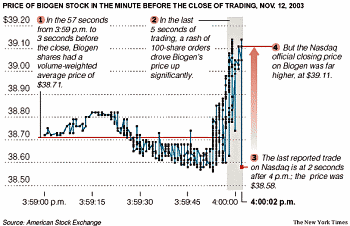
a series of minimally sized
orders, e.g., 100 shares, immediately prior to the open or close that,
based on the amount of displayed size, outstrips
short-term liquidity and creates excessive price movement on a
temporary basis
By jamming in a bunch of orders at the last second you can
force a price swing. Why would you do that? Because a lot of
compound securities are pegged to the closing price of individual
stocks on NASDAQ. Crazy!
According to NASDAQ Head Trader Alert #2003-093 they have some quantitative process to detect spraying; when they find it, they take an average price from the last 15-30 seconds. Another interesting nugget is AMEX's memo to the SEC in November 2003. It's in response to NASDAQ trying to block the S&P change, basically explaining that this is a good change and AMEX has no say in it anyway. The real problem is the notion of a 'closing price' at all. Why not trade 24 hours a day? It will happen soon enough. The world gets faster.
Since complaining
two days ago about being overbilled by AT&T, my phone has been
shut off entirely. No explanation. They do a great sending me spam
email, spam SMS, and junk mail, but they can't tell me why they shut
off my service.
I suspect they think I owe them money. I tried calling but, guess what? Due to heavy call volume your wait will be over 10 minutes. And their hold music is offsensive, a mixture of advertising, static, and volume changes that guarantees you can't concentrate on anything while it's on speakerphone. I am amazed at AT&T's contempt for its customers.
Update 2004-01-31: turns out it was not a
billing problem. Pulling the SIM card out and
putting it back in fixed it.
I've now spent three months trying to straighten out a cell phone
bill. I upgraded to GSM in the middle of November's AT&T's customer
service meltdown. Long story short: it took two weeks to get my phone
working again and at the end of it I was being billed for three
numbers.
Now there's nothing I can do to straighten this out. Calling support results in 10-50 minute hold times. Email support is not empowered to help. Every three weeks I accumulate enough patience to wait through the horrible hold music. The person always politely and confidently assures me that she has fixed everything. Then I get another bill with another improper charge. I realize this is fairly dull blog-fodder. Hostile customer service is so horrible precisely because there's nothing a person can do but rant impotently. I even tried going the regulatory route, but near as I can tell there is no consumer protection from cell phone companies that overcharge you and don't provide adequate customer care.
The spam tuneup I
performed last month is working well. I certainly feel like I'm
seeing less spam. The stats are good too.
3100 of the messages I received this month
were classified as spam (that's ⅔ of my mail!). Of those
3100, 2900 were caught by the Bayesian detector with 99% confidence.
About 1200 were caught by Vipul's Razor and about 1200
were caught by Pyzor.
Bottom line: the Bayesian stuff really works if you train it. The collaborative things are helpful but not complete.
WarioWare is a fantastically crazy silly GameBoy game. Or rather, a collection
of 200 "microgames".
These fun homages to classic gaming are
hurled at you in rapid succession with fantastic pacing and production.
You get 5 seconds to figure out each game and win it: sink a
putt, dodge cars, shoot a space invader.
As
GameSpy's
review says,
"Finally, a game in which crack may actually enhance one's performance."


The most effective debugging tool is still careful thought, coupled
with judiciously placed print statements.
Twenty-five years later this still seems true. Most programmers I
know debug by printing stuff out. Even Linus Torvalds has famously
criticized debuggers.
— Brian Kernighan,
UNIX
for Beginners, 1979.
Why is that? It's not technology - there are some beautiful integrated debuggers that let you hook deep into running code and poke around. And it's not ignorance, at least for me - I've had many happy experiences with fancy debuggers in the past. But I still keep going back to printing stuff out. Why? For me it's about simplicity. Running a debugger on an active process is often awkward. And it's a bit spooky: I never quite fully understand what's going on. Still I can't help but feel like I'm working with stone age tools.
The media, too lazy to report on actual issues in the Democratic
primaries, have taken to branding Dean "angry". As if that were a bad
thing.
We have a suspiciously elected president who lied to the American public to build a case to invade Iraq. ("Let them eat yellowcake".) His vice president's former company is making huge, fraudulent bank on the deal. His attorney general is systematically dismantling civil liberties, detaining citizens in secret with no due process. And that's just foreign policy. Let's not overlook the ruinous financial policy that is digging America deeper into debt so that his friends don't have to pay taxes. Isn't anger an appropriate response?  I bought my first MP3 today, from
Warp Records'
Bleep. It's online
music done right: reasonable prices, good encoding, no stupid DRM.
And buying direct from the label makes it easier to buy more
obscure releases from
Aphex Twin,
Autechre, Boards of Canada, Plaid, etc.
I bought my first MP3 today, from
Warp Records'
Bleep. It's online
music done right: reasonable prices, good encoding, no stupid DRM.
And buying direct from the label makes it easier to buy more
obscure releases from
Aphex Twin,
Autechre, Boards of Canada, Plaid, etc.
The legendary Twoism, originally issued in a limited vinyl-only
pressing on BoC's own Music70 label. Before this reissue and CD
release in November 2002, copies were changing hands on Ebay for up
to £800
The MP3s are well encoded via Lame 3.90 --alt-preset standard resulting in VBR with rates around 175kbps. The files have good ID3v2 tags (but lousy names). And the downloads are fast, 100kbytes/sec or better. The usability on the UI is good although I'm not wild about the monolithic Flash app with tiny fonts. The music preview option works well. My only real complaint is they don't let me download stuff forever: you're responsible for keeping track of the files yourself. Buying music online makes so much sense. I could buy Autechre EP7 for $13 on Amazon and wait a week to get a CD I'll rip and then store forever, or I can download it on Bleep for $7. And I'd rather pay a few bucks than try to steal a crappy, incomplete copy online.
Note to webapp developers: the + character is a valid part of
an email address. Don't stop me from using it. And fix your broken CGI
parsing so + isn't treated as space.
The + has a very useful meaning in almost all mailers: stuff after it is ignored. Ie, xyzzy@example.com and xyzzy+foo@example.com are basically treated as the same email address by example.com's mailer. Both addresses deliver to the mailbox owned by xyzzy. This has been a feature of sendmail for at least 10 years. It works in Postfix and qmail, too. The plus sign makes it easier to track how your email address is spread around. If I ever get email to nelson+cheapviagra@monkey.org, I know who to blame. It's also helpful if you're debugging webapps and need to create email-keyed accounts.  Call me ungrateful, but I'm unimpressed with Bush's
Mars
announcement. It's not really a plan - there's no funding, there's
no technology initiative, no particular insight except "um, go to the
moon first". It's baldly political. And with a first deliverable 16
years in the future, it's free of presidential responsibility.
Call me ungrateful, but I'm unimpressed with Bush's
Mars
announcement. It's not really a plan - there's no funding, there's
no technology initiative, no particular insight except "um, go to the
moon first". It's baldly political. And with a first deliverable 16
years in the future, it's free of presidential responsibility.
In the meantime the US is already at Mars via robotic landers. With a less than 50% success rate to Mars it seems prudent to send robots instead of people. Better science too — concentrate on investigation rather than protecting fragile humans. Space telescopes like Hubble or WMAP seem much more valuable (and cheaper) than planting a flag and radioing the president from Mars. I understand the romance of sending people to space. But aren't we past that? And it's not like we can do both: without significant new funding what this Mars program means is that we don't have resources for robotic missions, space telescopes, etc. For the next forty years NASA is all about flinging meat to Mars. PS: this editorial calling for one-way manned trips to Mars is pretty interesting.  The NYT has a great
science article on a new map of the
universe from Princeton astronomers.
The NYT has a great
science article on a new map of the
universe from Princeton astronomers.
The 600 x 4200 GIF is beautiful, particularly the fine grained structure in the Sloan survey. start at the bottom and scroll up to see a logarithmic view. Read the article for more info. The Princeton site also has higher res maps, and there's some Slashdot discussion. I've been on a map kick lately. I just bought The Times Atlas of the World, a giant beautiful atlas with huge amounts of political detail. I'm now eagerly awaiting the DK Great World Atlas, which hopefully has more geographical data. Maps help me understand how the world (or universe) fits together. Hugh Johnson's World Atlas of Wine is the single thing that best helped me to understand wine. Somehow cementing my fuzzy taste-memory to concrete cartographic representations made wine make sense. Drawing good maps is hard. For some more on the politics of world map projections, this essay is quite informative.  Flying on an airplane in the US will
soon require
a criminal background check. Don't worry.
Minipax says there's nothing
wrong. You have nothing to fear if you have
nothing to hide. Unless you're part of the 4% false positive rate. Or
if the DOJ takes this opportunity to extend their investigatory powers
beyond air safety.
Flying on an airplane in the US will
soon require
a criminal background check. Don't worry.
Minipax says there's nothing
wrong. You have nothing to fear if you have
nothing to hide. Unless you're part of the 4% false positive rate. Or
if the DOJ takes this opportunity to extend their investigatory powers
beyond air safety.
The EFF is fighting CAPPS II, as is the ACLU. The airlines aren't particularly interested in going along either.
I'll be speaking at the O'Reilly
Emerging
Technologies Conference in San Diego, Feb 11 2004. O'Reilly and
Associates has an amazing ability to collect smart and interesting
geeks. I've really enjoyed their past ETech conferences, looking
forward to this one. I hope to see you there!
My talk is Google is Harder Than it Looks. I gave a talk kind of like this at Gnomedex last year that went well.  One of my favourite things about going to Canada is
the Caesar
cocktail. On first blush it's just a Bloody Mary with clam juice in
it. But it's much better. In Canada they make
them well, they make them spicy, and they make them often. Ask for a
Bloody Mary in the US and you're likely to get a strange look and a
glass of tomato juice with some vodka in it. Ask for a Caesar in
Canada and you get a lovely well made drink. The clam juice is pretty
good, too.
One of my favourite things about going to Canada is
the Caesar
cocktail. On first blush it's just a Bloody Mary with clam juice in
it. But it's much better. In Canada they make
them well, they make them spicy, and they make them often. Ask for a
Bloody Mary in the US and you're likely to get a strange look and a
glass of tomato juice with some vodka in it. Ask for a Caesar in
Canada and you get a lovely well made drink. The clam juice is pretty
good, too.
4 parts clamato
So now you know why Clamato
exists. More on MetaFilter.
1 part vodka salt and pepper tabasco or horseradish lime juice worcestershire sauce celery salt on rim  Something really terrific is happening at
West
Restaurant in Vancouver, Canada. Fantastic menu,
skillful combination of flavours
and top quality local ingredients. Excellent service and room.
I've been to enough fine restaurants to
know when something is particularly special. West.
Something really terrific is happening at
West
Restaurant in Vancouver, Canada. Fantastic menu,
skillful combination of flavours
and top quality local ingredients. Excellent service and room.
I've been to enough fine restaurants to
know when something is particularly special. West.
The New Year's Eve tasting menu, a 3 hour meal:
Tofino Dungeness Crab Salad with Granny Smith Apple
I've only had such innovative and sastifying food a few times.
The wine pairings were perfect,
expert sommelier.
Seared Foie Gras with Apricot and Carmelized Boudin Blanc Crispy Spot Prawn Salad with Pineapple, Daikon and Mint Salad Nutmeg Gnocchi with Pecorino Pepato, 25 y.o. Modena Balsamic Boneless Lamb Chop with Eggplant Caviar and Roasted Artichoke L'Edel De Celeron Cheese, Apple and Currant Raisin Compote Lemon and Lovage Sorbet Honey Tangerine and Chocolate Souffle Tart |
|||||||||||||||||||||||||||||||||||||