Some Bits: Nelson's weblog

Gone With the Wind

(CW: rape, racism). Ken and I watched Gone With the Wind this week. As if it were prestige TV, in one hour segments over four nights. It’s imminently watchable that way. And for a movie as early as 1939 it still feels very modern. It’s completely enjoyable by modern standards, no early film awkwardness of plotting or direction. Well written characters, amazing sets and costumes, there’s a lot to enjoy in the film.

It’s also a racist piece of shit of a film. And deeply steeped in rape culture. And these sins don’t just mar the surface; you can’t watch the movie and just sort of ignore them. The entire intent of the film is racist, the racism is woven throughout the whole story. It’s a Lost Cause fiction about a Gallant South, about how Georgia suffered unjustly under the evil invading Union forces. I was prepared for the racism part; the film is notorious for it. I was less prepared for the rape culture.

The center of the film is the relationship between Scarlett O’Hara and Rhett Butler. It’s excellently written and both actors are amazing, so the performance is exhilirating. It’s also absolutely awful. The first time they kiss, it’s as they’re fleeing the burning of Atlanta and the destruction of Scarett’s world. Scarlett keeps saying "no" and pushing Rhett away, hitting him, pleading him to stop. And he literally forces a kiss on her against a blood red sky. To the film’s credit she holds her ground, pushes him away and slaps him, but Rhett doesn’t even look surprised.

It gets worse with the actual rape on the staircase, a drunk Rhett violently attacking his wife, grabbing her and carrying her up the stairs. To impregnate her, after she’d already told him she didn’t want a second child and implied she wanted no sexual relations of any kind. The hideous thing is in the morning she’s shown waking as from a dream, with a smile, a happy smile, because apparently… I can’t explain it, it’s simply rape culture and it’s awful. Particularly for Scarlett. In many ways she’s a great character, a strong woman who survives no matter the circumstances, uses men and sexuality for her own purposes. To have her so violated and then shown to enjoy it is deeply offensive.

Young Black
slave girls fan the white ladies and it goes entirely
unremarked

There’s nothing I can say about the racism in the film that’s not been said better elsewhere. Happy slaves, noble Klansman (barely disguised), the whole mythology of plantation life… it’s all awful propaganda. What I didn’t know before reading about the movie this week is how there were protests about the film both during its making and in its premiere in 1939. It was a hugely successful film but its hatefulness did not go unnoticed. Just most white Americans didn’t care. The Jim Crow South in particular was eager for a film that justified its continuing racism.

I don’t know what to say about the stereotype character Mammy. When I was a little kid I had a nanny like Mammy, a big caring middle aged Black woman who loved children. So this Mammy stereotype is deeply wired into me. And Hattie McDaniel’s performance is excellent. I particularly like how much latitude she has in the household, how she can speak the truth and be sassy and be respected. OTOH Mammy is only written as a character to support the white people in the movie. Nothing at all is said about her own life, or what the transition of emancipation might have meant to her, or whether she had her own children or life outside of being Scarlett’s minder. None of the other Black characters get any better treatment, the film is entirely blind to the reality of life in that place.

My mother loved Gone With the Wind. She loved the fantasy of the antebellum South, the costumes, the performances. She might have acknowledged the fantasy depiction of plantation life but would have found it unobjectionable. But I think what she really liked is Scarlett, a strong woman, a woman who survives very difficult times through grit and shrewdness and clever use of her feminine wiles. I don’t know what she would have thought about the rape culture, I think she bought into it as much as most people her age. That it was romantic for a man to ravish a woman. What an awful thing.

Next up: Giant.
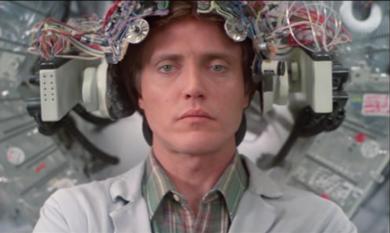
Brainstorm

The 1983 movie Brainstorm is worth seeing, or maybe revisiting if you last saw it decades ago. It fits in with Tron, WarGames, and Videodrome as early 80s imaginings of what the near-future of technology will look like. Great performances by Christopher Walken and Louise Fletcher.

The reason to watch Brainstorm now is is the production design, the imagination of consumer products and user interfaces for the near future. It feels like totally relevant, modern commentary on product design for things like the iPhone, Google Glass, Tesla, or a Microsoft Kinect. Dialed up to 11 with a sci-fi flight of fancy, of course, but well done for that. I’ll be honest and say the plot is sort of silly, a combination of military-industrial complex paranoia and some fairly hokey spiritualism. That’s partly redeemed by Louise Fletcher’s role as the head of the research project, a totally badass lady scientist. But mostly watch it for the animation sequences and the industrial design.

Chinatown and rape culture

I settled down a few days ago for an old classic film, Chinatown. Great Jack Nicholson performance, fantastic film noire homage, lovely 1940s period LA. And through the whole film I kept thinking two things. The game LA Noire owes a huge debt to Chinatown. And good lord, but is that film a serious product of rape culture.

The obvious: a central plot point is that the female lead (an excellent Faye Dunaway) was raped by her father. That fact is presented sympathetically enough and she’s a little more complex than just a victim. But how do we learn it? Our hero detective literally beats it out of her. It’s a horrifying scene, played to deliver the shocking reveal. But then it’s also this disgusting revictimization. And it passes on without notice, of course the hard-boiled detective had to beat the hysterical girl silly.

There’s another upsetting thing earlier, when our detective and the heroine first meet, where she seduces him. Two days after her husband’s violent death, a death the detective is implicated in. It’s not quite so stupid; we learn later she’s playing him, the seduction is strategically deliberate on her part. But of course the hard-boiled detective gets to bed the beautiful girl.

And then there’s the central unspoken problem, that the director is Roman Polanski. Not three years after Chinatown, Polanski drugged a 13 year old girl and raped her. And pled guilty, and fled the US before sentencing, and has been an active fugitive ever since. I’m normally OK with separating the art from the artists, but in his case it’s just too much. But of course the famous director gets away with raping a child.

Part of what’s so troubling about rape culture is how insidious it is. This kind of victimization of women was mainstream entertainment, without comment, for far too long. It’s an infection.

Watching The Hobbit via Amazon

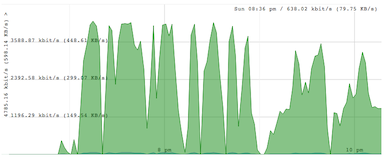
I like paying for digital movies. So I rented The Hobbit last night to watch on my Xbox. The movie was OK. The twelve times the streaming failed and the movie paused while it buffered was not. Amazon’s movie was about 3.5 gigabytes for 170 minutes, or 2700kbit/s. My download speed is a reliable 6000kbit/s. So what’s the problem?

The bandwidth graph above shows the problem; something terribly wrong with the streaming. First, the Xbox client doesn’t seem to buffer much, if at all. Playback would be a lot better if they used all 6000kbit/s and cached to disk. Second, their streaming server seems to have lost the connection ten times in three hours. Naturally they blame my ISP. At least they refunded the rental fee.

I like to pay for media, but maybe next time I’ll consider downloading an unlicensed copy. Pirate Bay offers a 2000kbit/s version that I could have downloaded and then watched uninterrupted for free. It was available two weeks before the official release.

JJ Abrams Star Trek as fanfic

I love the idea that the JJ Abrams films are not really Star Trek; they’re really Star Trek fanfic. I don’t remember where I first read that idea, but it’s exactly right. I liked both movies, don’t get me wrong, but they are just ridiculous. Here’s the first movie script:

Kirk is this awesome 13 year old kid and he has a hot car and then he drives it off a cliff but he jumps out just in time. And then he gets in a fight in a bar and then he joins Starfleet and sneaks on board the Enterprise. And then Sulu has to space jump and he pulls out this sword and he’s, like, a killer ninja. And there’s a time traveling Romulan with special magical Red Matter. And Vulcan blows up but actually it’s a parallel Star Trek universe where all the same stories happen only totally different. And Spock and Uhura, they kiss.

Totally rad story, right? The new movie is just as ridiculous, if somewhat clever in what it does. I enjoyed it. Here’s hoping Abrams gives the same tawdry treatment to the Star Wars films, that’s a franchise ripe for self-parody.

Cloud Atlas

The new Wachowski/Tykwer film Cloud Atlas is a hell of a good movie. If you’re at all curious about it, go see it in a real theater. It’s a terrific example of what film can be. Sprawling, uncompromising, beautiful.

It’s also one of those rare films that’s better than the book. I read the novel last month in preparation and while I enjoyed it, I found it a bit flat and hard to get through. The film picks up on all the interesting themes of the story and tells it more effectively. My only fear is it might be a bit hard to follow the movie; a plot synopsis of the story may help you enjoy the movie more and won’t spoil too much.

I particularly like how they re-imagined the book as a movie, changing the narrative structure. The book is a series of 6 nested stories told in halves, ABCDEFEDCBA. The film chops that up and interleaves the stories much more rapidly. That lets them systematically highlight the common themes and narratives between each story that makes the whole work so intriguing. They also play off the stylistic inconsistency of each story, the mix of action, sci-fi, and farce coming fast and furious gives the narrative some much needed variety. Add on top of that great filmmaking, casting (Jim Broadbent!), makeup, production design, and it’s a rare example of a complete movie coming together.

I’m also impressed at how the Wachowskis have stayed true to their vision of the filmmaker’s art. After the relative failures of the Matrix sequels and the underappreciated Speed Racer, you could imagine them compromising, retrenching. But there’s nothing tentative about Cloud Atlas, it’s an aggressive film. The collaboration with Tykwer also seems to have worked to everyone’s benefit.

Indie Game: The Movie

Interested in stories about motivated artists and craftsmen who toil for years on their own hoping for commercial success? Indie Game: The Movie is for you. I just watched it and it’s absolutely fantastic. Way better documentary filmmaking than the usual independent movie. And the film elevates the story; it’s not just about a few nerds making hipster games, it’s an intimate look into the lives of some very driven and talented people.

It helps that the filmmakers picked three amazing independent games to cover. Super Meat Boy, Fez, and Braid are all great examples of indie games that benefit from a unique artistic perspective while also being fun to play. I really enjoyed the inside view of what it felt like to work for years on something so personal, the crises of faith, the joy of success. The film rests a little too heavy on the tortured artist narrative, but it was a great reminder to me of the cost of success.

You can buy the movie for a very reasonable $10 from iTunes, Steam, or a direct DRM free purchase (1080p). The video quality is excellent.

District 9

Children of Men was a huge breath of fresh air to scifi films. Tight movie, shot intelligently, interesting cinematography and storytelling. District 9 isn’t quite as solid or well polished, but it’s a thoughtful and entertaining film. Worth seeing in a theater as an antidote to all the garbage American action flicks.

Both films are grimly depressing. But they’re not simplistic dystopian future films where the horrible world is comfortably distant from today. The world in these films is terrible now, today, for identifiable reasons. It’s a very pessimistic reflection on our current society. It works quite transparently in District 9’s case, drawing directly on apartheid experience to tell the story of what would happen if indigent aliens came to Johannesberg and squatted there in shantytowns. Basically the director is expanding on his short film Alive in Joburg, taking good advantage of his $30 million budget and less good advantage of a 112 minute running length.

District 9 is strongest at the start setting up the world. Excellent use of documentary-style filmmaking and lots of shaky-cam to reveal classic unthinking xenophobia of various stripes. The movie then goes on to more of a classic action flick with slightly irritating Enemy Mine moralistic overtones. It works pretty well though, doubly so because Neill Blomkamp applies his CG background to some really great mech-suit and giant spaceship scenes.

If District 9 is a success we can no doubt look forward to District 10, a Roland Mmmerech / Michael Bay $200M production. The explosions will be bigger, the action sequences will be edited to a frame of their lives, and the soul will be completely gone. In the meantime maybe they’ll be making good scifi films somewhere outside the US studio system.

Grown-up movie theater in San Francisco

The newly renovated Sundance Kabuki is a pretty good movie theater. It’s a fancy theater for grownups: reserved seats, an effort to show good films, even a bar that lets you bring cocktails into the movie screening.

We had a pretty good experience on Thursday seeing Julie & Julia. Great film. The balcony seats were comfortable, the projection and sound were good, and the audience was polite. That last point is important; I seldom go out to movies because I hate the rude audiences but a movie about Julia Child at a theater that’s $2 more / ticket than normal is a bit self selecting. Also the theater didn’t show any ads, too many previews, or offensive threats to put the audience in jail. A welcome change.

The real novelty of the place is decent food and drinks in the movie. That was a mixed bag. The menu sure beats jujubes and popcorn, but it’s not a proper dinner. And the alcohol service is limited to an awkward, crowded upstairs bar, a few small theaters, and balcony seating in the main theater. But the balcony worked out quite well, it was very nice to enjoy a martini and some fresh potato chips from our front row balcony. I can recommend Dosa across the street for a late dinner afterwards to make a full date.

I sure wish San Francisco had something like Portland’s brewpub theaters. I have many happy memories of beer and pizza watching second-runs and old flicks at the Bagdad. Great place to watch Repo Man.

Go see Speed Racer

I’m not going to pretend it’s a good movie. Speed Racer is a summer film with no redeeming narrative or characters. But it’s absolutely beautiful and if the visuals interest you at all go see it very soon. Because there’s no point in watching this film other than the sensory experience in a real theater, and it’s unlikely to be in theaters for long.
The pleasure of the movie is entirely in the incredible visual language. The Wachowskis aren’t shy at all in their formalism and the film is a triumph of oversaturated plastic colours, insane cartoon collage, and overwhelming motion sequences. Visually the whole film is kind of like the monolith sequences in 2001. Only instead of LSD infused cosmic transcendance it’s MDMA fueled heart pumping sensory overload. It’s absolutely exhausting, ridiculous, and beautifully conceived and rendered. Either you’ll find it interesting or you’ll hate it.

Netflix usage

In the five and a half years I’ve been a Netflix subscriber I’ve rented 104 movies. That’s an average price of $11 a rental. I’m apparently one of their best customers.

The Apartment

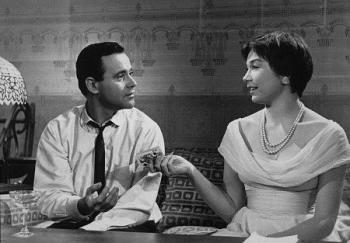
Looking for something intelligent to watch? Can’t wait for Season 2 of Mad Men? Do yourself a favour and rent The Apartment, the 1960 film from which Mad Men borrows half its period setting.
It’s a great movie thanks to the fantastic performance from Jack Lemmon. He’s a total sap, a bit of a nerd, and yet despite everyone walking all over him he remains charming and self-posessed. He’s also got enough backbone to get the girl in the end. Shirley MacLaine is good as the girl too, and while the movie falls a bit too much into dopey romance comedy it always has a bitter New York edge that keeps it tasty.

The Fountain

I went to see Aronofsky’s new movie yesterday (as you would know if you were following me on twitter). I’m glad I went, but it was somewhat disappointing. It suffers the same problem as Kill Bill; lots of formalism, lots of beauty, but ultimately signifying nothing.
I think the biggest problem is that the main characters are so abstracted that we don’t really care about them. Both Pi and Requiem for a Dream were highly stylized and abstract as well, but the lead characters and situation were strong and personal enough to create emotional connection. In this film the characters exist in a bubble of formal beauty, inaccessible to us.

Still it is awfully beautiful, and the music’s great, and there’s some nice symbolism for its own sake. If you’re a film geek it’s worth watching.

A Scanner Darkly impressions

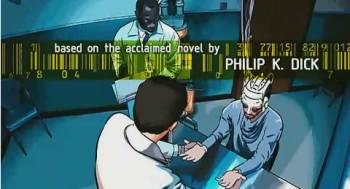
I’ve been so excited about the A Scanner Darkly film that I read the book again and then went to the opening screening today. Here are my impressions.
It’s pretty good. Not great, and I don’t think it has any hope of appealing to people who aren’t fans of the book. But if you were thinking of seeing it anyway, then go, it’s good.

First, the obvious questions. The rotoscope animation effects work. Everything has this shifting unreal quality that fits the story very well. And technically, it’s well done. Also the casting is great, except Keanu Reeves. I had hopes Keanu would be OK in this role; his woodenness could just be taken as schizoid lack of affect. But no, he’s just dull. Robert Downey Jr steals the show. And Winona Ryder hardly has to work to sell lines like “I snort a lot of cocaine”. Yeah, doll, we know.

Linklater’s script lets us down a bit; the movie makes even less sense than the book in critical parts. In particular some crucial scenes are left out that help you follow who’s who. I love how disorienting Dick’s books can be where you’re not quite sure you’re following the author’s narrative so you go back and reread a section two or three times. But in a linear and concrete medium like film the story needs to be clear and Linklater doesn’t quite get it. I wonder if he just had to cut two or three crucial scenes because of time or budget.

But the most important thing about the story is the depressing banality and alienation of bright people hopelessly fucked up on drugs. And the film captures that very well. Some of the early doper scenes are sort of funny, giggling along with Woody Harrelson. But as time goes by it gets more and more horrifying and depressing. I was particularly pleased that the film ends with Dick’s own eulogy for his friends lost to drugs.

This has been a novel about some people who were punished entirely too much for what they did. ... These were comrades whom I had; there are no better. They remain in my mind, and the enemy will never be forgiven. The “enemy” was their mistake in playing. Let them all play again, in some other way, and let them be happy.

A Scanner Darkly trailer

The trailer for the film of A Scanner Darkly is online. Looks good on Yahoo, or try this direct download.
Everyone’s talking about the rotoscope visual effect, which is definitely cool and appropriate to the story. But what’s most exciting is that a new Philip K. Dick story is being made into a film. And unlike other films there’s no way to paper over the schizophrenic horror of this story, so we should finally get the unmedicated creepiness that makes PK Dick novels so great. A Scanner Darkly is the most disturbing and depressing of all his novels, particularly when you ignore the scifi trappings. If they stick to the story, it’s gonna be a hell of a film.

I worry about the cast. Keanu Reeves, Robert Downey Jr., Woody Harrelson, Winona Ryder. If they just add Christian Slater they’d have the Asstastic Five. But it could work.

Hero

I saw Quentin Tarantino presents Jet Li in Yimou Zhang’s “Hero” (aka Ying xiong) (trailer). The director is one of the fantastic folks coming out of Beijing, and you couldn’t ask for a better cast. Alas, the film didn’t work for me nearly as well as the other recent art-fu hit, Crouching Tiger, Hidden Dragon. I prefer Zhang’s other excellent films (Raise the Red Lantern, Ju Dou, To Live).
The best thing about Hero is the formal use of colour and setting. It’s sort of like The Cook, The Thief, His Wife, and Her Lover with martial arts. But this same formalism drains the film of any passion or joy, it’s just one set piece after another. Even the fight choreography is dull.

The story is tiresome too; the Rashomon thing is only clever when the different views of the story reveal something about the character telling them. And the conclusion, with the Noble Hero sacrificing himself for the good of The State, is too creepy for me.

Still, it’s a good movie, worth your time to see.

Liquid Sky

Dylan found a music video that combines simple techno music with images of oiled women in bikinis operating power tools. Somehow that reminded me of one of my favourite movies of all time, Liquid Sky.

The film is ostensibly about space aliens that come to New York to kill heroin users at the moment of orgasm to capture opiates in their brain. Or something. But really the movie is a beautiful and lyrical exposition of the New Wave scene, with amazing costumes, makeup, and soundtrack. Anne Carlisle makes an amazing dual appearance as both Margaret, the Connecticut girl turned bisexual punk model, and Jimmy, the nasty little queer boy model. It’s kind of like the Warhol scene, only much cooler.

So I came to New York, where I learned to be beautiful was to be androgynous. So I became androgynous, no less than David Bowie himself.
I’m not saying it’s a good movie. But it’s great.

The Fast and the Furious

I may be three years behind the times, but The Fast and the Furious is a pretty great movie. Cool cars, tight editing, and the kind of After School Special for Adults plot I love in action movies.

I’m impressed with Vin Diesel, too. I like action movie stars who do what they do well. His new Riddick Xbox game is great, does the video game tie-in better than anyone so far. Smart move forming Tigon Studios, his own game company.

Maybe one day Vin will be governor.

Signifying Nothing

I finally watched Kill Bill vol. 1. What a tedious movie! I generally love obsessive geekishness and formalism in making art, particularly movies. But it’s important that the movie also actually be about something. That it have a point.

That’s why I liked Jackie Brown so much: Tarantino could indulge his obsession to homage while actually telling a meaningful human story. You know what would be brilliant? A Dogme 95 Quentin Tarantino film. Have the filmgeek boy make a movie without all the lighting and editing tricks. Restriction is freedom.

The Matrix: Revisited

I watched The Matrix again tonight, partly because my TiVo is sick and partly to erase memory of the horrible sequels out of my mind. Now I understand what made the first film so magic: the interplay between real and simulation. The film toys with us, showing us little glimpses of the synthetic. Deja vu, the reality of bullets, the ability to do kung fu. And the lovely Cronenbergesque bits, the baby with the hoses, the bug, the sockets in flesh. The whole film is a discovery of unreality.

The next two films strand us, in the words of the script (and Baudrillard), in the desert of the real. Ugly boring world with stupid Zion hippies. And Neo is already brilliant and all powerful, so there’s no discovery. No pleasure.

This is reflected in the special effects technology. The first Matrix film is beautiful because it is, ultimately, a film. The FX are mostly film tricks (slowing, rotating) and the stunts are mostly human stunts, people on wires. The reality-based effects work highlights the gap between the Real World and The Matrix. By contrast the digital effects work of the second two films is just unreal. And boring.

There was no way to make a good sequel.