Some Bits: Nelson's weblog

DVDs, HDCP, and you

One of our Christmas presents this year is an Oppo DV-980H DVD player. It’s a featureful little DVD / DivX player from a small A/V company that’s building interesting products.

One of the player’s features is upconversion. It’ll take an ordinary DVD and convert the output to 1080p so it looks great on your HDTV screen. But thanks to the evils of DRM, it will only do this over an HDMI cable, not standard component cables.

Video up-conversion over the component output is only available for unencrypted discs such as home video and consumer-created contents. Most commercially pressed DVD discs are CSS-encrypted and will be limited to 480i/480p resolution. This restriction applies to the component output only. The HDMI output is protected with HDCP and has no such restriction.
Is your TV more than a year old and lacks HDCP support? Too bad! Been using the same component inputs for three years because you’re a movie enthusiast and early HDTV adopter? Too bad!

Fortunately, the Oppo player has another neat feature, coyly referred to above as “consumer-created contents”. It plays DivX and XviD AVI files; either read off of disc or through the handy USB port. And those movie files will be upconverted to 1080p on the component cables with no fussy encryption.

So in other words, if I legitimately buy a DVD I can’t play it nicely on my TV. But if I steal the same DVD online and download it to my Oppo, it’ll play beautifully. I love how DRM is protecting the movie industry.

Processing

The best class I took at the MIT Media Lab was Principles of Visual Interface Design with John Maeda. It was an odd class, we did abstract graphic design exercises by writing Java applets. Writing code that made art. It was a huge stretch for me since I have no design background. But John’s a great teacher and I learned a huge amount in that class. I still enjoy looking back at my class portfolio.
Java in 1997 was a rough medium for doing design work. Over time John and some of his students have worked to develop better environments for digital design. The most influential has been Processing by Casey Reas and Ben Fry. It’s a great environment, a sketchbook and IDE that clears away all the nonsense of programming Java and gets you right into interactive graphic design.

For fun today I downloaded Processing and whipped out a little design exercise, playing with what a field of ovals looked like. Such a pleasure doing something like this in a refined tool. Processing gets you results quickly and makes it easy to iterate and tinker and try out various ideas. You can try out my applet yourself or just look at the source code. Of course there are lots more Processing examples online.

And congratulations to John Maeda on becoming President of RISD!

Windows Media Player 11 eats your CPU

Microsoft recently upgraded the Xbox 360 with a neat feature; Divx playback. That means the console can now play back most downloaded AVIs. All it takes is a little media server sending the files to it over the network. If you believe Microsoft, your only server option is Windows Media Player 11.

Except that WMP 11 is totally evil. Because if you turn on file sharing, somehow wmpnetwk.exe ends up consuming 100% of your CPU. Even when you’re not sharing files, and even when you aren’t downloading a new video. All the time. Judging by the Google search I’m not alone in having this problem. And what a pernicious bug; 90% of Microsoft’s users will never understand why their computers are suddenly terribly slow.

Fortunately there’s a bunch of third party alternatives for servers. The only one I’ve used is the demo of TwonkyMedia, but it seemed to work well on Linux.

Woody Guthrie, dirty jokes

I’ve been listening to Woody Guthrie’s 1940 album Dust Bowl Ballads. It’s mostly pretty grim folk blues, the misery of people fleeing the economic disaster of the Oaklahoma Dust Bowl. So I was a bit surprised to find this funny little sexual entendre hidden in his Dust Pneumonia Blues.
If it wasn’t for choppin my hoe would turn to rust
I can’t find a woman in this black old Texas dust
“Choppin” must be what the boys called it back in the 30s.

Gay bashing in online games

Below is a fantastically edited sample of the daily antigay crap that we put up with in online gaming. Audio is NSFW; “gay boy I hope you die and burn in hell” is as mild as it gets. Frankly it’s so upsetting I only watched the first half.

The problem here is that Halo 3 is a testosterone pumping game played mostly by young guys. And the game has an open voice chat channel that’s essentially anonymous. And so people say horrible things on it all the time. The only way I could ever play it online was to mute the voice chat entirely. But then you miss out on any strategic coordination and half the fun.

There’s an argument that “xxxGayBoyxxx” provoked this response by choosing an obviously gay name and using pink for his colours. Well, yes, he is provocative. But you get this kind of homophobia all the time without any provocation. I’ve spoken up when some horrid child started babbling “you faggot you killed me” and the response from the other folks in the game was pretty unpleasant.

Casual gay bashing is all over gaming culture and it’s hideous. It affects which games I play and how I play them. Part of what’s fun in social games is playing with other people; but when those other people continuously act like assholes it’s not fun. Fortunately most games aren’t quite the sewers of bad behaviour that Halo 3 is.

Blogging explained

Hey, Goat, you writing your blog?
Go away, Rat.

You know, I like blogs... I really do... You know why?
Go away, Rat.

Because they provide their frustrated creator with the delusional outlet of being a published author, sort of like how the prison warden lets the psychotic inmate scribble “poetry” on the cell wall so he doesn’t beat his bunkmate with a toilet seat.

Perhaps you didn’t like that analogy.

From today’s awesome Pearls Before Swine, a comic strip from Stephan Pastis.

Follow the adventure

The other game I’ve been excited about recently is Assassin’s Creed, the beautiful stealth game set in the Holy Land during the Crusades. Sadly, it’s not good, and I can only assume the high reviews came from people who didn’t finish the game. It’s a beautiful game, but the gameplay gets repetitive way too quickly.

It’s too bad; they squandered a really interesting setting. Jerusalem during the time of Christian occupation? Templar conspiracies? Sounds brilliant. Alas, the story quickly devolves to “do these five repetitive tasks, then kill this guy”. I can’t help but think if there were a little choice or interaction in the storytelling I’d find it more compelling. Instead I find myself reading my email while the cutscenes play.

One thing I do appreciate is some of the gameplay and storytelling chances they took, the cut scene glitches and the times when Altaïr wakes up in the present time. It felt a bit like failed experiment Fahrenheit / Indigo Prophecy. And it’s the first game I’ve played that creates the feeling of a crowded city rather than the empty zombielands of most games. Hopefully someone can do something more interesting with the game engine.

Choose your own adventure

I’m pretty excited about Bioware’s new RPG Mass Effect. I’ve only played it a bit so far but I’m already knee-deep in the story. The action combat gameplay is meh, but the storytelling is fantastic.

What makes the game work is the interactive dialog engine. Meeting a new character is more than just waiting for a cutscene to offer up some crucial clue; instead you enter into a little narrative puzzle trying to figure out what to say to get the character to do what you want them to. It’s very simple technology, mostly a branching path of dialog nodes, but that interactivity makes all the difference. And as icing on the cake, the moral choices you make in the dialog influences your character’s development.

I don’t understand why more games don’t tell stories this way. Bioware, Black Isle, and now Obisidian have been doing it for years. And what a string of hits: Fallout, Baldur’s Gate, Planescape: Torment, Knights of the Old Republic, Jade Empire. All much loved story RPGs and all using the same dialog structure. Why don’t other game developers do this? The only non-Bioware affiliated example I can think of is Deus Ex 2.

It’s a simple storytelling technology, but that constraint seems to liberate the writers. It’s a bit like Infocom’s Z-machine where the story engine is simplified enough that it gets out of the way. Of course games still require great art, backstory, and writing. But the little dialog engine is key.

Cancelling Facebook

I’ve joined Merlin and Mathowie in deactivating my Facebook account. I mostly did it because Facebook wasn’t useful to me but the incredibly hostile new beacon feature and their new social advertising efforts were the last straws.

What asshole bizdev person at Facebook thought it’d be a good idea to let third party sites implant your purchase history on Facebook? Tracking user behaviour across third party sites is wrong. Ignoring an opt-out popup for 20 seconds is not evidence of informed consent. We used to brainstorm ideas like that at Google but the basic “Don’t be evil” ethos always squished the discussions I was in. Facebook apparently lacks a moral compass.

After the initial novelty Facebook stopped being useful and just became annoying. A particular problem was the zombie superpoke spam, new crappy viral applications that popped up every week demanding my attention. I care very much about my social relationships, but I don’t care to maintain them through a website that reduces my social contacts to random bits twiddled in childish toy applications.

In true Web 2.0 form there’s no way to actually delete my Facebook account. All I can do is mark my account “deactivated”. They even helpfully told me I’ll still get invitations to join crap. Facebook isn’t just a crazy ex-girlfriend, it’s a crazy ex-girlfriend who follows you around when you’re shopping and whom you can’t get to stop calling you.

Another gamer emoticon

Awhile back I wrote up a blog post about some unusual gamer emoticons: o/, \o/, qq, and O.o. Recently my Warcraft guild is favouring a new emoticon with some variants.

<3 is a little sideways heart, to express love. Usually used ironically in response to a bitchy joke, or in apology for making said bitchy joke. Variants include </3 for a broken heart, <$ to convey a financial motive for love, and <4 as the superlative of <3.

Raid leading

When friends ask me what I’ve done in the past few months sometimes I sheepishly tell them about my level 70 balance druid in World of Warcraft. I’m a bit embarassed to list endgame raiding as a major life accomplishment, but the truth is the game is fun and challenging and something I care about.

One thing I’ve gotten out of playing WoW (and before, Eve Online) is some understanding about myself and how I am effective as a leader. The high end for online games is organizing a group of 25 or more people to play together and complete a challenge over a few hours. It’s great fun to play with other people and it’s demanding of everyone’s skills. And it takes a lot of organization.

I’ve found that leading a group is a whole different thing than playing in one. Today I co-led our raid on Gruul’s Lair and it was totally stressful. Not the actual game tactics, but the social stuff. Figuring out who to invite, giving guidance to people who needed it (without offending), organizing the raid strategy, distributing the loot. All hard work and totally exhausting.

I didn’t care much for the experience, honestly. It’s too much like work and not enough like fun. I think I’m more effective on the side, making useful suggestions and analysis offline and letting more charismatic folks do the actual day to day leading. An advisor, not a general.

I had an even harder time leading in Eve Online, where I’d risen to fleet command in my corporation. Spaceship fleet actions in that game are virtual military engagements of your fifty guys vs. their fifty guys and decisive command is absolutely necessarry. I’d always waffle at the moment of crisis, asking “what do you think we should do?” rather than commanding. Consensus is great in an engineering design meeting but a disaster on the battlefield.

Barry Bonds, the SF shame

I’m not a big baseball fan. But I like to go to a game occasionally, particularly in the amazing new San Francisco ballpark. Nice to be outside, in a crowd, eating garlic fries.

Except I haven’t gone to a baseball game in SF in two years now because I couldn’t stomach watching Barry Bonds play. Cheating, lying Barry Bonds. Today there’s finally an indictment against him. The San Francisco Chronicle’s few remaining journalists even have good coverage of the story, including a top-notch infographic.

The amazing thing to me is people still defend Bonds, say he doesn’t use steroids or they don’t make a real difference. So what explains a 50% improvement in his home run rate at age 34? I guess that flaxseed oil is pretty powerful stuff.

The SF Giants haven’t rehired him and it’s hard to imagine any other team picking him up. So maybe I can go to a ballgame next year.

Google Desktop + Reget Pro = Memory Leak

I think I figured out what’s causing Google Desktop to go nuts and consume 400 megabytes of memory on my system. It’s the download manager Reget Pro. While it’s downloading a new zip file at 120kbytes/sec Google Desktop consumes 30kbytes/sec of memory. When I quit Reget Pro Google Desktop stops consuming memory entirely. Memory consumption seems to be proportional to download speed, too. There’s some garbage collection that happens afterwards so I’m not sure if it’s a persistent leak, but it doesn’t look right to me.

User support forums have some information about Google Desktop having trouble with corrupted zip files. Reget is downloading multiple sections of the file at once, making for a weird looking zip during the download. So maybe that’s the problem.

Google is so big now I don’t even know how to file an effective bug report for this. Kind of hoping someone who works there reads this blog post. I also tried the official support forum.

Amazon MP3 previews

One of the best features of the new Amazon MP3 store is the new album music preview. Single click to preview all the tracks, all Ajax loading in the page. 30 second snippets from each track automatically play, cleverly from the middle of the track, not the start. Simple and effective.

Thanks to last.fm I’ve learned I need some Air in my life, but their albums vary quite a bit. The previews are great; I’m finding I like the older stuff like Moon Safari and Primiers Symptômes best.

iTunes steals my computer

A few days ago I plugged in my phone to the USB to charge it. Charging my phone causes two programs to start running; photo import and iTunes. This time charging my phone also resulted in Apple downloading yet another software update. Which demands yet another reboot.

And now two days later my .mp3 and .mov files are suddenly playing in Apple’s software again. Despite my deliberately configuring my computer to use other applications and explicitly telling iTunes not to steal my file associations. Each new iTunes update I have to go back to Preferences / Advanced and uncheck “Use iTunes as the default player for audio files” again. Of course by then it’s too late, the damage has been done.

This behaviour is beyond a simple bug; I think it’s Apple’s deliberate unfair competition. Apple pushes the 1.1.2 iPhone update to prevent people from unlocking the phone, to protect their artificial monopoly. And as part of that meaningless upgrade they also “accidentally” enforce other artificial monopolies on video and audio.

I don’t want to use the Quicktime player. It artifically refuses to play videos full screen unless I pay Apple, so I use VLC. I don’t want to buy music from iTunes. I want to use WinAmp and buy my music from Amazon. And yet because I own an iPhone, every few weeks Apple’s hostile software forces me into their products. It’s wrong.

Update: I was mistaken, the update wasn’t 1.1.2 firmware but some other mysterious change I don’t want or need.
Update 2: several readers have pointed out that Windows Quicktime now allows full screen viewing in the free version. I still don’t want Apple stealing my .mov file association, though.

Clichés I never want to see again

  1. Yes, Virginia, there is an X
  2. It’s the X, stupid
  3. N things that X
  4. X bites Y
  5. X is the new Y
  6. Hey hey, ho ho, X has got to go
If you find yourself writing one of these phrases, don’t.

Also be careful with LOLX, but there’s still a little room left in that one.

American torture policy

This week’s political theatre over torture ended shamefully for my country as some top Democratic senators (including California’s own Diane Feinstein) gave in to Mukasey’s nomination.

For a brief moment it felt like the Democrats would act with honor and hold up appointing a new attorney general until he’d confirm that he wouldn’t approve torturing people. Yeah, the confirmation hearings were mostly passive aggressive politics, but I thought maybe there’d be some principle behind it. Apparently not.

Waterboarding, such a friendly noun. Sounds like a fun new extreme sport, something the kids were doing this summer on the lake in the Hamptons. Even the description “simulated drowning” is misleading. It’s not simulated, it’s actual drowning, and the only reason the victim doesn’t die is the torturers stop before complete asphyxiation. (Well, most of the time).

We can’t even get the head lawyer for the US to agree he won’t approve torturing people. Dissent within the DoJ is squelched. What is wrong with this country?

An example of how blogging isn’t journalism

Erick Schonfeld’s TechCrunch blog post today tries to cover the new $199 Linux PC being sold at Wal-Mart:
Our Crunchgear colleague John Biggs has an item in the NYT today about Wal-Mart’s $200 Google PC that runs a version of Linux called the Google Operating System.
There are two important facts wrong in this first sentence. It’s not a “Google PC”, it’s the gPC. And it doesn’t run the “Google Operating System”, it runs gOS, a project of Dave Liu. In fact, as near as anyone knows Google has no involvement with the development or marketing of this PC. TechCrunch reporting otherwise is a significant error.

Journalists make mistakes too; why’s TechCrunch blog post not journalism? First, the story TechCrunch posted is really just a quote from someone else’s story with a bit of unsupported speculation tacked on. Fine for a blog post, not good journalism. Second, despite lacking any original reporting it still gets fundamental facts wrong. Real journalism involves editors who should catch something so embarassing before going to press. Either this post wasn’t edited before publication or else the editor didn’t think it’d be important to verify something as significant as an entry by Google into the consumer PC market.

On the good side, the blog post comments are great. The third comment gets the story right and there are links further down to good coverage on Wired and ZDNet. User comments are something blogs do better than journalists.

I feel bad picking on TechCrunch for the second time in a week. The issues I’m pointing out aren’t just them, it’s a lot of blogs. TechCrunch is just a highly relevant target given their influence. People increasingly think of TechCrunch as being like news reporting. It’s not. It’s an excellent blog.

Some blogger want to do actual journalism? Go research who’s collecting the ad referral revenue from ad clicks via gOS’ browser. I don’t know, but I’m betting it’s not Mozilla.

A disclaimer of sorts: I haven’t worked at Google for over 18 months. I have absolutely zero inside knowledge about gOS, Everex’s products, or any Google plans for creating hardware or operating systems. I’m just reading TechCrunch.

“Don’t open attachments”

A lot of Windows worms on the Internet spread via email attachments. In the old days they were .exe files and nerds everywhere LOLed at the dummies who ran strange executables. Then the worms switched to .scr and nerds LOLed again but a bit more ruefully, explaining quietly how that filetype was an executable, too. And .com and .ocx and dummy don’t you know Windoze? LOL.

This week’s worm is Trojan.Pidief.A, a new joy. It’s a .pdf attachment which exploits a bug in Adobe Reader’s handling of mailto: URLs. LOL dummy, don’t open PDF documents! Cuz if you do, Russian gangsters will install the Gozi trojan and steal your bank accounts. LOL.

You can’t blame users for opening attachments; emailing PDFs is useful, good activity. The problem is the fundamental security model is broken. Email documents have to be interpreted in a restricted environment. There is no consumer computing platform today with a useful restricted environment.

Adobe bears special responsibility here for their software that’s installed on every computer on the planet. Their broken, buggy software that results in your money being stolen by Russian gangsters. Adobe did get a patch out Oct 22, amazingly just one day before the PDF worm was disclosed. But given how awful the Reader upgrade experience is I suspect a lot of computers are unpatched.

Candidate for commander in spam

Ron Paul is the first serious presidential candidate promoted by the revolutionary new medium of email spam. From my mailbox today:
Google.com & Youtube.com Search: “Ron Paul”
Join The Revolution!

***************************************
We Need A Real President That Will Restore And Protect
Americans! Stop The War! Protect Our Borders!
*********VOTE RON PAUL 2008************
hYOtAz
I’m voting for the hYOtAz candidate.

DejaVu > Bitstream Vera

A few years back I mentioned Bitstream Vera Sans Mono, an excellent free monospace TrueType font. I install it on every computer I use for coding, terminals, etc. The whole font family is pretty useful, actually. The serif’s a bit ugly but the sans is pleasant and it’s great to have a free well hinted font.

But Vera development stopped at 1.10 and there’s only spotty coverage outside of basic Western European scripts. So I was excited today to find the DejaVu fonts, an extension of Vera with more languages.

I just installed it and am glad to see modern Greek, better Georgian, Lao, Thai, and Cyrillic render in PuTTY. There’s font support for Arabic and Hebrew too, but PuTTY wasn’t happy going right to left. And there’s even some math symbols and IPA!

Here’s a test page with lots of screenshots.

Blogs vs. journalism redux

I stirred up some trouble with my post about TechCrunch misusing the term “off the record” or burning their sources. Some reactions: Brian Ford, John Gruber, JD Lasica, Scott Lawton, Dave Winer, even Valleywag. Nothing from TechCrunch themselves. I’d love to hear Arrington explain what “off the record” means to him. He’s probably been too busy having off the record conversations in Hawai’i.

Most of the discussion has been about my provocation that “blogging is not journalism”. Unfortunately it’s a hackneyed discussion, my fault for using a false dichotomy to rile my readers (call it yellow blogging). Of course there’s a continuum between stream of consciousness blogging and authoritative journalism and it stretches across media. Traditional journalists aren’t perfect. And unsourced rumour blog posts can be amazing scoops.

What bothers me is when blogs do reporting in ignorance of decades of established journalism ethics and practice. Journalistic rules have value. How you treat a source is important; burnt sources stop talking. Authoritative sources make a story much stronger; otherwise you’re just blogging rumours. And avoiding or disclosing conflicts of interest matters; if not, you appear biased. It’s great that blogs are aggressively reporting rumours and stories. But please, bend the rules of journalism thoughtfully.

One advantage of the blog world is that bad reporting can be corrected by other blogs. Even so, I believe powerful blogs like TechCrunch have special responsibility to be careful in their reporting given their influence and appearance of authority. As Winer notes it’s rare for someone in the tech world to publically criticize TechCrunch because of the threat of repercussion.

Thanks to Andy and Philipp for their discussions

c|net spam redux

I wrote a rather strongly worded blog post against bnet, a c|net property. It looked to me like they were keyword spamming Google with business keywords, particularly when I got a garbage page as the #1 result for a search.

Stephen Howard-Sarin, a VP working on BNET, was kind enough to write and explain that some of what I thought was spamming was actually a simple bug:

We had a Reuters story about PIMCO on BNET, and it got tagged like other content. But our contract with Reuters only allows us to keep a story live for 30 days. At the end of the period, we pulled the story but Google had index the story and the tag-listing page by then. So when you went to find it, you got a crappy error page.
Fair enough! I apologize for assuming malice in what was just a simple mistake. I’m still not wild about bnet’s aggressive cross linking and keyword URLs but frankly if I ran a content site like theirs I’d be doing some of that too. For me the line is drawn at intentionally fooling search engines into sending traffic to you even when you don’t have content. bnet wasn’t deliberately doing that, so I withdraw the accusation of spamming.

Completely coincidentally, rumour has it that Google has recently altered its ranking algorithms for link weighting. I’ve got no idea what Google has done or if it would affect link structures like bnet’s, but I note that today the lousy bnet page is no longer on the first result page. Maybe Google just got around to reindexing the page.

Many thanks to Mr. Howard-Sarin for being polite and professional. It’s been a good reminder for me to elevate my own blog standards. I’m a bit embarassed at my use of the word “scumbag.”

When bloggers aren’t journalists

I like TechCrunch, it writes interesting blog posts about stuff I care about. But it’s a great example of how blogging is not journalism.

TechCrunch has a strange habit of blogging things where the only source is off the record. Ie, from today’s Valleywaggish story about a manufactured MySpace scandal.

How old is he really? We first heard 40. We dug a little online and came up with nothing. But then we got a senior person at MySpace to talk to us about it off record at the Web 2.0 Summit last week: this person confirmed that he’s really “36 or 37” and that MySpace has been trying to keep this quiet for some time.
Or a few weeks ago, about Google and Facebook
Notwithstanding that NDA, we’ve now spoken with three of the attendees off record to get an understanding of what Google is planning. Google’s goal — to fight Facebook by being even more open than the Facebook Platform.

Anyone talking to media knows that telling a journalist something “off the record” means you’re telling them so they know it. It’s not going to stay secret. But it also clearly means that the comments aren’t to be used a primary source. The point of “off the record” is to steer a journalist the right way so they can dig in deeper and get the real story from a real source, on the record. TechCrunch, though, just reports stuff “off the record” directly. Remember that next time you’re being chummy at a party with Arrington.

Blogs are great for discussing current events, particularly shades and nuance from multiple angles. And I like juicy rumour sites. But real journalism has a strong code of ethics, a responsibility to source reports, and careful editorial review. TechCrunch isn’t even trying to do that.

Heroes and Bionic Woman both suck

I wanted to enjoy the new TV season of nerdy shows, I really did. But there’s not a lot to love here.

The first season of Heroes was great fun, I even managed to get Ken to watch it despite his aversion to nerd TV. The fresh naive characters and the pleasure of self discovery were great. Sure, there was some scary bad stuff, but mostly it was joy to watch people learn their powers. Particularly Hiro. By contrast the second season is one giant bummer reel, lots of depression and scary crap and no joy. Hiro, the most fun character, is exiled to some stupid feudal Japan adventure that seems entirely irrelevant. The new character Monica is the only breath of pleasure in the new season, but then she’s mostly about troubles, too.

But if Heroes is midly dissatisfying, the new Bionic Woman is horrible. There was some hope that Eick could use his Battlestar Galactica magic to retread another cheesy old scifi show. But terrible casting and stupid plots (Islamic terrorists in Paraguay? Really?) make for awful TV. The one clever thing in the game is an undercurrent of feminism and body ownership; if they can ever elevate that theme beyond an occasional throwaway line it might be sorta interesting. But first they need to fire their lead actor.

At least I still have Mad Men. The third season of Prison Break is sort of working, too.

Your hard drive will fail someday, too

My home Linux server with all my files had a hard drive failure, but I happily came through mostly unscathed. Your hard drive is going to fail someday too. Backups and a rescue plan will save you, maybe these notes will help.

My computer started acting weird; empty web page loads, ssh failing to connect, random permission denied errors on file access, etc. I couldn’t figure it out until I saw the dreaded error in my syslog, hda: drive not ready for command. The moment you suspect drive hardware failure, turn off the drive. You may have some hope still.

After a two day wait for a new drive I unplugged all my old disks and reinstalled Debian. Then I plugged in the old drives one by one to copy the files off via rsync -a. I left the the known bad drive for last. Once one drive fails I don’t trust any of the others of the same age.

I’d been faithfully running rsnapshot and so had a backup of all my most important files on a second disk. Unfortunately I wasn’t backing up everything, leaving me to wonder what I might have lost. rsnapshot on Debian backs up /home, /usr/local, and /etc by default. That seems like it’d be enough but it leaves out /var which it turns out has important things like MySQL databases and Apache logfiles. I’d also manually excluded my MP3 collection from the backup and I sure as heck wasn’t going to re-rip 60 gigs of CDs.

So after getting most everything back from the backup and the other disks I set to recover the dead drive for the last bits of files. I guessed it was a mechanical failure so I tried freezing the drive first but the motherboard wouldn’t even recognize the disk. Then I swapped hard drive logic boards; fortunately I had two identical disks. The Frankensteined disk worked and I copied all my old files off. If the disk had a more pernicious failure I would have tried GNU ddrescue to make a copy of the disk image while skipping around the bad parts of the drive.

So now I’ve got all my files back but I still have a mess. Since I wasn’t backing up the Linux install itself I’ve lost track of what packages I had installed before. And while I have my /etc backup I still have to manually reconfigure all the software. So going forward I plan to follow jwz’s advice and get a second disc that’s a full mirror via rsync.

What about RAID? No. RAID 1 mirroring is the only sensible thing for a home setup and even that is bad. What if your RAID controller fails? What if a disk fails and you don’t get notified? What if you do a rogue rm -rf / and your RAID controller faithfully deletes files on both disks? A versioned, time delayed backup like rsnapshot provides is way more valuable.

Your hard drive will fail, it’s just a matter of time. Do you have a backup and recovery plan?

c|net, the spamming scumbags

c|net has always seemed pretty squirrely to me, what with the weird com.com domain name and the rafts of crappy articles crowding around the occasional good content. But c|net’s “go-to-place for management” site bnet takes the cake.

I ran into bnet researching the PIMCO Distressed Mortgage Fund. Their page is the first hit on Google and promises “White papers, case studies, technical articles, and blog posts.” Only the page actually has no content on it, just list after list of keywords and a bunch of ads.

Searching around it’s clear there are a lot of keywords bnet is spamming: hedge funds, mortgages, currency, management, etc. In fact, bnet seems to have a keyword stuffed URL for just about any valuable business search term. Some of the links even lead to crappy boilerplate articles, the sort of text that just barely passes a Turing test without actually informing the reader. And lots of ads and outbound links.

These kinds of ad farms are pretty common on the Web and Google’s generally good at filtering them out. I guess c|net had a good enough reputation that Google was fooled into trusting the URL and description meta tag. That won’t last. I always wonder about the engineers who work on these spam projects. Aren’t they ashamed?

Update: it seems I was wrong and bnet wasn’t intentionally spamming. Please read this update.

rsnapshot is fast

After my hard drive failure adventure I bought a second hard drive for the sole purpose of backing up a complete copy of everything via rsnapshot. I was worried it’d be too slow for my 165 gigs of crap, but it’s not too bad even on my not-terribly-fast IDE disks.

The first backup of 165 gigs was slow; 3 hours of rsync. But incremental backups of everything take just 5 minutes. 2.5 minutes of cp -al to make a historical snapshot and 2.5 minutes of rsync to update the primary backup. The incrementals are about 250 megs. Most of that are a couple of giant logfiles that get appended to on every email; rsnapshot has to back up the whole file.

My weighted companion cube

Oh weighted companion cube, you were a wonderful companion. Your weight held down many buttons for me. Your cubiness blocked the bullets from my delicate flesh. And you asked nothing in return. I’m sorry I betrayed you, would you like a nice piece of cake?

Portal is a really impressive little game.

Common Unix printing system

CUPS is good software. It’s a suite of printer management software for Unix. And on my new Debian install it couldn’t be simpler to get things working. A real improvement on twenty years of Unix print software nightmare.

My only confusion was where to start; Google searches suggested it’d be scary and hard. It’s not, you just install CUPS and connect to http://localhost:631/. Note it has to be localhost because Debian doesn’t listen on TCP/IP by default; use ssh port forwarding if you have to.

Once I got to the webapp I clicked the “add printer” button and smiled as it autodetected my old parallel port printer. Gave it a name, told it what kind of printer it is, and voila; postscript printing. The coup de grâce was that Samba magically found my new CUPS printer, which means my Windows machine can print to the printer too. I spent three days making that work last time I set up a printer.

Easy to configure Unix software; who woulda guessed?

COPIA, a mediocre food and wine center

If you were visiting California from afar and wanted to have a food and wine adventure in the Napa Valley you might think COPIA would be worth a visit. Don’t bother, do something interesting instead.

The mistake we made was thinking COPIA would be like a museum with interesting exhibits to visit. It’s not. It’s more like a visitor’s center, a big open space with some mediocre interpretive plaques showing you Our Friend the Farmer. Or in this case Our Friend the Brand Identity with ample space for wine labels, food packaging, and other contemporary logomark bearing flat objects. Boring.

I think maybe the place works better in its second role as a neutral meeting and educational space for the wine industry. They had a series of scheduled wine tastings every day that looked pretty good and more structured than boozing it up down Highway 29.

Lunch at their restaurant Julia’s Kitchen was fantastic; both the chef and pastry chef were quite impressive and naturally there’s a great wine selection. But there’s so many places to go for beautiful scenery, food, and wine in Napa that COPIA can’t compete. It’s too bad, it’d be great to have a wine museum destination in California.

Amazon MP3 store

The new Amazon MP3 store is awesome. $0.89 or $0.99 a song, $9 or so an album, and simple MP3 files with no DRM or iTunes nonsense. The MP3s come with great ID3 tags and excellent quality 256kbps encoding (sometimes VBR). The downloader app is even decent; I think it’s there to make life simple for people who aren’t download experts.

This store is it, folks. We’ve been whining for years that buying music online sucked and we got better results stealing it. Well, that’s not true anymore. If Amazon sells a piece of music there’s no advantage to stealing it other than thieving something for free.

Proper respects to Warp Records whose online store Bleep has been selling unencumbered MP3s for almost four years now. Bleep is awesome but it has a limited catalog. Amazon will be the big time.

Update: one wrinkle, the Amazon MP3 version of M.I.A.’s album Arular is a bowdlerized copy. The word fuck is radio-edited out in “URAQT” and “Dash the Curry Skit”. Why am I being treated like a child? Presumably this is the label’s fault, not Amazon’s.

Update 2: thanks to rjrjr I see Amazon has now updated the store, offering both kiddie and normal versions.

Update 3: thanks to Amazon support for letting me “exchange” the album. Of course you can’t really return a download, but they made an exception for me.

Redeeming Amazon gift certificates

Handy tip for Amazon associates; you can redeem gift certificates before you buy something. Just go to your Amazon account page and click on apply a gift certificate. Paste in the code and bingo! Instant credit.

I’ve been an Amazon associate since 1998 or so. All I do is link to things from my blog. The payments have always been pretty small but since I’d link to Amazon anyway, why not get paid? The most popular purchase this year is nose hair trimmers, about one purchase a week and $0.90 in my pocket. Good grooming and enough change for a half cup of coffee all at once!

I don’t even recognize about half of the items I get payments for. It’s not random shopping; the payments are almost all from direct links. A long time back I released a Blosxom Amazon plugin with my referral code built in by default; I wonder if someone’s blog is the source of the purchases I don’t recognize?

Halo 3 skull locations

One of the replayability features in Halo 3 are “skulls”, special doodads hidden in obscure places in the various levels for you to find. Finding them is fun in itself and once you’ve found them you can use them to unlock modes that make the game harder. I can’t imagine finding these on my own, so I went online to Halo 3 Planet, Team Xbox, and Hushed Casket to find them. Here’s a list of their basic locations, spoilers ahead.

Blind Skull*, Sierra 117 (L1)
Iron Skull, Sierra 117 (L1)
Grunt Birthday Party Skull*, Crow’s Nest (L2)
Black Eye Skull, Crow’s Nest (L2)
Tough Luck Skull, Tsavo Highway (L3)
Catch Skull, The Storm (L4)
Fog Skull, Floodgate (L5)
Famine Skull, The Ark (L6)
Cowbell Skull*, The Ark (L6)
Thunderstorm Skull, The Covenant (L7)
IWHBYD Skull*, The Convenant (L7)
Tilt Skull, Cortana (L8)
Mythic Skull, Halo (L9)

Deceptive conversational marketing

I’m uncomfortable with the ethics around “conversational marketing.” It’s way too easy for bloggers and online community members to pass off paid-for advertising as personal opinion. And without clear ethical standards like in journalism, too many people are following the money.

The clearest example of this kind of sleazy advertising is Federated Media’s people ready campaign for Microsoft. Remember the day when the phrase “people ready” started showing up in ads spouted by bloggers you read? All paid advertising. My respect for Michael Arrington, Om Malik, Fred Wilson, and Matt Marshall as citizen journalists went down a bit that day. I hope most of these folks just didn’t think very carefully about their participation. Some recanted and FM’s people ready site is now offline. An embarassment buried?

At least “people ready” showed up in clearly marked banner ads. What’s scarier are when community members inject advertising in their blogs and forum posts without appropriate disclosure. Draper Fisher Jurvetson funded PayPerPost is a whole business walking this shaky ethical line. Publicis Modem is in the game, too, I just got spammed by “Tracy” who is “reaching out to me” to participate in a “viral international buzz campaign”. Yuck. Even my Warcraft guild is infected by conversational marketing: a Federated Media contest for HP computers is driving buzz for those products on my guild’s forums and in-game chat. It’s irritating.

Of course, deceptive advertising works. Paying people to talk about your brand does increase brand awareness. But it makes me lose a little respect for the community members who shill for advertisers. It’s not the worst thing someone could do, but it’s a little tacky. Seeing people talk about HP computers in my game today felt like the day I saw the Green Card spam show up on Usenet. Advertising is fine. Deceptive advertising that pollutes our online communities is not.

NTP surveys: 1999, 2005

One of my ongoing interests is NTP, the Network Time Protocol, the protocol used to set a computer’s clock. It’s one of the oldest protocols on the net and it’s something of a miracle. A few 76 byte UDP packets is enough to set your clock to within 100ms of universal time.

Back in 1999 I did a class project surveying the NTP network. I was excited to find today that someone benefitted from my work, doing a new NTP survey in 2005. The results aren’t too surprising. The number of visible NTP servers doubled in six years. Time serving has gotten more accurate and network delays are lower now. There are proportionately fewer stratum one clocks and they are about twice as busy. In general the good ol’ NTP network is just getting better with age. It’s comforting.

One big change since 1999 is that modern operating systems all come preconfigured with NTP clients. Macs, Windows, and Linux machines all set their clocks from the Internet out of the box. I contribute to this; I put my own server into the NTP pool used by lots of clients, particularly Linux machines. Unfortunately basic survey methodology can’t really learn much about those clients. I’m starting to study the client population a bit with my pool server, some graphs are here. I’m seeing something like 30,000 to 100,000 different clients a day.

Games as art: Halo, Bioshock

I write a lot about video games here. Partly because I’m a gaming nerd who enjoys games. Also because I think games are an interesting art form, the first uniquely new medium since cinema. Games have visuals, and sound, and story. And games have something new, interactivity. When those elements come together well it’s impressive.

In yesterday’s NYT Daniel Radosh has a thoughtful op/ed about games as art. He believes, but he claims that games today mostly don’t achieve artistic merit. They’re trying too hard to be like movies, the typical achievement gameplay is too simplistic, etc. I can’t exactly disagree.

His hook is his critique of $170M-on-release Halo 3, which “does not succeed as a work of art because it does not even try”. Again, I agree. The Halo story is clumsy and poorly told, the visual settings are beautiful but lack poignancy, the music is meh. Halo is a very well crafted piece of gameplay, though, and I respect that part of the gamemakers art.

By contrast to Halo, I keep thinking back to Bioshock. That game, I think, does achieve artistic merit. Mostly in the cinematic form; the art direction is truly phenomenal and the story is good. And the gameplay in Bioshock is also quite brilliant, particularly the interaction between the physics and AI. It all comes together pretty well, and Bioshock is impressive.

Early cinema has its recognized brilliant movies: Birth of a Nation, Battleship Potemkin, Citizen Kane, M, Metropolis. We don’t yet have the perspective in games to crown clear winners, but I think most game fans have ten to twenty candidates in their heads. Just because Halo 3 is a guilty Busby Berkeley pleasure doesn’t mean the game medium isn’t finding its artistic roots.

See also destructoid

Halo 3 kinda looks kinda crappy

I succumbed to the Halo hype and bought a copy on opening day. It’s a fun game, particularly the cooperative multiplayer. Nothing like Bioshock in terms of artistic merit, but good AI and strong gameplay.

But there’s one big problem in the game; it looks kinda crappy on HD screens. Huge jaggies everywhere. I’ve read different explanations as to why; either the max resolution is only 640p (I don’t quite buy it; 720p is way more likely. Update: Bungie confirms they render at 1152x640) or else they’ve limited themselves to simple 2xAA instead of better anti-aliasing. (A friend tells me his beautiful Xbox 360 game does edge detection and smoothing. Cool!)

I guess it’s a tradeoff; they have some impressive HDR lighting and very complex models and the framerates have to be solid. And of course once the bullets are flying you’re not watching the jaggies. Still, it’s a shame.

Saul Griffith wins a MacArthur fellowship!

Huge congratulations to Saul Griffith of Squid Labs for winning a MacArthur fellowship. Commonly called the “genius grant”, it’s one of the most prestigious fellowships possible for unusually creative people. $500,000 to spend as you see fit is an awfully nice thing of course. Even better, it’s a unique recognition for people whose expertise is odd enough to typically not “fit in” with their more conventional colleagues.

Saul’s in good company this year, including the amazing soprano Dawn Upshaw. I mostly follow computer science; previous MacArthur fellows in that area include Tim Berners-Lee, John Holland, Karl Sims, even rms. All amazingly innovative thinkers.

Saul was one of the brilliant people that made the MIT Media Lab great. It’s not easy to characterize his work except to say he figures out how to fabricate incredibly innovative and clever things like low cost eyeglasses and hand cranked generators. One of my favourite memories from Boston was flying his hand-made kites, strong enough to lift me off the ground and let me fly. Just an amusement, but typical of the joy Saul brings to his work.

skate.

Have you ever watched skateboarders trying to perfect a trick? They try the same thing over and over again, five, ten times until they finally nail it. EA’s new game skate. is exactly like that. You try tricks over and over, reloading in the exact same spot until you get it. It can be frustrating, but it’s satisfying when you finally nail it and get a bit of video to keep.

The innovation in skate is a fantastically detailed physics and control engine. Instead of doing tricks Tony Hawk style by mashing lots of buttons, skate requires you to precisely control two analog joysticks to move your body and board around. The controls feel quite natural, if difficult to master. The physics are quite detailed, too. Your board must have at least 30 simulated surfaces interacting with walls, rails, etc as you grind and pop around.

Most games are very generous with player input; the game tries to guess what you meant rather than doing a literal interpretation of your motions. skate is mostly the opposite. The result is the progress you make in the game as you learn harder tricks is not through virtual powerups; instead you learn better muscle and reaction skills in your hands. It makes gameplay quite demanding rather than a sugary pleasure like SSX, but it’s quite interesting.

skate also has a neat video editing feature that makes it easy to share your tricks and bails online. And I like the laid back skater feel of the game, a contrast to the X-treme!!! cop-punching antics of the newer Tony Hawk games. It’s fun just to load up and cruise around the town and play with the incredibly detailed physics.

Tomato router firmware

The Tomato firmware for routers seems to be good software. It’s a simple replacement firmware for the Linksys WRT54GL and a few other Broadcom based routers. It’s tightly focussed on being a good router, nothing more. And it has decent documentation.

The main feature it has over most routers is Quality of Service routing. The default configuration once you turn it on gives priority to DNS requests, small Web requests, and outbound ACKs. That last feature is really important; it should solve problem that a single upload totally kills all downloads on an asynchronous connection like residential DSL. I also tweaked it to give ssh and ntp priority.

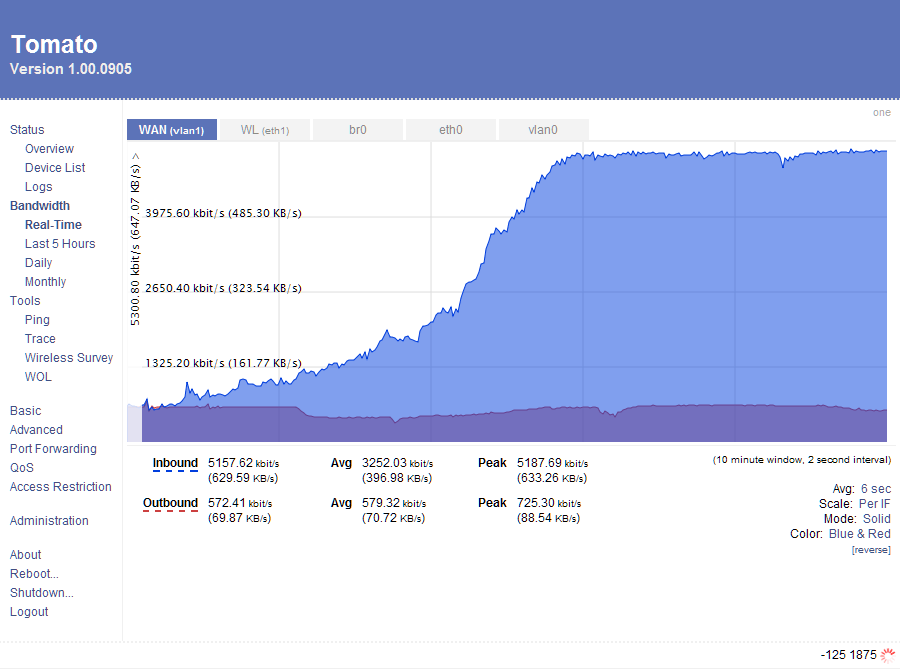
The other main Tomato feature is fancy bandwidth graphing. Overkill for me, but cool. And the firmware has lots of knobs to turn; I like being able to tweak the NAT connection tracking.

Tomato isn’t going to solve my problem of flaky router hardware, but at least the software may work sensibly. The QoS feature should be a significant improvement. Hopefully some day a consumer router manufacturer will get smart and build QoS in to their products.

Layered Technologies security breach

I like my hosting service provider, Layered Technologies. $100/month or less for a dedicated Linux box with minimal support. Great for my hacking projects.

Unfortunately they just notified me by email that they had a security break in their support system that may have exposed login information for thousands of their customers. The notification was responsibly delivered. The breach could be disastrous.

Layered Tech had a support policy of asking for your root password everytime you filed a support ticket. This is why you don’t do that.

Space Giraffe

Jeff Minter’s new Xbox Live Arcade game Space Giraffe is brilliant. It’s nominally a Tempest-like shooter with some gameplay subtleties. But what it really is is completely fucked up. If you have an Xbox 360 check out the demo. If you don’t, this video gives an idea.
The gameplay is good, but it’s the æsthetic design that makes the game brilliant. The graphics are over the top technopsychedelia coming from Minter’s acid head music screensaver engine. When the graphics inevitably blur into a purple haze the sound design takes over as you interpret the sounds of ringing telephones, bleating sheep, and shattering plates as cues of what’s going on behind the full screen glow effects. It seems awful but it’s really fun, bringing me back to the sensory overload experience of a 1980s arcade. I mostly agree with this reviewer’s comparison to Ulysses. A bit impenetrable, but deeply rewarding.

I love Xbox Live Arcade; they’re cultivating a catalog of inexpensive games with creative visuals and fun casual game play. A game like Space Giraffe has no hope as a traditional release, but as a $5 Xbox download? No problem. Lumines is also brilliant on XBLA and GEON: Emotions looks promising.

The curse of routers

My Netgear FWG114P router has failed three times in the last two days, requiring a reboot. Last time was locked up dead, couldn’t even ping the router over the LAN. It’s working now, but in my experience once these things start failing they have a week before they die entirely.

My friends now make fun of me for how often I complain about routers on my blog. But WTF? Why do all my routers die in a few months? I’m not doing anything that strange with them. My only thought is that the 80° server closet they’re in is causing heat problems. But that’s nowhere near out of the 104° spec.

I’d thought paying extra for Netgear blue box hardware would help, but I guess not. My next option is to either go with a Draytek 2800G at $200, hoping for reliability, or else go back to a junky Linksys router with the hopes that Tomato firmware will make it work reliably.

Online backup that simply works

Mozy is good software. It’s a simple online backup solution for Windows or Mac. Files are quietly backed up to their remote server with no hassles. There are a zillion companies doing remote backup now, I haven’t tested them all because Mozy works just fine for me. (I’d consider rsync.net for a hacker solution).

Mozy solves most of the hard problems of online backup. Basic install and configuration is simple. The backup client manages bandwidth well, including a configurable throttle. Restores are easy, including multiple snapshots in time. And the backup client just runs automatically, efficiently uploading only changed files. I don’t even notice it’s there.

I have some minor complaints. Mozy’s backup sets for basic things like email or spreadsheets are fine for casual users, but advanced users have to hunt for the “advanced backup set features” in the options to choose specific directories on their own. The first time you open the configuration options takes 5+ minutes as it scans your hard drive. And the Virtual Drive restore seems to be ridiculously slow; fortunately the web restore worked much faster.

Quibbles aside, Mozy is a great solution for backup. MozyFree lets you back up 2 gigs for free. MozyHome gives you unlimited backup for $5/month for personal use and MozyPro gives you commercial use for $4/machine and $0.50/gigabyte.

Mad Men

AMC’s new TV series Mad Men is completely fantastic. It’s a period ensemble drama about a Madison Avenue advertising agency in 1960. It first sounded a bit dumb, but it’s beautiful and brilliantly written and terrific television.

The period setting is amazingly well executed. 1960 is just far enough back to be somewhat mythical while still familiar. And because that era has generally been neglected it’s fertile ground for a new drama. Incredible costumes, hair styles and furnishings make the show beautiful. And the writers’ delicious indulgence in forbidden things like sex and drinking at the office, smoking, and awkward racist jokes is both uncomfortable and slightly wistful.

And the writing is intelligent, not the stupid pandering that passes for most TV. For example, the centerpiece of the third episode is a suburban kid’s birthday party. The desparation and discomfort of the parents is just devastating, but it’s not thrown in your face so much as exposed through a series of vignettes. Great storytelling.

Zillions of files

I must remember when doing small hack projects not to write code that downloads some web page every minute and writes it to a file on disk. Fortunately Linux no longer chokes on giant directories, but a directory with 500,000 files in it is not very useful. Even worse, I’m making two backups of these useless files, one offsite.

Changing a Subversion repository root / URL

What do you do if your Subversion server URL or repository location changes and you want to update a checked out copy on your client? The solution is the magic command svn switch --relocate.
  1. Change to the top directory of your checked out client.
  2. Run svn info and verify the Repository Root is now the wrong place. The URL will be wrong too.
  3. Run svn switch --relocate oldRoot newRoot. oldRoot will be whatever svn info told you it was; newRoot is, well, the new root.
  4. Run svn info to verify the Repository Root is correct.
svn switch also has something to do with branches. But in this case we’re not managing a branch, just switching the Subversion repository address. Useful for server migrations, hostname renames, and protocol switches.

iTunes updates suck

iTunes updated itself again today. And once again the update experience is awful. It took 5 minutes, the promised 4 meg filesize somehow ended up being 50 megs. When the update is done I’m informed I have to reboot. It put a launch icon on my taskbar again. And it’s no doubt made itself the default app for all my music and video files, again, despite being told not to. Oh yeah, and more Quicktime crap installed again. Hello, browser crashes.

The best part? The only purpose for the update was to make it impossible for me to install ringtones without paying Apple a dollar.

Fuck you, Apple. Is there a good Windows alternative to iTunes that supports iPhones? All I need is to backup the phone and copy music and video to it. iTunes sucks.

No takebacks

The Larry Craig story just gets weirder. He may not resign afterall and there’s a leaked voicemail between Craig and his lawyer discussing the matter. The poor man is exploding in front of us. Here’s a letter to him, I hope he gets it.

Dear Larry,

There are no takebacks in public politics. You can’t plead guilty to a misdemeanor and then say “oops, my bad”. You can’t publicly announce your resignation and then say “hmmm, I’ve changed my mind”. You are screwed.

Do us a favour. Spend six months in Palm Springs getting your act together. Or Provincetown, if you prefer the sea. Read some books, get a tan, take that cute boy who smiled at you all evening at the bar home to your rented cottage and have a one night stand. Meet a tall handsome rancher on vacation from Montana and fall in love. Relax, come out. Being gay is good!

Then come back to politics and take down the Republican bastards who abandoned you in your darkest hour. Look Mitch McConnell in the eye and tell him what’s “unforgivable” is the years of anti-gay hate mongering of your former Republican party.

Idaho probably won’t take you back, but I bet California would welcome you. Heck, our governor used to pose nude for gay magazines. There’s no takebacks, but there are second chances for closeted gay men.

Some news about Nelson

My blog has become a place for carefully written essays. I like what I’m writing but it’s not very personal. So here’s some casual news about Nelson.

I’ve been working part time for the past few months as an engineering advisor to Twitter. It’s been great being in a startup environment. Twitter has a neat product with some interesting technology challenges. And a great engineering team who have come up with some very clever solutions. It’s been fun helping them out, I’m planning to do some advising and consulting for other interesting startups as well.

Despite appearances I have not moved to France. We don’t even have a plan for our next visit yet. If circumstances permit I hope to spend a month or two there every year, but I’m not moving permanently.

I bought a house! After living six years in a pleasant but dull suburban part of San Francisco between West Portal and Glen Park, Ken and I were ready to be more central. So we’re moving to Noe Valley, a few minutes walk from the commercial center on 24th and a convenient Muni ride to downtown SF. We’re spending a few months redoing the kitchen and bathroom before moving. If you know any good contractors, handymen, arborists, etc in San Francisco, please mail me!

If you’re a friend of mine and want to keep up on daily personal news, you may want to follow me on Twitter. I’m not too diligent or erudite, but Twitter is an awfully handy way to tell folks what I’m doing right now.

BoingBoing still has lots of ads

My favourite geeky blog, BoingBoing, just launched a redesign. It’s good, a clean two column layout with lots of whitespace. And not so many goofy graphical badges.

But it still has way too many ads on it. Three graphical ad units (two animated) and two text ad units. The FMpub text ads unit blends in so well with the Google text ads unit that at first I thought they were all “Ads by Google”.

I think it’s great that the BoingBoing folks can make a living selling advertising on their blog. It’s just there’s so many of them. It’s tacky and a bad experience for their users. But as always AdBlock Plus keeps my pages clean, although it’s not blocking the FMpub text ads yet.

Sympathy for a hypocrite

Yet another Republican senator has a gay sex scandal; Larry Craig of Idaho has pled guilty to disorderly conduct for soliciting sex in a Minneapolis airport bathroom. It’s your usual gay scandal; months of rumours, denials in the press, heck, he even figures in the 1982 congressional page scandal. And now, busted for cruising a tearoom. He’s a defence-of-marriage anti-gay-rights Republican bastard, so there’s some pleasure in his fall.

But I’ve known men like Larry Craig and so I have some sympathy for him.

I don’t go around anywhere hitting on men, and by God, if I did, I wouldn’t do it in Boise, Idaho! Jiminy!” — Larry Craig
Gay men of his generation didn’t have an easy time figuring themselves out. Fourty-five years ago homosexuality was classified a sickness and being gay was not a respectable option. A lot of homosexual men followed the easy path, got married, had kids, and pretended to be straight. And pushed their homosexuality way down inside themselves, bottled it up.

The insidious and awful thing about the closeted life is that self-deception makes it easier. I fully believe Larry Craig when he says he’s not gay, because in his mind and in his public life he’s not gay. It’s just he’d be so much happier if he actually were gay, instead of a furtive homosexual. Here he is living a public straight life, then skulking into bathrooms to satisfy a compulsive desire that shames and frightens him. Taking terrible risks, mostly getting away with it. Until today, when he’s caught, and his career and life are destroyed in public.

So I find men like Larry Craig sympathetic, a little bit tragic. Such a painful life for him the past forty-five years. It’s a common story. It’s not easy to be gay today; it was a lot harder growing up in the 1950s in Idaho. I don’t judge a man for succumbing to societal pressure.

But I do judge a politician for succumbing to the offensive anti-gay positions of the Republican Party, no matter what his sexual orientation is. And for that, I’m glad to see Craig on the road to losing his position as a senator. I hope he’ll come out as gay, get back into politics, and make something of himself as a real man. I’ve seen that transformation. The gay men who discover themselves in their 50s and 60s come through to living a much happier life.

Windows activitation armageddon?

There are rumours that Microsoft’s Windows Genuine Advantage servers have failed. XP and Vista users are reporting their operating systems are being incorrectly marked as pirated and then rebooting in a crippled state. This problem may continue for days.

I can think of problems with activiation servers going back at least fifteen years to the bad old days of Unix site licenses. Somehow the site license server was always the brittle component. But for Microsoft to accidentally break millions of customer’s computers, well, that’s astounding. Hopefully the problem isn’t as bad as it sounds.

See also: Google Video breaking the right for its users to watch the videos they bought. DRM is consumer hostile.

iPhone voicemail download

I like how my iPhone downloads voicemail for local playback. Instead of talking to some horrible AT&T phone robot to get my messages the audio files are right on the phone to play with a nice UI. There’s a slider for going forward or back, you can store messages, and you can undelete them. All very easy to use.

There are drawbacks. It takes about 60 seconds for the message to download, so if I just miss a call I have to wait a bit to listen to the message. Not a big deal. And I think I’ve lost the ability to play back my messages from a normal land line; I can’t figure out how to get to the AT&T voicemail robot for my account.

I wonder what it took to get this feature built? I’ve never heard of a cell phone doing this before; did AT&T build a custom voicemail system just for the iPhone launch?

Update: Thanks to my loyal readers I now know this feature is called visual voicemail. And yes, AT&T built it custom for the iPhone. The voicemail robot access is still available; call your phone and press * while listening to your greeting. It even syncs your message deletion, etc with the phone’s versions. Nicely done.

Wikipedia and notability

Should Wikipedia play a role in making things notable?

Overworld Zero is a minigame inside the classic PC game System Shock 2. It’s basically an elaborate easter egg, a clever one with some remix and game within a game relevance. It’s obscure, but interesting. The best online reference for Overworld Zero has been its Wikipedia article. That article is about to be deleted on the grounds that the minigame is not notable.

I’m not a member of the Wikipedia editing community, so I’ve never quite understood the editorial policy for when something is too irrelevant to merit a Wikipedia article. There’s an infinite amount of paper on the Web so why not accept everything? Editorial quality, that’s why. And Wikipedia has a thoughtful definition of notability.

A topic is presumed to be notable if it has received significant coverage in reliable sources that are independent of the subject.

Overworld Zero isn’t notable by this definition. But it should be. And because the reliable sources of the gaming world have overlooked it, I was happy that the Wikipedia article existed to establish the game’s notability. But Wikipedia explicitly doesn’t want to play the role of definining notability, so the article is about to be deleted. And that makes me sad.

Thomas Edison, heavy metal lyricist

A yellow oasis in hell
premeditated stupidity, a phrenological idol.
The sombre dream of the grey-eyed Corsican
A Brain so small that an animacuale went to view it with a compound Microscope. Wrestling of shadows, a square chunk of carrion with two green eyes held by gossamer which floats at midnight in bleak old rural graveyards.
Three million miles beyond the limits of the universe where the angels dare
There flies forever from nihil to nihil the foulest demon of the Cosmos
From Thomas Edison’s prose poems.

Bioshock demo

The Xbox 360 demo came out for Bioshock last night, and oh my goodness is it good. I just slowly played through and savoured every bit. The demo is fantastic. I’m rushing out to preorder the limited edition right now.

The design of the game is beautiful. The setting is Rapture, an 1940s underwater city built by the eugenicist Ryan as his utopia. It’s a sort of Xanadu under the sea, an Ayn Rand fantasy gone terribly wrong. An inspired and novel setting with lots of fun period music and graphic design. And the game design leads you through the scenery in a beautifuly cinematic way. There’s lots of visual tricks to draw your eye up to see magnificent details. Great use of spotlighting, too.

The game is very much a System Shock / Deus Ex successor. Most of the same gameplay elements; personal upgrades, turrets and robots, a hacking minigame, booze and cigarettes and a big wrench for bashing zombies (er, splicers). All that’s missing is Overworld Zero, and with any luck it’s buried in there somewhere. I enjoy gameplay innovation, but there’s something to be said for improving on proven gameplay designs.

The other thing that made System Shock and Deus Ex fantastic was the interesting narration that progressed via gameplay. Bioshock looks to be doing a great job of that as well. The demo only shows a little, but it seems like Ryan is being set up to be a new SHODAN for us to battle once we make our way through the splicers and little sisters roaming the halls. I can’t wait to find out.

Print to PDF

PDFCreator is good software. It’s a simple Windows printer driver that prints to a PDF file instead of paper. There are other ways to print to PDF; I like this one because it is free and very easy to use. The underlying Ghostscript engine even produces decent quality PDF.

I create PDFs all the time when I want to give a document to someone. Everyone knows how to open a PDF attachment in email and it always renders the same no matter what software the recipient has. And emailing a PDF is much easier than printing and faxing something. Printing to PDF is also a big help when you don’t have a physical printer. Last month in Oregon I checked in to a flight online, created a PDF of the boarding pass from the web page, then faxed it to myself at my hotel with a free email-to-fax gateway. Byzantine, but effective.

iPhone road trip

I drove down to LA for the weekend with my fancy new iPhone. It makes a pretty good companion on a road trip.

The most amazing change was having a little Internet terminal in my pocket with me. Every driving break I took was a chance to check my email, update my Twitter account, read some RSS feeds, check where I was going on Google Maps. This is a mixed blessing; I love staying connected to the net but the iPhone also isolates you from your local reality. Part of the fun of a road trip is being where you are right there, no matter how odd or dull or uncomfortable or totally cool. I was staring at the Internet so much I was ignoring my surroundings.

It is possible to read email and web pages on the iPhone while driving on a quiet road, but it is not a good idea. Under no circumstances could you reasonably type on the thing while driving.

Connectivity is still a problem. First you have to hook the music output to the car stereo. Thanks to consumer-hostile car manufacturers my only option is an FM transmitter. There aren’t any certified iPhone FM transmitters yet; unshielded wiring picks up the GSM tower chatter. But if you’re willing to live with a little occasional noise most of the iPod adapters work. The Apple store guy recommended the $80 Monster Cable transmitter. It worked fine, but the construction quality is awful. I’m going to return it and wait for an iPhone approved cradle.

Battery life is a problem. I think the iPhone can survive a full day of occasionally playing music and trying to keep up with far away cell towers, but I was glad to have a way to charge the thing while in the car.

The iPhone Bluetooth is mostly compatible with my Audi A6 builtin handsfree microphone/speaker. Incoming calls correctly paused the playing music and my car picked up the call. There’s an annoying noise for two seconds before the call starts. And the Audi has a problem where it only downloads contact info from the SIM card, not the phone memory. Since the iPhone doesn’t really store contacts on the SIM I’m left without my phone book in the car UI. Only a minor nuisance.

The iPhone metal case is too slippery and easy to drop. I bought an thick ugly rubber cover so my sweaty hands won’t fumble the phone while pulling it out of my pocket. I’m hoping to find a form fitting skin that’s only 1mm thick and not ugly.

Overall I really enjoyed having the iPhone with me. It really is a good enough Internet terminal that it replaces a laptop for most functions. I’m still a bit uneasy about being connected all the time; travel should be a time to go offline. I think once the novelty wears off I’ll be good about keeping the thing in my pocket unless called for.

Stock spam mutations

We’ve gotten stock pumping spam for years. “Buy this penny stock, it’s going to go up!”. First it came as text files, then text files with random content at the bottom to avoid Bayesian filters, then images to avoid text detection, then noisy images to evade OCR.

Recently we started getting PDF stock spam. That lasted a week or two, now the new thing is ZIP stock spam. I finally opened one of the 15 ZIPs I get a day to find a 180k text file inside. 2k of stock spam text, 178k of anti-filter random text.

I first assumed all this PDF and ZIP traffic was some sort of worm traffic, an exploit payload. I’d think most users would be trained not to open strange attachments, it’s suprising to me that this could be effective stock pumping spam. Maybe it’s just a test.

The SEC needs to shut these operations down.

Three way calling

Ever since I was a kid I was fascinated by the idea of three way calling, talking to two different phone lines at once. I fondly remember in 1985 being hacked into some phreak conference call that also had chains of three way calls hanging off it, I felt so cool.

Thanks to the magic of iPhone three-way calling is easy enough that I can actually use it. Most cell phones have been able to do three-way for years but I’ve never figured out how to do it with a traditional awkward phone UI. I’m always afraid I’ll hang up on someone rather than flash the hook or I can’t figure out how to rejoin the calls or whatever. It’s just too hard.

Three-way calling couldn’t be easier on the iPhone. During a call the screen has a bunch of buttons on it. Tap the “add call” button to put party #1 on hold and call party #2. Now there’s a button “merge calls”. Tap it and now everyone’s talking. The screen even shows you the contact names of both parties.

Amazing how easy things can be when you have visual feedback and more input mechanisms than almost hanging up on people.

Memories of high school’s favourite music

Overhead the albatross hangs motionless upon the air
And deep beneath the rolling waves
In labyrinths of coral caves
The echo of a distant tide
Comes willowing across the sand
And everything is green and submarine

And no one showed us to the land
And no one knows the wheres or whys
And something stirs and something tries
And starts to climb towards the light

Bloglines stagnation?

It looks like Bloglines is well and truly losing active users. My blog has about 500 subscribers in Google Reader and about 460 in Bloglines. So Bloglines is already behind the upstart. But how many of those 460 Bloglines subscribers are even reading anymore?

Four months ago I encouraged everyone to switch from RSS to my atom feed. About 45% of all my subscribers have switched. 40% of Google Reader subscribers have switched. But only 5% of Bloglines subscribers have.

My guess is there’s a lot of stagnant Bloglines accounts that don’t actually read those feeds anymore and would never do anything as active as switch subscriptions. That’s too bad; Bloglines was really innovative at one time. Google Reader is awesome, I just wish it had some serious competition.

iPhone’s silent switch

While the sleek touchscreen defines the iPhone’s design, one of the things I like about it are the simple mechanical buttons on the side. There’s a dedicated volume rocker which instantly makes the iPhone a better music player than any iPod. But even better is the silent mode switch, an old fashioned mechanical two position switch. Slide it away, feel a satisfying click, and your phone is now in silent mode. There’s even an orange dot visible for visual confirmation.

You can measure the disaster of cell phone UI by how many button presses it takes to silence the damn ringer. My first Nokia phone took 2, the Ericsson took 3, and on the RAZR it’s like 17 button presses. You don’t need silent mode often, but when you do you need it quickly and without a bunch of screen reading distraction. The physical switch for that is lovely.

MSN’s search scam

Microsoft recently has bragged about how their search traffic and market share is going up, claiming as much as a 3% share gain in a month. Impressive gains for a dog of a product? No, just a complete marketing scam. A bunch of new search traffic is garbage.

Many of the new searches are coming from casual games at Microsoft Live Search Club like Chicktionary. Go ahead, try a game, it won’t hurt. It’s basically Scrabble; you make words out of 7 letters. The trick is every time you make a word or ask for a hint it does an MSN Search. Kaching, instant search traffic!

But it gets worse. Microsoft is paying people to play this game; you get 20 tickets per 5 minute game and tickets can be redeemed at a value of about $1 / 100 tickets. So they’re paying for search. And people are writing bots to play the game, inflating the search traffic even more. Possibly much more.

At least they aren’t showing ads on these garbage game search results. So they aren’t scamming their advertisers directly. Only indirectly, by artificially inflating their traffic numbers.

When I was at Google I was nervous when Microsoft started making a serious go at the search and ads business. Microsoft has a lot of smart engineers and resources and a powerful monopoly that they have a history of illegally exploiting. As it turns out MSN search hasn’t been much competition to Google, although the story isn’t over yet. Those Facebook and Digg deals do matter. But it’s just shameful that the best MS can do for market share is to pay robots to play cartoon chicken games.

iPhone + Belkin Wireless G = sad

The iPhone has a pretty nifty WiFi implementation. It worked great in my house with my cheap Belkin router for about 15 minutes, then never worked again. The iPhone thought it had a connection but nothing would load. Then I switched routers at home to the Netgear FWG114P and now the iPhone Wifi is fine.

Was the problem Apple’s or Belkin’s? Was it the ARP implementation, or the DHCP lease maintenance, or the WEP-128 implementation, or the 802.11g switching magic? How could I possibly know? Wifi is more voodoo than science and the complexity of Internet protocols is so high I’d never be able to figure out the specific problem. And if I did, I couldn’t fix it anyway; all the firmware is closed. So I just keep going through routers until I find one that works.

My Star Trek PADD

Remember in Star Trek where the unnamed ensign would walk up to Captain Picard or Sisko and hand him a datapad to quickly look at the day’s orders for a quick approval? Not Kirk; his unnamed ensigns were foxier but all he got was a busted old aluminum clipboard. I mean the PADD, the Personal Access Display Device, the super futuristic thinscreen tablet computer thingy that served the role of notepad in recent Star Treks.

My iPhone is exactly like that.

My early morning coffee + newspaper + cat ritual now has a new addition, my PADD. Quick email check early in the morning with my super futuristic iPhonePADD. There’s something very appealing about the smooth face of the device and the great screen that makes it welcome even in a bleary eyed morning.

Props to goldman for his lightning nerd memory of the name PADD

Mail order steaks

After being vegetarian for nine years I think I particularly appreciate a good steak. And the best we’ve had at home are mail order filet mignon from Kansas City Steak Company. Beautiful texture, good beefy flavour, consist cuts. $25/pound isn’t cheap but isn’t terrible and as advertised the “triple-trimmed” means you really don’t need to cut anything at all away before cooking.

There’s lots of mail order steak options. We’ve tried many and these are by far the best. Significantly better than what we can get in our local high end grocery store, too.

iTunes hell

iTunes is bad software. I’ve avoided it for years but I’m finally stuck with it because of the iPhone. So now, I rant impotently.

This morning I’m informed iTunes wants to update. Maybe a patch for all the iPhone bugs? I don’t know, it won’t tell me what the update is for. But it insists on updating Quicktime too and spamming my desktop with Apple product icons and demanding a reboot.

Last night my sister asked me how to copy some new iTunes tracks she bought to her old iPod. Problem is she hasn’t plugged the iPod into a computer in two years and doesn’t have all the iPod tracks on her new computer. Any attempt to copy the new tracks over seems to involve a sync and removing all the old tracks that are not on her PC anymore. Neither of us could figure out a way to fix it in the few minutes we had; last I heard she was burning CDs and leaving the iPod at home.

The iTunes initial import of my music took forever. And was broken; it followed symlinks and m3u playlists and ended up with several copies of each of my songs. And while iTunes could identify and display the duplicates I can’t find a button for “remove duplicate entries”.

The whole process of managing what songs and movies are stored on my iPhone is terribly clumsy. What’s wrong with just opening the stupid thing as a hard drive and copying files over?

Game sound design genius

I’m a total fanboy for Tetsua Mizuguchi (水口哲也), the designer behind the brilliant games Rez, Lumines, and Meteos. All these games have simple fun gameplay combined with hypnogogic music and visual design. I’ve never played games with such powerful æsthetic appeal.

Currently I’m obsessed with Lumines on Xbox 360. I’m not usually a big puzzle game fan but the music and visual design is so beautiful I can’t stop playing. All the bonus packs get a bit expensive on XBLA, but art this good in a game is worth it.

I’m excited about the next game his company Q Entertainment is doing; Every Extend Extra Extreme. It’s an Xbox 360 adaption of a great freeware game concept.

SPF does not stop spam

The spam on my Debian mail system is getting intolerable; 30+ stock pumping spams are getting through the gauntlet every day now. And pretty much all of that spam passed spamassassin’s SPF_PASS check. So SPF seems to be adding pain but not providing much benefit for spam prevention.

The Sender Policy Framework is one of a variety of recent SMTP complications that tries to address fundamental problems in Internet email. It lets a site use DNS records to indicate what hosts are authorized to send email in their domain, making it a bit harder to forge email headers. And it seems to function; about 98% of my email seems to be doing SPF. Sadly, that includes 98% of my spam.

In other words, SPF may let you know what domain really sent the mail but that doesn’t help classify spam. It does me no good to know that agedwards.com or ncat.edu or even hotmail.com actually authorized the sender’s IP address. Spamassassin weights a valid SPF record as basically zero in its spam scoring, so they must have the same conclusion.

Google’s cookie policy no-op

Things have changed a bit at the big G; they now have serious privacy policy employees and are making public statements about user privacy. That’s great. Yesterday they announced a new cookie policy, moving away from cookies that expire in 2038 (the maximum length):
In the coming months, Google will start issuing our users cookies that will be set to auto-expire after 2 years, while auto-renewing the cookies of active users during this time period.
The old policy was always cited as shorthand for Google-is-evil diatribes: “they put cookies on your machine until 2038!”. I recently heard some call-in radio guest asking whether Google should pay him to store this file for them. What’s the emoticon for eye rolling?

However, the cookie change will have zero effect on actual user privacy. Every time you go back to Google the cookie expiration will reset to two years. In other words, the cookie will never expire; what are the odds of you not visiting Google on your computer for two years? Maybe after the global war, when we emerge from the Vaults after the fallout is gone we’ll enjoy the nuclear winter in privacy.

So in practice the new policy changes nothing. Is it evil? No. Every major web site in the world does the same thing, refreshing cookies every time you visit. And the cookie gives the user actual benefit, preferences. But now Google won’t have to put up with the “2038 is evil!” inanity. Hopefully the privacy discussion will shift to something more meaningful, like why Google doesn’t have a complete opt-out for cookies. Or logging.

iPhone “applications”

I’ve noticed a curious word usage on the Internet; the discussion of iPhone “applications”. As in, “iChess is a great iPhone application” or the iPhone “can do mass storage and IM with help from other apps right now.”

News flash: you cannot add applications to your iPhone. Apple has made the hostile decision to keep the platform closed. You can load web pages with Javascript, however. And sometimes a web page feels like an application.

It’s still awfully early, but there are already a lot of iPhone webapps out there. What’s emerging is an iPhone webapp has a page that looks good at 320x480, automatically navigates to an internal anchor to scroll the viewport past the address bar, uses iPhone style graphics and fonts. And most importantly, loads a lot of content in a single page so you don’t have to keep going to the slow network. The Digg iPhone page is a good example of these principles.

I’m delighted there are good webapps on the iPhone. But they are not real iPhone applications. They can’t access the cell phone, or SMS, or your music, or the camera, or your contact list, or your notes, or your calendar, or your photographs. They’re just web pages. Users should demand better from Apple for their $600 phones.

The Silverado, Portland, OR

The Silverado is the kind of skeezy 70s throwback fag bar that’s disappearing, the kind you don’t appreciate until it’s gone. Rainbow flags on the walls, dark smoky room, gay porn on TV screens everyone’s ignoring, shirtless bartender boys. Because it’s Portland there’s decent beer, but men visit for the go-go boys, not the drinking.

The dancers work hard. Shift change every fifteen minutes, one or two up on a center stage and one in a dark cage in the back. Nominally dressed in underwear (tight, clean, and today primary colours, not white), most of the dancing is about pulling down the shorts to show a V of groin muscle and below an excalamation mark, the root. They work for tips, $1 slid into the underwear buys you a quick feel. A couple of bucks rewards the whole crowd with an eyeful of full nudity, swinging twirling floppy motions.

Sadly, the Silverado has lost its lease. The old Stark gay ghetto in Portland is disappearing to heteroyuppification, led by the removal of the downtown Henry Weinhard’s brewery and the subsequent development of the Pearl District. The gay bars down there were all pretty sleazy but they were a culture. Now they are dying.

I paid my respects at the Silverado and lasted through a whole Hefeweizen until the cigarette smoke got to me. As I was leaving a remarkable young man was doing an excellent job dancing, clearly enjoying sharing his significant natural assets with the appreciative crowd. $1 seems like a cheap tip but his enthusiasm was earning him a lot of them. I added to his basketful, thanked him, and then came home and washed my hands.

Nose and ear hair trimmer

I’m 35. My friends and I are all sliding out of youth and into middle age. Settled down with a home, or a partner, or kids, or pets. Putting on a little weight. Worrying about insurance. And growing coarse, dark hair out of noses and ears. It’s unpleasant and slightly taboo, but it’s happening.

There’s a simple solution: the Panasonic Nose and Ear Hair Groomer. $15 and five minutes every few weeks gets it all under control. It works great; doesn’t pinch or pull, is OK to get wet, easy to take apart and clean. Works well.

Embarassing personal details shared on blog? Check. Next up: more pictures of my cat.

Second Life numbers

Linden Labs has quieted down a bit since the Second Life hype and subsequent backlash of a few months ago. But the current issue of Technology Review contains some boggling statistics in their article Second Earth:
According to [CTO] Ondrejka, Linden Lab must purchase and install more than 120 servers every week to keep up with all the new members pouring into Second Life.
...
Second Life, meanwhile, is gaining roughly 25,000 members a day, sometimes stretching Linden Lab’s ability to keep its simulations running smoothly.
Let’s reality check that. 120 servers a week is 6000 servers a year, or roughly $25 million a year in hardware expenses alone, not to mention power. I sure hope they’re not actually spending that. And 25,000 members a day is 9 million users a year, or just about doubling their 30 day active population in 40 days. Frankly, I don’t believe those numbers. Maybe it was a really great week when the reporter called.

Snarks aside, kudos to Linden for becoming so transparent in publishing data. There’s some interesting third party analysis. If I read this right, they sold L$ 136M into the game economy last month. At a current exchange rate of about 1:270, does that mean they made $500,000 in real US dollars? Still nowhere near enough to buy 120 servers a week, but at least it’s real money. I may well be wrong about their economy though.

iPhone first experience

I wasn’t going to get an iPhone; I’m not a phone or Apple fetishist and it seemed awfully expensive. But thanks to some friends I ended up with one, and so far: wow.

The out of the box experience is fantastic. Great packaging, the battery was already charged, Apple even managed to get AT&T/Cingular to do a good job on the signup workflow. I was up and running in a few minutes.

And the phone UI is really impressive. I haven’t felt the need for a manual yet (good thing, there isn’t one in the box). Phone calls, email, web browsing, all easy to set up. The Internet options are good enough I think I can leave a laptop at home on short trips.

Some things are awkward; I wish it had more native apps, I don’t like the Home button, ... But overall it’s a very impressive product experience.

Router options

I’m not the only one with home router woes; I’ve gotten lots of sympathy and some requests for advice. My new Belkin router is mostly working now, but at $40 I don’t have a lot of faith it will last. That, and its implementation of UPnP isn’t compatible with uTorrent’s. Yay.

I’ve gone ahead and also bought a Netgear FWG114P. It’s one of the blue metal box Netgear devices for business use; I’ve had great luck with this line of hardware before. At $120 the big feature you get is VPN support, but I’m hoping it’s got better electronics too.

Another option is to buy a $65 Linksys WRT54GL; the L makes all the difference. That means it runs the old Linux based firmware that you can flash upgrade with 3rd party open source. So the software won’t have stupid bugs but the hardware is still a gamble. I had a first generation WRT54G crap out on me after about a year.

One last option recommended by a reader is a Draytek router like the 2900G. They’re a European brand with a reputation for high quality and extra features. I like the 2910G; two outgoing WAN ports with load balancing and failover. They’re a bit spendy at around $200.

July 4, 1987

Today is the 20th anniversary of my first kiss. I was on the roof with my girlfriend watching the Fourth of July displays and she kissed me and it was fireworks. True story.

It took me another year or so to figure out I’d rather be kissing boys than girls. When I came out to my former girlfriend she just said “oh yeah, I knew you were gay”. I wish she’d thought to tell me!

Both of my high school girlfriends are on Facebook.

The brilliance of Facebook’s news feed

I recently set up a Facebook profile. I’m pleasantly surprised by how good it is. They got a lot of little things right, as well as a few big things. Like news feeds.

At signup I did the usual tacky thing of listing twenty or so friends. The next day I logged in and found a bunch of friends requests from people I didn’t even know were on Facebook. How did they find me? Via their news feed. They logged in and saw “Your friend Alice Toklas added Nelson Minar as a friend”. And so they knew I was on Facebook and they added me, too.

The news feed is the single biggest innovation I’ve seen in Facebook. It instantly enhances the social network by letting me see things my friends do with their friends. It exposes me to new people and applications. And it gives me something new to do on Facebook every day. Clever.

Interestingly, the news feeds are also the thing that caused a giant privacy kerfuffle when first introduced. Users found it creepy that suddenly their friends were seeing what they’re doing. So Facebook added a bunch of privacy options to hide your updates. Of course it all defaults to full openness, which in this case I think is the right thing. It may have been a mistake to foist news feeds on old users without some warning first, but as a new user I love them.

Can OpenID hurry up already?

Trying to register for web access to my health insurance account, I’m greeted with the following restriction:
Please select a User ID that is between 6 and 20 characters long using numbers and letters. It must contain at least one number and one character. You cannot consecutively repeat a character or number more than twice. Eg. AAA12345 is not allowed.
Yes, on this site my username has to have a number in it. As I remarked a long time ago my real problem with web logins isn’t remembering my password, it’s my username. Every site has different restrictions, the names have to be unique, it’s a total pain.

I’m completely ready for Internet single signon. OpenID is looking great but adoption is very slow. I’m willing to trust a big company like Yahoo, Microsoft, Google, even my ISP to maintain my identity. Can we do it now please?

Google shilling for health industry

I think it’s great that Google has a bunch of blogs now; they’ve always been weak at informal communication. But sometimes a blog post can hit a sour note, like this health advertising blog post, which uses Sicko as an opening to sell more ads to healthcare companies.
Does negative press make you Sicko?

... Moore’s film portrays the industry as money and marketing driven, and fails to show healthcare’s interest in patient well-being and care. Sound familiar? Of course. The healthcare industry is no stranger to negative press. ...

Many of our clients face these issues; companies come to us hoping we can help them better manage their reputations through “Get the Facts” or issue management campaigns. Your brand or corporate site may already have these informational assets, but can users easily find them?

We can place text ads, video ads, and rich media ads in paid search results or in relevant websites within our ever-expanding content network. Whatever the problem, Google can act as a platform for educating the public and promoting your message.

I’ll be charitable and assume the person who posted this blog entry hasn’t actually seen the film. Because if she had, she’d realize that you want to stay very, very far away from this story.

In a funny way I think Google is to be applauded for mistakes like this. It suggests that there’s some openness in letting employees do things on their own. The company does not speak with one voice. And that’s good, even if some of the chorus is shilling for evil.

Slimtimer: timesheet tracking

Do you have the need to track your time across different projects? Maybe you’re billing for consulting hours or just trying to keep track of how much time you spend on email vs. coding vs. meetings. There are a zillion timer apps out there that all suck. I finally found one I like: Slimtimer.

Slimtimer is web based. That sounds terrible, but the little tracker app has just enough Javascript and AJAX love to work well. In particular, it’s smart to not break when you close the browser without stopping your current task. And since all the data lives on someone’s web server you can access it anywhere, get a lot of fancy reports, access it via an API, etc.

My only complaint is it’s a bit geeky. Everything is tracked down to the seconds. And getting a simple time sheet involves the words “Pivot” and “Rows” and “Columns”. But it’s still all very usable, and in general the application is very well executed. Recommended.

Woes of home DSL

In the early days of US home broadband you had a static IP address and a live real TCP/IP connection. Because of the demands of security and customer support that’s been whittled away. Now we have the hassle of dynamic IP addresses and abominations like PPPoE.

I just upgraded my home connection to sonic.net, a small California ISP where the person who answers the support line actually knows what they’re doing and respects you might, too. So far so good, except sadly I find they’re blocking all traffic on port 25. So much for running a mail server at home. I can’t exactly blame them, but it’s a nuisance.

I’m on my fourth home router in twelve months; the junky Buffalo router didn’t turn back on after I unplugged it today. No blinky lights = no internet. This time I’m trying a Belkin router. At $40 they’re essentially disposable, but I’d still gladly pay more for one that actually worked.

Victorian pornography

I’ve been enjoying two lovely erotic novels recently, books thoughtful enough to be engaging as well as prurient. This blog post is safe for work but the links are generally not.

My Secret Life is a autobiographical novel of a gentleman’s vigorous sexual life in Victorian London. The book is mostly an encyclopedic account of various encounters, growing increasingly byzantine as the book progresses. But between all the debauchery is a remarkably honest and sympathetic protagonist.

Then came reflection. Had I really frigged a man ... An act I had certainly heard of being done by men to each other, yet all but disbelieved, and looked on as a very foul action yet I had done it, had enjoyed it all. ... It ended in reflecting that I never had intended to do those things, that opportunity had let me unwittingly to do them, and resolving that I would never do it again, I fell asleep.
Sometimes he’s very libertine, sometimes quite conflicted. There’s a lot of interesting class-related observations. The relentless sexual combinations with only slight variation sometimes read like Penthouse Forum letters, but there’s enough thought behind it to keep my interest. The book is available free online, I’m reading an abridged edition.
The other book I’ve enjoyed recently is Lost Girls, Alan Moore’s porno graphic novel. Obviously not a Victorian book itself, but set in Victorian Austria. Nominally the story is about the erotic hijinks of Alice (of Wonderland), Dorothy (of Oz), and Wendy (of Nevernever Land). The writing doesn’t always work, but some of the reimagining of classic childrens’ stories are quite good.

But as a graphic novel it’s not really about the text, it’s the art. And the art is a lovely diaphonous dreamworld, mixing eroticism and innocence and vibrancy in a very powerful way. Some good page samples: 1, 2, 3. At $60 it’s not cheap but the print quality is beautiful.

BoingBoing has lots of ads

I made a snarky linkblog entry about a BoingBoing post that read more like an eBay ad. A friend of mine IMed me to suggest I look at BoingBoing without Adblock Plus, that it looked like NASCAR now. Boy howdy! There’s at least three graphical ad units (two animated) and three textual ad units on a single blog post. That’s not counting the fourteen or so badges on the left hand side promoting stuff the authors are personally involved with.

I love BoingBoing, I really do, and I read it every day and I love what they do and I still remember back when it was a zine on paper. And it’s great that Battelle is building a media empire out of advertising; sometimes journalism leads to riches! But really, six ad units on a single blog post? Is that a good idea? I particularly like how the FMPub text ads are colored almost like you’d already clicked on the link; I wonder if camouflage increases clickthrough?

I’ve made a screenshot of a BoingBoing page with the actual post content helpfully grayed out so it doesn’t distract you. Sorry the screenshot isn’t animated; the chump on the left is smiling and nodding at his phone like he’s in a Mentos commercial.

Why PC gaming is doomed

How is it that despite a 10 year head start on the Internet the online experience of PC games is so much worse than consoles? XBox Live is worlds better than the pastiche of special accounts, downloaders, and patch systems of PC games. Yesterday I decided on a whim to buy Battlefield 2142. And since I was lazy, I bought it online rather than at a store. If I’d known it would take six hours to install during which time my computer wasn’t fully usable, I wouldn’t have bothered.

I now have three or four different systems for installing and managing games on my PC: Steam, Stardock, etc. All of them suck. And every single game has a different login system, a different account, a different way to find friends online and play. Compare to Xbox Live, a seamless integrated experience. PC games are screwed.

Here’s all the idiotic steps the install took.

  1. 15 minutes to install EA Link, their toehold on my computer. It runs everytime I reboot now.
  2. 4 hours to download the 2 gigabyte game installer. There’s no bandwidth throttling so I can’t play other online games while downloading.
  3. 15 minutes to download the 30 megabyte manual pack which includes 16 PDF files in different languages. If I ever need an Arabic manual, well, I have it already.
  4. 15 minutes for install stage one where I watch a yellow progress bar creep up twice with no ETA displayed. What’s it doing? Making two copies of the 2 gigabyte installer.
  5. 15 minutes for install stage two, the hideous InstallShield. It thrashes the disk so hard my machine is non-responsive to other activity.
  6. 3 minutes watching intro movies I can’t skip. Those movies added 10% to the game download time.
  7. 5 minutes creating yet another login account with yet another password.
  8. 5 minutes “optimizing shaders” when I start to play.
  9. The cruel joke: another 45 minutes downloading the 200 megabyte patch for the game I just downloaded, necessary before I can play online.
It’s not just that it took six hours for the game to be ready. It’s that it took six hours of dominating my PC making it hard to do other things. And two of the six hours were a cruel taunting joke where it looked like I was going to be able to play any second now only to find yet another period of waiting or another download. Is this really the best that EA can do? They deserve to be destroyed by a Microsoft monopoly.

Old Beatles video of Rain

Thanks to Metafilter I’ve enjoyed watching an old Beatles video for the song Rain. That’s one of my favourite overlooked Beatles songs and the video is just lovely.
Hard to imagine that music like this could survive in today’s hipster ironic world. “Rain” is just straightforward and sweet and a little goofy. And the boys are cute and nice, not snarling tortured artists hating their world or gangsta thugs demeaning women.

I tend to be pretty snidely ironic myself. It’s an obnoxious reflex, a lazy substitute for actual wit. Why not speak plainly and pleasantly? I mostly fail to banish my own irony, but I have at least learned to appreciate honest things.

MMOGs and realtime gameplay

I’m failing to enjoy Lord of the Rings Online. It has amazing graphics, the best fantasy backstory material available, and a strong fan community. The instance-based epic quests make LotRO the first MMOG with a strong storyline and the deeds system is a clever innovation to give some purpose to grinding. But the gameplay experience is failing. The graphics engine is broken. The combat seems simplistic. And it’s terribly, terribly laggy. Monsters jump around as network packets arrive, crowded areas take forever to load, and the whole game is played under the miasma of a 200ms delay.

For example, as a Hunter what I do is run up to a monster and then shoot an arrow at it. So I take my finger off of W, the run key, and use that finger to press 1, the shoot key. Every single time, I’m told “you cannot do that while moving”. It seems the the client is waiting for the server to acknowledge I stopped moving before letting me shoot, forcing me to wait 200+ms for the round trip before my input is accepted. It’s not network congestion or ping time (those are fine), it’s just the software isn’t designed to feel like realtime.

All this makes me appreciate the brilliant gameplay experience of World of Warcraft. I pretty much never feel lag in WoW, the game plays like an action RPG. In combat it feels like my ability to execute move combinations swiftly makes a real difference. Thanks to an addon I know that there’s actually a 200-300ms delay between actions, but the client and server must be working together doing speculative execution to make it feel like realtime. It’s not easy to do that and make it work, but it’s very important to gameplay.

Order

Neither Ken nor I are naturally tidy. Newspapers accumulate in the living room until trash day, I leave three pairs of shoes under the coffee table, Ken left one unsuccessful Christmas present right where it was unwrapped until April. We’re not totally filthy slobs, but the clutter accumulates.

When we were in Paris we tried an experiment of complete order. Nothing stayed out where it didn’t belong. Books on bookshelves, magazines in a neat pile out of sight, electronics and eyeglasses stored away in drawers. It was easy to start since the apartment was entirely orderly when we arrived. And we found keeping a tidy home was actually pleasant.

So now we’re bringing order to our home in San Francisco. So far we’ve organized the living room and dining room; the bedroom comes next. I’m finding that having less clutter in my life makes me calm and happy. The next step for me is to throw away, give away, or sell a bunch of the crap I’ve accumulated and no longer want.

Calm.

fatal: epoll_create: Function not implemented

Running a Debian system that pulls its code from testing? If so, then you recently upgraded from etch to lenny. And if you’re still running a 2.4 kernel now some of your servers like MySQL and Postfix will be broken. Postfix threw an error about needing “epoll_create”. It seems lenny doesn’t work with 2.4 kernels anymore.

Not quite sure why aptitude didn’t warn me on upgrade, but the solution is not too hard. Upgrade to kernel 2.6. I did aptitude install linux-image-2.6-k7, said a prayer, and then rebooted the server 2000 miles away. My lucky day, the server came back. There’s probably a safer way.

I got some help from the good folks at #debian on the OpenProjects IRC servers. Hanging out there reminded me how lazy I’ve become as a Unix admin. I used to read kernel patch notes and get excited about libc changes and carefully read docs on every minor upgrade. But that stuff seems boring to me now and Debian generally works well enough that I can just blindly upgrade. Progress of a sort, despite today’s hiccough.

The death of the San Francisco newspaper

San Francisco hasn’t had a good newspaper in years. The Chronicle has been mediocre since at least 2000, but things got much worse following the Examiner/Chronicle merger. At first it seemd like the combined editorial staff would work better, but without competition the Chronicle has slid into increasing mediocrity. Not to mention the offense of the anti-trust merger scam involving Hearst, Willie Brown, and the Fang family.

The Chronicle is now so bad it’s difficult to even read it. And it’s only going to get worse; they’re about to lay off 25% of the editorial staff. Reportedly they’re losing $1 million / month. And despite having one of the better online news sites their web operations aren’t saving them, either. The Chron has been reduced to filling the bottom of the front page with a giant print banner ad; it’s humiliating.

Sunday’s Chron included an outside op/ed called The Death of News lamenting the financial problems of the newspaper industry. Unfortunately, the only conclusion he offers is some vague idea that the death of newspapers is all Google’s fault and Google should save them. But it’s not really Google. If anything, Craigslist is eating up the newspaper’s classified ads market way more than Google. And why aren’t good newspaper websites enjoying the same Google advertising revenue that newer online sites do?

A big part of the problem is that newspaper content isn’t exclusive. I read my wire articles on myway.com with Google ads (that I usually block). I never go to the Chronicle’s website. It’s sad that even the country’s best paper, the New York Times, seems to be losing money.

We need to fund investigative journalism somehow. It’s essential to US democracy.

Paris apartments in the middle of the city

If you’re going to stay in Paris for a week or more, consider renting an apartment. Particularly if you’re travelling in a group that would benefit from 2-3 bedrooms. Apartments are generally cheaper than hotels and integrate you more into the day to day life of the city. They’re also a bit awkward to check in and out of and don’t come with daily maid service or a concierge, but for a longer stay that’s not such a big deal to me.

If you want to stay in the middle of Paris, I can without hesitation recommend Guest Apartment Services. They exclusively manage about 20-30 apartments, mostly on the Ile St. Louis (a very desirable location). The apartment we rented in the Marais on Rue Charles V was fantastic, very well furnished and maintained. I’ve seen three of their other apartments and all were nice places. Prices for a 2 bedroom range from 330€/night to 690€/night and quality does vary. We got a discount for a month long stay in off-season; I think most of their business is shorter term.

There are lots of other options for apartments in Paris. Mostly you end up renting directly from the owner, which can mean random quality. I liked having a professional service managing the apartment instead of dealing directly with the owner.

They’re quite responsive by email. Mention my name if you contact them!

Unusual emoticons from games

We all know the basic smiley faces :-) and (^_^). I’ve picked up some other emoticons that seem more specific to gamer culture.

o/
Hello! A little man waving an arm. Used for greetings; one reply is \o.
\o/
Hooray! A little man cheering with both arms raised. An alternate to “w00t!”.
qq or QQ
Crying. Two eyes with tears streaming down. Usually used ironically, particularly in the phrase “less QQ and more pew pew”. Ie: stop whining and play.
O.o
Oh really? A face with one eye cocked in astonishment or scrutiny. Often used in response to inappropriate jokes and Quentin Crisp hats. Useful emoticon; I can’t think of a good alternative picture or phrase. Bay suggests O RLY?, which is close, but O.o doesn’t really connote skepticism.

Most of these I got from chatting in Eve Online, where most players are European. The O.o form feels particularly English to me. I see a fair number of these in World of Warcraft as well.

Gay elves

In fantasy games I’m constantly rolling elves because they’re the always the gayest looking characters. But I’m astonished at just how gay you look in Lord of the Rings. I already looked pretty awesome at the start, but then I got Quentin Crisp’s hat as a quest reward and now I leave whorls of faerie dust as I mince about Middle Earth.

LotRO on the right; on the left is a blood elf from Warcraft for gayness comparison. I love how in online games you can customize how you look with gear. I make a point of hanging on to the prettiest rags even when I’ve far outgrown them. If you can’t play dressup, then what fun is the game?

Lord of the Rings Online: hitching

I learned a new technical term today, hitching. There’s a new MMOG out, Lord of the Rings Online. So I started playing it today only to find the framerate is all janky. Stuttering. Or as the 10+ forum threads I found call it, hitching. The whole game freezes for a few tenths of a second, totally ruining smooth animation. See for yourself.

Apparently this problem is happening for a whole lot of people and has been happening since early betas. Near as I can tell it’s occurring when new textures or geometry are being loaded. It’s absolutely horrible and ruins the visual experience. Problems like this make me want to give up on PC games.

The game itself seems OK so far. But it’s too much like World of Warcraft, only not nearly as polished in gameplay and UI. There’s a reason WoW is so huge; it’s very, very well executed. It’s going to be a long time before any game can overtake it.

We’re back in San Francisco

Everyone’s asking; Ken and I are back in San Francisco after a uneventful flight home. (Other than the disaster of gates E80-E87 at CDG. Ugh.) We have a ritual on returning: try to stay awake for a few hours in the afternoon, then make a cocktail, then order a greasy American pizza stuffed with bacon and cream sauce. We manage to eat half of it, watch a bit of TV, and finally pass out exhausted around 8:30pm.

I edited down my photos to a set of 92 on Flickr.

French social order and cafe chairs

If you go to a Paris cafe early in the day you’ll find the chairs are lined up neatly in rows. They’re packed so tight you could just barely squeeze someone in each chair if everyone were impossibly slender Parisiennes who only eat one salad a day. But it’s perfectly acceptable to move the chairs this way and that to make yourself more comfortable or accomodate different sized groups. At the end of a busy day the chairs are scattered everywhere. Cafes may look rigidly ordered, but in fact they are pleasantly malleable.
French social life is much like cafe chairs. There are zillions of rules, laws, and petty bureaucratic requirements everywhere. Every park in Paris posts a large sign of the rules, buildings have plaques reminding you of the law of 1881 forbidding posters, even the public lawns have ritualistic timing for when you’re allowed to sit on them.

But the truth is life in France is more flexible and casual than the rules imply. Yeah, there’s not much parking in Paris, but if you’re a boulanger you can stop in the street for a few minutes and block traffic to drop off fresh baguettes. The park really does close at 10pm, but if the gate is open and you’re quiet no one is going to much care if you cross through it. In general the French adapt their rules to what makes sense in any specific situation. To stereotype heavily, France is a happy compromise between the complete chaos of Mediterranean cultures and the rigid order of Germanic and Scandanavian cultures. Ordered but still flexible.

Restaurants to go back to

We’re nearing the end of our stay in Paris, at the point where we’ve counted up the remaining days and planned visits to our favourite restaurants. It’s a good way to remember the places we truly like. Dinner last night at Le Caveau du Palais was particularly satisfying. The woman who runs it is fantastic and an absolute terror, but she must have liked us because she gave us a nice big comfortable table. The rabbit terrine was great, all white meat nicely flavoured with some fresh herbs. I’m not kidding about the best confit de canard in the city; cooked to an inch of its crispy life with fantastic pomme sarladais. A lovely tarte fine du pommes, some aged calvados, and a long slow stroll home along the banks of the Seine. Life can be very good in Paris.

Paris flea market success

I finally had some success shopping at the flea market; I found Paris in her Splendor! After a somewhat overwhelming visit last weekend with some friends, I went back today strictly to look at etchings Au Réverbère, a shop at stall 43 in Marché Dauphine. It’s a bit intimidating; you have to ask for permission from madame to look at the etchings, but the quality is good and she is friendly.

I ended up selecting three etchings from the 1861 lithograph book Paris dans sa splendeur. Beautifully detailed work, large plates, mostly of famous buildings and touristic scenes. We have some framed in our apartment and they are lovely. I chose three historical plates of 17th century Paris (Nos. 73, 74, 75). They should look handsome framed together. It’s a shame that the standard now is to cut up these old books, but they do look nice framed on a wall.

Part of the flea market experience is negotiating prices, but I absolutely hate doing it. The woman was very nice and chatty and after some conversation in French about the new president, her trip to the US, and various qualities of paper she offered me a deal about 20% under the nominal listed price. It was in my budget so I took it. Looking now on the Internet I see I could have paid half if I bought from someone random on ebay.fr. Or I could pay twice what I did buying from a dealer in the US. So who’s to say? The whole book of 100 lithographs seems to go for about 2000€. Ouch.

Fish: Bofinger

Want an authentic Parisian brasserie experience? Try Bofinger. It’s one of the classic Parisian restaurants that ends up in tourist guides much like Benoit or Le Petit Zinc. And like those places it delivers a very nice meal with good service, a comfortable room, and good food. They’re all a bit overpriced and feel a bit corporate, but they’re also quite good and reliable. Perfect for a first week in Paris.

Bofinger has an emphasis on fish as well as a fair number of Alsatian things on the menu. My oysters were absolutely lovely as was Ken’s grilled sole. Really everything was quite good except for the tarte tatin, the russian roulette of French desserts (unless it’s absolutely fresh, there’s no point). Next time I’ll order the café gourmand, a collection of tiny desserts with a coffee.

If you want to go for dinner you definitely need to make a reservation, preferably several days in advance. You want to sit downstairs in the beautiful room with the skylight, although how that works with non-smoking I’m not sure. I should note their telephone reservationist is very difficult; Ken and I have failed several times to communicate with them. They have an online reservation form that may be of some use for that problem.

Beef: Maison de l’Aubrac

My general advice is to avoid eating beef in France, particularly if you’re from the US. The cuts here tend to be tough, gristly, and unevenly cooked. One exception is the competing steak/frites places that are amazingly good in their simple formula. The other exception are the various Aveyron restaurants you see advertising beef from the Aubrac. The meat is still pretty chewy, but the flavour is great.

We had a very nice lunch yesterday at the Maison de l’Aubrac. It’s just a stone’s throw from the Champs Elysee, but don’t let that worry you. It’s a good casual place, set up like a rustic country inn but with proper service and a menu that is all beef, all the time. The best dish I had was asparagus with beef cheeks, beautifully tender and flavourful without the creepy gelatinous fat you often get with joues. Nice steak tartare, too, and while my faux-filet was not terribly good Ken was impressed with his brochette of veal.

And as bizarre as it sounds they advertise being open 24 hours a day. So if it’s 4AM and you need some raw ground meat, here’s your place.

Bread

So the trick turns out to be to go to the corner boulanger just at 6PM, right when the fresh batch of baguette tradition is put out. The nice woman will apologize that the bread is still warm and it is necessary to shrug and look just a little sad. Because secretly you both know that you’re going to run home and immediately eat half of it stuffed with delicious cold salted butter from Brittany.

Some days in Paris

I haven’t been blogging much from Paris lately because I’ve reached that point where everything isn’t new and exciting anymore. Part of the point of living here for weeks at a time is to integrate and enjoy things slowly rather than being a mad tourist every day. But I’ve been busy, here are some of the things I’ve done in the last few days.
Friday was occupied by finding an eye doctor for Ken who would see us the same day (Ken’s fine), then running around to shops to buy cheese and bread for dinner. Saturday we went to the Musee d’Orsay with visiting friends, then dinner at Le Petit Zinc. Sunday was the flea market (nice lunch there at Le Paul Bert), followed by a walk around the Ile de Cite and Ile St. Louis and Berthillon ice cream. For dinner I picked up some terrible pizza and was 5 minutes’ walk from the post-election tear gas festivities at Bastille, which I missed entirely. Monday was mostly quiet except for a lost laundry ticket garbage picking adventure and some epic drinking at Le Petit Prince. And yesterday I went to Etoile for the parade, got a fantastic photo of the Arc de Triomphe, took a walk around the Place de Mexico looking for a Space Invader self-portrait, photographed the Eiffel Tower, then dinner with friends at the Ambassade d’Auvergne.

So that’s what occupies my time. Some touristy stuff, a lot of dining, and in the spaces inbetween bouts of photo editing, blogging, and video games. I feel like I actually live in Paris with enough time to not need to cram exciting events into every hour, yet with easy access to do interesting things that present themselves. Sadly, we return to the States in a week.

Spam in World of Warcraft

All is not well in Azeroth and the Outlands; the spammers have found their way in. For the past few weeks players of World of Warcraft have been bothered every 10 minutes with random in-game instant messages saying “buy cheap gold now at www.blahblah.com”. It’s incredibly obnoxious.

It’s so bad that users have tried to compensate by writing spam filter addons that block the messages and file support tickets about them. It’s a bad day when your game is as bad as your email. And now Blizzard’s unhappy about all the work the reports are creating and are taking steps to make it harder to file tickets. If this battle lasts much longer I think the game will be ruined.

What kills me is that Blizzard hasn’t taken the obvious steps to simply stop spam. Messages inside World of Warcraft go through a tightly controlled central server. All they have to do is put some basic throttling and account limitations in and the problem disappears. So far they’re unwilling. A particular frustration is that it’s commonly believed that the spam comes from free temporary accounts, but Blizzard is more more interested in allowing the free users to send messages than protecting paying long term customers from getting spam. It’s a bad business decision.

Update: the 2.1 patch will include some spam prevention measures, mostly better user blocking tools. I sure hope they’re doing some behind the scenes stuff to stop the spam being injected in the first place.

The Loire

Last week’s warm weather got Ken and I itching to go to the countryside, back to our favourite region of the Loire. This valley is true storybook French countryside, all wine and cheese and mustard and chateaux and rivers and charming villages. We’ve visited there about five times now, always just for a few days of staying in chateaux and relaxing while exploring little villages. It’s lovely. For a view, see my various photos of the Loire.

This trip was structured around two hotels; Le Prieuré near Saumur and the Château de Marçay near Chinon. The Prieuré was lovely, an old priory perched up on a hill above the Loire. Excellent restaurant and completely quiet, very restful. The mushroom museum nearby is worth a visit. And the Ch. de Marçay was fantastic, as always. It’s our favourite place to stay in France; a fantastic old building, a great restaurant, and incredibly friendly staff that makes us feel very welcome there, more so than at some of the better known and fancier chateaux. This last visit was our best yet; the current menu was excellent and more seasonal than the past, including some of this spring’s first morels. And the fantastic sommelier from Au Plaisir Gourmand now works there, it was great to see him again.

The highpoint of our tourism this trip was a visit to Domaine des Vallettes, a winery in St. Nicolas de Bourgueil. We always see wineries and cheese farms when we’re driving around but have been too intimidated to stop in and take the invitation to taste and shop. But after a couple of weeks of French lessons I felt a bit more bold, so in we went. And had the most pleasant reception by François Jamet, the winemaker. He invited us in to his cellar with a big smile and started pouring wine. Good wine, a simple rosé, a simple red, a more refined St. Nicolas de Bourgueil red, and some 10 year old Bourgueil he had sitting around “for fun”. All modestly priced, no bottles over 10€, but all well made and quite enjoyable. We came away with six bottles and the satisfaction of having a conversation in French for 45 minutes with someone who truly seemed to enjoy explaining his wine and chatting with his random American visitors. A real pleasure.

Experiences like this are why I keep coming back to France and seeking out the countryside. People are very friendly and happy, the land is beautiful, and if you seek it out you can find some great food and wine and relaxation.

Le Restaurant du Palais Royal

It isn’t often you find a quiet place in the middle of Paris, much less one with excellent food and outdoor seating. So the Restaurant du Palais Royal is special. The food is good modern French with interesting spicing and the wine list has some good finds hidden away (like a 2000 Gevrey-Chambertin, yum). But the real appeal of this place is the outdoor terrace on the garden of the Palais Royal. The Palais is now private businesses, but in the middle is an amazing and quiet formal French garden that is essentially silent in the evening. Makes for lovely outdoor dining.

It’s a bit spendy but the prices seem quite reasonable for the quality of food, service, and the view. You’ll definitely need a reservation to sit outside. If you’re going for dinner ask about when they close the garden; some nights it closes at 10pm, making for an awkward transition during dinner. But last night it was open until 11:30 for perfect contentment in the gardens.

Thanks to Fabrice for the recommendation

Presidential debate

Tonight is the last big debate between Sarkozy and Royal for the presidency of France. Paris is quiet; restaurants are empty, bars are either closed early or full of people listening to a loud television. All the streets of the Marais are echoing with the sounds of the debate. Parasiens are paying attention.

In the US, less than half the elegible voters bother to vote for president. In the first round here, 80% voted.

Roue libre

The first minutes on the bike were pure pleasure. A cool breeze in my face, Paris moving by at a fast pace, the freedom to go where I wanted. It’s a great town for biking; lots to see in a short distance and lots of bike routes. And while I find driving in Paris totally terrifying, on a bike it feels pretty safe.

So I rented a sturdy steel bike from the RATP city offices, a great deal at 10€ a day. And went on a long ride to the Bois de Vincennes. I can’t say it was a particularly beautiful ride; the bike paths tend to be on major roads. But it was nice having the freedom of going anywhere in Paris at my own speed.

La Cavetière

Our apartment is very close to Bastille and the big square there has a huge assortment of pleasant outdoor cafés. One of our favourites is down the street a bit, La Cavetière. The food isn’t particularly remarkable, being much like a hundred other casual brasseries. But the cooking is quite good and the menu choices are a bit more interesting and thoughtful than the usual. And they seem to have interesting wine choices every week.

What makes this place particularly nice is that it’s sympa. The woman who works the outdoor tables is amazingly friendly. Our first time there she chatted with us about how she was glad we were there, how Americans never came to her restaurant, and wasn’t it a nice day, and are you sure you don’t want more wine? She speaks French very quickly but clearly and with the good will we understand each other. On our second visit a week later she recognized us, asked us how we’d been, patted me affectionately on the shoulder while taking our orders. That kind of genuine friendliness is not common in Paris, particularly for visitors, and for me it is very welcoming.

Kannimaaraa; decent Indian

Ken and I made an excursion to the seldom touristed Place d’Italie today to check out la Butte aux Cailles and to have some non-French food. We ended up at Kannimaaraa, a pleasant and decent little Indian joint. Asian restaurants in Paris cater to French tastes and are very mildly flavoured with little to no hot spice. Same with Kannimaaraa, except my korma was nicely flavoured and there was a little jar of pickle on the side to provide some heat (once I convinced the quick-moving waiter I knew what I was about to eat).
It’s not so good that it’s worth a special trip, but if you want a break from French food and you’re near the 13th it was pretty good. I particularly liked the wacko room decor, the presence of many blowing fans, and very fast service. One guy was in and out for lunch in 20 minutes!

How Paris voted

Le Figaro has a detailed set of election returns from last Sunday’s vote, with percentages broken down by department (roughly, county) and for Paris, arrondissement (roughly, neighbourhood). I don’t have the technology to do a cool red/blue map, so I made a little list (below).

No big surprises. In general the wealthier arrondissements to the west support Sarkozy, the immigrant and less expensive areas to the east support Royal. The urban middle is a pretty even mix. As an American I mostly understand “Sarkozy: conservative, Royal: liberal” but in fact it’s much more subtle and complex than that. Any by US standards, they’re all flaming liberals.

    Sarkozy Royal          Sarkozy Royal
 1eme    39    28      11eme    26    41
 2eme    31    35      12eme    32    32
 3eme    29    37      13eme    27    37
 4eme    34    32      14eme    30    34
 5eme    33    32      15eme    41    24
 6eme    44    24      16eme    64    11
 7eme    56    15      17eme    46    23
 8eme    58    14      18eme    23    42
 9eme    35    32      19eme    28    40
10eme    25    42      20eme    23    42

Total    35    32

I left out Bayrou and Le Pen, the 3rd and 4th runners. Bayrou outpolled Royal in the 7th, 8th, and 16th! If facism is your thing, the 18th had the most votes for Le Pen at 5.2%. It also had some of the fewest for Sarkozy; go figure.

Update: thakns to JY I found a map of election results. Charmingly coloured pink/blue!

Old France

I’m living on a quiet street in Paris several blocks away from any significant shopping or tourism. Nevertheless, it’s lively. So far this morning we’ve had an organ grinder, three policemen clip-clopping by on their horses, and a knife grinder pushing his cart and ringing his bell. It’s charming, if a bit noisy.

Color management in Photoshop

I finally figured out why the colours in all my photos on Flickr look wrong: Firefox is stupid and broken and doesn’t honor embedded ICC color profiles. I’ve been doing all my photo editing in Adobe RGB and saving Adobe RGB JPGs with ICC profiles attached. Firefox ignores the profile, interprets the images as if they’re sRGB and the colours end up all washed out.

One solution for this is to tell Photoshop to just do all the work in sRGB, the default that color-stupid apps like Firefox assumes. But I’m stubborn and want to use Adobe RGB when editing on the off-chance I want to print something. The solution is to convert to sRGB right before saving the JPG, via “Edit / Convert to Profile”. In theory the Photoshop “Save for Web” option will take care of this for you, but in didn’t seem to work for me and save for web does other things wrong anyway.

Awhile back I bought a ColorVision Spyder to calibrate my monitors. It works great, makes a huge difference. Now that I understand better how profiles work (or don’t work, in the case of Firefox) I think I can get consistent colour all the way to the printer.

Fumer tue

One thing I hate about being in France is all the smokers. About 1/3 of the people here smoke and they do so with great frequency in the streets, in cafes, in restaurants. The worst offenders are young women who (I’m told) smoke to stay thin. I literally tense up anytime I’m in a nice outdoor café and a group of young women sits next to me. My eyes start scanning for the cigarettes (Marlboros, usually) and I start judging which way the wind is blowing.

French restaurants are all supposed to have an espace non-fumeur, but often that doesn’t work very well. And outdoor seating pretty much always allows smoking, more of a problem than you would think. In better restaurants there’s often an understanding not to smoke near diners, but it’s dicey. After years of living in smoke-free California I’m simply not happy tolerating noxious exhaust anymore.

In theory in 2008 this is all going to change in France when the rest of the non-smoking law goes into effect and smoking is banned in cafes and restaurants. Assuming the law survives today’s election, I give it about 50/50 for actually being applied consistently.

Bistrot de L’Oulette

I haven’t been blogging about restaurants in Paris much because we’ve been going to places we already know or have had dinners that weren’t particularly remarkable. But we’re on our stride now with the Bistrot de l’Oulette, a lovely casual place near Bastille. In theory the place focusses on cuisine of the southwest, but while the wine list was specific the menu had choices from all over.

It was too hot for cassoulet, so I ordered escargot and rabbit. The escargot was fantastic; 10 or so little snails served wrapped in a cabbage leaf, with a lovely light parsley/garlic cream. It had all the flavour of your usual Burgundian snails presentation without the sinking feeling of eating half a stick of butter. And my bunny was delicious, tender slow cooked meat slightly shredded and served in a glass with some rich highly aromatic broth. My friends’ duck confit was a traditional presentation, beautifully cooked and with some amazing pommes sarladaise on the side. My dessert was impressive too, a fresh apple tarte baked in a fantasy of phyllo rather than the usual flat pie shell. Yum!

The service is casual, but very friendly. The restaurant was over half tourists but not in a bad way and I think the English menus and non-smoking room make this a good choice for trepid Americans. It’s not terribly expensive at 33€ for a three course meal, and the cooking is honest and careful. I’m sure we’ll be back.

PS: it used to be called the Bistrot Barcane. New decor, same owners. There’s a more formal sister restaurant in the 12th.

French election posters

This Sunday is the first vote for President of France, and all over Paris you see thousands of copies of the official campaign posters for the three leading candidates. Between the French sensibilities and limits on advertising, the campaign process here is much quieter and calmer than the US.

I find the posters very odd. Bayrou and Sarkozy both look like tools. And Royal’s black and white thing is downright creepy, particularly up close when you can see the sterile film grain. Thanks to Nardac for pointing out the Barbara Kruger homage.

Paris flea market tips from my sister

Paris has one of the best flea markets in the world with an astonishing array of hundreds of specialized vendors selling antique furniture, art, jewelry, etc. It’s a fantastic place but entirely overwhelming. Fortunately, my sister Rena is an expert on collecting fine art and was recently in Paris. She gave me permission to reprint her advice:

The best markets are Serpette and Paul Bert. Serpette is inside of Paul Bert which is all exterior. Look for the amazing booth of “designer jewelry” which you cannot miss - she has the best looking booth inside and it is filled with Chanel and coco chanel stuff - it’s just a very unusual and beautiful thing to see - not that you’d buy anything.

Dauphine is also great - we found a dealer in orientalism on the far wall inside that was terrific - we bought some prints. There is also a dealer in inexpensive prints of all subjects - he’s in the middle and has bins outside his stall - i recommend him. We bought three prints from him of mythological subjects.

In Vernaison there is a dealer of rugs that I loved - there are very few that have affordable rugs. We found his prices to be good - he is outside just at the entrance of Vernaison.

Eat at the restaurant at the welcome sign to Paul Bert - it’s great and terrific prices. We especially liked the hot chocolate and french onion soup. everything was terrific. I think it’s called Cafe Paul Bert. If you find yourself near Dauphine needing a bite, go to the cafe there - I think called Cafe Dauphine - not inside with the stalls but just outside it - we had fabulous chicken.

So, what is my advice for what to buy and how? I think the flea market is best for those of us from far away for prints and small objects. For instance, we found a small 19th century bronze rectangular medal of Mercury for $150 from a small dealer in Vernaisson who simply had an odd assortment of small objects. Under $500 you cannot go wrong as long as you buy what you like. I think the prints are undervalued - in the US most of that stuff is hard to find and much more money. I recommend finding a set of prints you like of some subject that appeals to you and framing them alike for hanging - especially if they remind you of Paris. We also found stock certificates to be undervalued - in Dauphine upstairs there is a booth that is totally a mess, but he has large books filled with stock certificates from all sorts of things - expeditions into the Congo, World’s Fairs (that’s what we liked), mining, etc. They are $3-20 and really fun pieces of history and the prints are also usually quite beautiful. But, you have to patiently flip through 20 books of dusty pages to find them.

We find the hunt as fun as owning the stuff. It’s a memory of your time in Paris and the story of what a great deal you got is really fun.

If you end up interested in rugs, I think my advice is that for under $2,000 you can’t really go wrong if it looks like it is in good condition. We like the more nomadic designs which tend to be bolder and more geometric, but these decisions are totally based on taste. If you spend more than about $2,000 on a rug you are getting into more serious territory and may want to know better what you are buying since there are many fakes out there and overpricing of them.

I suggest that you go in the morning, walk through Paul Bert and Serpette, take a break for lunch and walk through Dauphine and Vernaisson. Take a break for hot chocolate and decide what you may want to buy. We wandered for 2 partial days and bought things on the third morning.

If you lived there, it seems to be a GREAT place for furniture, but we did not spend too much time on that since we could not take it home.

Le moulin à merde

As much as I like Paris, something has to be done about the appliances in this country. My new apartment has a decent shower, but the instant hot water heater only works when the radiator is heating. And it’s mounted on a wall in the kitchen; wtf? The washer+dryer (one unit) under the kitchen counter is also pretty limited; three hours to wash eight pairs of underwear and socks.

But the craziest appliance in my apartment is one we have no name for in the US, so I’m calling it le moulin à merde. It serves the same function as a garbage disposal only instead of being in the kitchen sink it’s in the toilet. Old buildings have awkward plumbing, in this case a thin little pipe coming out of the toilet instead of a 2 inch sewer pipe. So you have a grinder. It seems to work but it’s noisy as hell. Ken and I agreed to not flush after late night micturation, but simply adding to the water level is enough to start it chewing.

All of this is a natural consequence of having small and old apartments. But sometimes I miss being the comforts of being a big fat American consumer with a 40 gallon hot water heater and a clothes dryer that’s directly sucking ozone out of the atmosphere.

Thanks to JY I now know the official word for the toilet device is sanibroyeur. Crushing, not grinding.

Le Marathon de Paris

Bright and early this Sunday morning Paris arose for the Marathon de Paris. Fantastic warm weather for a morning out, and lots of fun and excitement in the streets cheering people on. I now feel pretty sure of the pronunciation of “allez”. I took lots of photos; truth be told I was more interested in the crowd than the runners.
The last time I saw the Marathon de Paris was sleepily in the back of a cab after being in a plane for 12 hours. The marathon goes all the way across Paris from the Bois de Boulogne to the Bois de Vincennes and back and there’s not much provision made for crossing the route. Bad time to try to get to the left bank.

In Paris

I found something better than drinking cold pink wine in Provence; drinking cold pink champagne in your apartment in Paris. We just arrived today to a lovely place in St. Paul that we rented for a month. It’s comfortable and the weather is great. And we already know the neighbourhood so could make a quick trip for groceries (coffee, butter, english muffins), cheese (montrachet), and wine (the aforementioned pink champagne).

At the risk of sounding even more smug and self satisfied than usual, I have to say; France is pretty great.

French vocabulary lesson

4.5 hours a day of private French instruction is a lot, but it gives us the chance to explore a bunch of topics and vocabulary that are new for us. Like today, when we had a free ranging discussion about words for people’s occupations, hobbies, and lives. Some interesting words:
flâner
To wander or loaf around. A neutral term, not negative. Baudelaire coined the noun flâneur for someone who spends their life wandering around the city and experiencing it.
epanouissement
To blossom. A positive term, used to describe someone who has finally found an occupation or vocation that is perfect for him.
oisiveté
Idleness. A negative term used to describe someone lazy, inactive, a bum.
Violon d’Ingres
Idiomatic expression meaning “hobby” or “second avocation”. Ingres was a famous painter, but on the side he was also an accomplished violinist. Also the title of a lovely piece by Man Ray.
It’s fun to learn subtle words in different languages. I don’t think there’s exact synonyms for any of these terms in English, particularly epanouissement. American culture has a very different take on how one spends one’s days.

Provence weekend

French class has been exhausting, so as a little break Ken and I planned a couple of days bumming around little towns in Provence. We started by having lunch in Bonnieux, a town clinging to a hillside with a view across the valley to Lacoste and the castle of the Marquis de Sade. That evening we ended up in St. Remy de Provence, one of the more pleasantly touristy little towns with lots of shopping and the birthplace of Nostradamus.

Alas, the Hostellerie du Vallon du Valrugues didn’t work out so well. Nice enough resort hotel, a bit needing renovation, but the new restaurant Pierre Reboul was a disaster. Fantastically creative and delicious cooking destroyed by a service staff who was well schooled but had no management. We ordered the seven course Easter menu and walked out after four courses and three and a half hours of mostly being ignored. Quel dommage! Maybe they’ll fire the useless maitress d’hotel and get a competent manager; I hope so, the chef was impressive.

Our next day was consumed by driving to les Baux de Provence. It’s only 30km away, but somehow between the fine weather and the fantastic and comfortable manoir hotel we arrived at we didn’t see any need to do anything complicated like battle through the crowds to visit the tourist sites. (Which are lovely, by the way, but we’d seen it last year). That evening was one of the best dinners Ken and I ever have had, at the Oustau de Baumaniere with chef Jean-André Charial. Excellent and highly refined cooking, a fantastic wine list going way back at reasonable prices (hello, 1969 Corton!), and absolutely perfect service. All in all I can recommend a few days in les Baux as a perfect French experience.

The last day we made up for our indolence by visiting Tarascon, a mostly unremarkable town on the Rhone. Not much to the place except an amazingly preserved 15th century castle with a great view of the town below. Tarascon is also home to the Tarasque, a six legged armored turtle with a lion’s maw who lunges out of the Rhone to steal and eat children. My kind of monster. You can still hear his call echoed in the frogs in the moat.

Quiet life in Provence

I’m starting to get the Provençal thing. I’m sitting on the balcony of my hotel, looking south over Aix, drinking cold pink wine and enjoying my wireless Internet. The irregular roofline of the houses in front of me is the most complicated thing I’m facing.

Aix en Provence

Ken and I have been living the relaxed Provençal life in Aix-en-Provence. It’s a nice town, fairly large and propserous with a lot of students in the various universities. And being in Provence it’s very relaxed and open, lots of outdoor cafes and casual life.

Our time has been dominated by French classes from 9am to 12:30pm every day. The school is excellent and I’d well recommend it. The teachers are professional and friendly and excellent. We’re taking private lessons but they also have a variety of group lessons with students ranging from retired American tourists to young Swedes intent on passing a French certification exam. The school also provides a variety of social activities and a bit of a home base in Aix. Definitely a good place to spend a couple of weeks on a vacation.

3 hours of class a day turns out to be a lot. After class, and lunch, and a nap, there’s not much time for a walk and a glass of wine before dinner. I’m telling you, Provence is quite demanding. So I haven’t seen too much of Aix other than wandering lots of little streets. The town is a bit raffish but also quite pleasant.

Adventures in self-sufficiency

Today’s project in France was buying a wireless router so that Ken and I can share the wired Internet connection in our hotel and, later, our apartment in Paris. Surprisingly the guy at the computer store didn’t speak any English, but routeur was easy to figure out and if you look at the pictures on the box, you know what you have. I ended up with an WRT54GC, a nice small size. Glad I already know the Linksys firmware; the router’s in French and I’m afraid to flash a non-European micrologiciel into it.

I sewed a button onto a shirt today, too. All I have to do now is bleed a pig and I’ve got all of life’s basic skills under control.

First thoughts in France

Bon soir! Ken and I are safe in France. We spent two chilly days in Paris. It’s a totally different city when it’s wet and near freezing. All the outdoor cafes are indoors! Not nearly as fun. But it’s still a nice city and I can’t wait to be back there for our month.

Right now we’re in Aix-en-Provence for our French lessons. We got off to a rough start; a thief of a cab driver from the train station, a plain but adequate hotel, a slightly unfriendly seeming city. But the class so far is good and we just had a lovely pizza cuit au feu de bois. So life’s looking better.

Off to France

Ken and I leave today for France. We’re spending the weekend in chilly Paris, then two weeks in Aix-en-Provence for French lessons, then four weeks back in Paris, returning to San Francisco on May 15. We’re really looking forward to it, although right now what I really want is the end of the massive anxiety I always feel when preparing for a big trip! I don’t know that I’ll be online or active much for the next couple of weeks but life should return to normal once I’m in Paris on April 14.

Puzzle quest: fun casual RPG hybrid

Here’s a simple formula for engaging games: existing game + RPG. Mario Golf’s core game is boring computer golf: choose a club, aim a stroke. press the button. But wrapped around that is an RPG. There’s a world to explore, a character to level up, little quests. The core game is fun but shallow; the RPG gives it depth. This same mechanic works with the Tiger Woods golf series, action games like SSX and Tony Hawk skating, etc. There’s even an MMOG version of this, the awesome Puzzle Pirates.

The latest stealth hit game to do this is Puzzle Quest. The core game is the match-three game Bejeweled. But wrapped around it is a high fantasy world of quests, monsters, character levelling, etc.

I’ve only played the PC demo, but it’s clear the RPG elements add a lot of depth. Clearing rows of gems from the board gives you “mana” in one of four colours. Your character specializes in certain colours. You also specialize in certain special moves that manipulate the board in different way. As you specialize more in the RPG, the way you play the puzzle changes.

The game has pretty good reviews, although it looks like the PSP and NDS implementations are a bit weak. It’s also getting a lot of buzz. Apparently no one thought it would sell well because it’s pretty hard to find in stores. Amazon lists a 2-3 day delay on the order. In the meantime, try the PC demo.

Giant robots!

I have a love/hate thing for real time strategy games. I love the economics, the fast paced gameplay, and watching my little army men go rampaging. But they require stressful micromanagement, so I never play one for long. My favourite of all time is Rise of Nations.

Supreme Commander is the new big RTS release. It’s the successor to Total Annihilation, the 1997 RTS that still has a rabid fan following for its simplicity and modability. I didn’t play too much TA, but it looks like SupCom is the same game in every way, just new.

What sets SupCom apart from other RTS games is the economic model. There are a few resources on the map but mostly you build your economy up via buildings and units you can place anywhere. Your economy is all about flow; not “I’ve accumulated six zillion dollars and I’m going to build a giant army now” but rather “I’m making a hundred dollars a minute and can build 4 giant robots a minute”. I don’t know the economic model is really that different from other RTS, but it plays better.

The best part of SupCom is the beautifully animated units of multiple scales. It’s great fun to watch your spiderbots, mobile artillery, and giant mechasuit guys slug it out. But you tend to spend most of your time zoomed all the way out where the units are reduced to 3x3 icons. But zooming in, there’s some fun stuff happening.

It’s a good game and I’m already getting a bit tired of it, as with all RTS I play. Part of the problem is that the game is very demanding on computer resources and has a horribly buggy sound system that breaks half the time. That part’s not so fun. But the giant robots are awesome. If you want to read more about the game, try this excellent fan blog.

rrdtool graph prints 0x0

rrdtool is an amazing little tool for storing and graphing time series data, but it’s very idiosyncratic and awkward to use. The commands are confusing and there’s a lot of mystery to the output.

If you run rrdtool graph to produce a graph, and it outputs the cryptic string 0x0, what that means is you forgot to give a command like LINE2 or AREA to actually draw a graph. Normally it prints out a string like 481x154 to tell you the size of the image it drew; 0x0 means it didn’t draw an image at all.

Slimserver and Internet radio

I’ve been a long-time fan of Slim Devices’ MP3 hardware, the SqueezeBox. $300 for a little box with network in, audio out. I’ve used one for years to play my MP3 collection on my kitchen stereo.

I recently updated everything and learned that Slim Devices has greatly expanded their network capability. The player has morphed from something that just plays your MP3s to something that streams audio off the Internet. I’m now able to easily listen to Live365 radio (hello, SomaFM!), Shoutcast stations, my Sirius radio subscription. With the new SqueezeNetwork setup you don’t even need to run a server in your house; your player can connect directly over the Internet to public streams. There’s some sort of iTunes integration, too.

The coolest thing I’ve found so far is the Public Radio Fan Browser, a user supplied addon that uses the program listings at PublicRadioFan.com to find me an audio stream playing a public radio program I want to listen to, right now. Terry Gross, any time of day! Hey, Ira Glass, entertain me while I’m mixing cocktails! Or is it bedtime and you can’t go to sleep? Just tune in Prairie Home Companion! All so easy.

And just to go full circle, there’s even a Java app that emulates the hardware on your desktop PC. Seems odd, but it means Ken and I can listen to my music the same way on my home stereo or my PC. It’s great.

Magic XML pixie dust

Haven’t had you fill of semantic web nonsense recently? Then enjoy reading A Smarter Web, Technology Review’s love letter to information processing pipe dreams. Some quotes for you, taken from the article:
It hasn’t helped that until very recently, much of the work on the Semantic Web has been hidden inside big companies or research institutions, with few applications emerging. ...

RDF allowed developers to write software without worrying about widely varying content-use restrictions or national regulations, all of which could be accommodated afterwards using RDF’s Semantic Web linkages. ...

The effort to build the Semantic Web has been well publicized, and Berners-Lee’s name in particular has lent its success an air of near-inevitability. But its visibility has also made it the target of frequent, and often harsh, criticism. ...

Harsh criticism? Yes. But frequent? Maybe there’d be frequent criticism if there actually were any semantic web systems doing anything that mattered.

Switching feed to Atom

If you subscribe to my blog in a feed reader I recommend you switch to my new Atom feed. I’ve been publishing a hacky old RSS 0.91 feed for years, but Atom’s better in every way. Big advantage to you, the reader: if I make a minor update to a post you won’t see it as a new post. No rush, I’ll keep the old RSS feed working for awhile still.

It’s ironic how long it took me to publish an Atom feed. I was at the first shadowy cabal meetings that led to the Atom spec, I wrote an early Atom feed for Blosxom, and I’ve long advocated using Atom over RSS. But Atom’s a fairly complicated format and I wanted to get it right, so I never did it. RSS is ugly, but that can be liberating.

Many thanks to Aristotle for the kick in the pants to get this done. He pointed me to Sam Pearson’s implementation of Atom for Blosxom, which works great.

A router that doesn’t talk to anything

The Apple Airport Extreme N is bad hardware. It doesn’t implement basic protocols correctly, it’s overpriced, and its wireless is incompatible with a lot of hardware. Avoid.

I’ve been looking for a decent home wireless router: the Linksys, Belkin, Netgear, and Buffalo routers all seem to last about six months before flaking out. But at least they mostly work when they do. The Apple router is broken by design. Some flaws:

  • The wireless doesn’t connect to the Nintendo DS, my Squeezebox, or the Xbox 360.
  • The WEP implementation doesn’t do standard WEP keys. Yes, WEP is not good, but there’s a lot of hardware that still doesn’t support WPA. (Like the Nintendo DS and my Squeezebox).
  • It has no Web interface for configuration, only some funky special utility that has a horrible Windows UI.
  • Every time you make any tiny configuration change it reboots the router and drops all your connections.
  • It doesn’t support UPnP, requiring manual port forwarding for many applications.
  • There are only three ethernet ports on the back.
There are some nice things about it. The wireless radio seems to work well for the one device I can manage to connect to it. The hard drive and printer support is nifty. It’s shiny white lickable. Too bad the basic stuff doesn’t work.

I’m told the router works great if you have an all Apple network. But the funny thing about network hardware is it talks to lots of different devices. Apparently Apple didn’t care to test or support compatibility for them. So I’m back to the crappy Buffalo router; this one’s flaw is that the wireless fails about twice a day. But at least it does basic protocols correctly. WTB: decent router.

Tracking the time on a computer

Last weekend’s Daylight Savings fire drill is a good occasion to remember that the only right way to keep track of time in a computer is UTC. The core clock used to track important things should never be set to a local timezone and certainly not a daylight savings adjusted time.

The problem with local time is it’s not consistent. Sometimes it runs backwards so that ‘2:31AM’ occurs twice in one day. Sometimes it skips an hour; the time ‘2:31AM’ simply does not exist for yesterday. If your database uses local timestamps in a transaction log it’s going to be very confusing when things go backwards or skip around. And hourly estimate calculations are screwed up when some days have 23 hours, some have 25. I’ve even seen screensavers automatically activate at 2AM on a daylight savings time transaction because suddenly the computer had been idle an hour.

It’s amazing how many computers get this wrong. Operating systems are mostly OK now; Unix has always gotten it right and I believe MacOS X and Windows XP/Vista all use an absolute time reference internally. But lots of software still uses local timestamps. Apache, for instance, logs its timestamps in local time. Don’t do that.

For safety I set my server computers to the UTC time zone so even dumb apps still get an absolute time. A bit annoying to look at timestamps in California, but it works.

Amusing endnote: the OS/390 system Ken uses is shut down twice a year for the daylight savings transition. That’s a problem of their local installation, not the OS.

Distributed computing: where are they now?

Back in 2000 I founded a distributed computing startup called Popular Power. Simple pitch: a for-profit platform like SETI@home, selling scavenged CPU cycles to big businesses. We couldn’t raise the venture capital we needed and shut down in fall of 2001. A sad ending, but I’m still proud of what we did.

As is typical with big idea startups, when we started our business there was no competition. By the time we launched the product in April 2000 we knew of three or four competitors and when we shut down there were about ten. What happened to the most serious competition?

Entropia was founded by Scott Kurowsi, the GIMPS guy, and Andrew Chien, a distributed computing professor from UCSD. They raised over $30M from Mission Ventures, Moore Capital, and RRE Ventures. But it seems to have gone nowhere; the website is down today and Wikipedia says the business stopped operating in 2004.

Applied Meta’s founder Andrew Grimshaw started a company to commercialize his experience from the academic project Legion. Over time they raised over $20 million (mostly from Polaris), renamed themselves Avaki, and recast themselves as enterprise middleware. They were acquired by Sybase in 2005 for $3.1 million.

United Devices got my attention when they hired David Anderson, the designer of SETI@home. They never took off as hoped but are still in business delivering “application-centric virtualization solutions for data center and HPC environments based on industry-leading grid technology”. I believe they’ve raised over $45M from Oak, Mobius, Intel, GE, Constellation, AOL, and a European consortium. Dave left long ago and is now running BOINC, an open source distributed computing platform.

Data Synapse was founded by someone we had talked to when developing the Popular Power idea. Early on they specialized in the financial services market and seem to be surviving as a small business, including Nov 2005 funding from Goldman Sachs. They now describe what they do as “virtualizing applications across a real-time infrastructure”.

It’s clear that none of these businesses have had a huge success. One is gone entirely, one was bought for about 15% of the investment. Back in 2001 all of these companies abandoned the idea of being a utility on the public Internet and moved instead to selling their technology as a enterprise software product. Popular Power made that switch too, we even had one small sale before shutting down the business. But enterprise sales is a tough business with year long sales cycles and lots of custom work. While I’m genuinely impressed with the tenacity of the two survivors, neither seems particularly interesting now.

A better RSS reader

Google Reader is a good RSS reader. I’ve used a variety of feed readers over the past few years; NetNewsWire, Bloglines, FeedDemon, etc. They all seem great at first and then eventually they start to suck. Google Reader is just shiny and new and awesome.

The UI is a freakin’ marvel. Clean and simple, each story is presented nicely in a box for easy reading. The page is all AJAX up and down but not in an obtrusive way, it just works like you’d want. The UI seems simple, but underneath is a bunch of careful design and technological complications that make it work right. My favourite feature is the way scrolling down in the viewer automatically marks things read as you pass by them. So clever!

The only thing that would make the product perfect for me is a single key to mash to read the next item. Spacebar almost does it, but it has a bug for articles longer than one page (it scrolls down the article you’re looking at, but then skips the next article). The j key does always go to next article, but doesn’t scroll the current one if it’s longer than one screen. And I wish I could go through the articles in my category order rather than the seemingly random order I get with “All items”.

But those are minor quibbles. It’s a great product in a space that’s really needed some innovation. Thanks, guys!

PS: OPML is a good thing too. It’s an awful format, but it works well enough to let me painlessly try out different readers. Took me 30 seconds to migrate from FeedDemon to Google Reader.

Paris this spring

Ken and I are headed back to France this spring. Six weeks this time; three months seemed too long last fall. We’re leaving March 29 for two weeks of French classes in Aix-en-Provence followed by a month living in the Marais in Paris. We’ll be back May 15.

Several folks have asked me about renting apartments in Paris. It’s easy, there’s a huge market of vacation rentals. A decent one bedroom will cost about $120-$200 a night, so if you’re staying in Paris over a week it’s a reasonable alternative to a hotel. I found our apartment last year via the broker Paristay but I probably wouldn’t use a broker again; not much service for the fee. A better option is community sites like VRBO or Craigslist. I went the other direction and rented a place via a Paris apartment concierge service that exclusively manages a few apartments. I’m hoping that will insure quality.

SPF spam trap hell

Email just got a bit more complicated for me.
host mx0.gmx.de[213.165.64.100] said: 550-5.7.1 {mx099} The recipient does not accept mails from ‘monkey.org’ over foreign mailservers. 550-5.7.1 According to the domain’s SPF record your host ‘72.36.170.170’ is not a designated sender. 550 5.7.1
The Sender Policy Framework tries to prevent spam and email spoofing. It lets the owner of a domain say “only these servers are allowed to send mail from my domain”. Receiving servers check the origin of the email and if doesn’t match, bounce it. Like above.

SPF doesn’t really stop spam; most spam comes from made up domains. But it does give a way for legitimate domains to further legitimize their email. Maybe some day all non-SPF email will be treated with suspicion and then we can start working on blacklists of bad domains.

But for now it’s all just a big headache for me. Using these awesome SPF tools I was able to figure out what was going on. Either I need to use monkey.org’s official outgoing SMTP server (which brings authentication issues), get my little server added to the SPF list (which brings trust issues), switch to fully hosting my own mail, or switch to fully not hosting my own mail.

Another step to the end of SMTP.

Apparently the SPF records have been present for six months and I never received a single bounce. I wonder if some mail has been silently deleted though.

Linkblog moved to del.icio.us

I’ve moved my little linkblog over to del.icio.us. Everything should work the same as before and the RSS feed is redirected to its new home. But I had to mix a few different flavours of chewing gum to hold this together; if something went wrong, please mail me.

Why the change? Because linkblogs are most interesting as a social phenomenon and I wanted to share my linkblog with a bunch of other people. And because I like outsourcing the hosting of the things I do. The del.icio.us data model is close enough to my own that it was an easy shift. Who knows, I may even do the tagging thing the kids these days are into.

The migration was surprisingly difficult. I ran into a couple of rate limiting problems moving 4200 links into del.icio.us (one of which I fixed). Even now the result isn’t perfect; delicious claims to only update the RSS feed every 30 minutes so my linkblog in the left column on my blog will now have a posting delay. But the data is all in a central place now and I have less code to maintain; the change was worth the effort.

Something is happening with OpenID

OpenID is good technology. And it seems to be gaining momentum.

OpenID solves the problem of you having hundreds usernames and passwords all over the Web. Instead you have a single identity that lets you log into all participating sites. It’s convenient for both users and websites.

A key feature of OpenID is it’s decentralized. No one company owns all OpenID accounts; instead, users are free to choose their own OpenID provider (or several, for that matter). OpenID is like Passport without a predatory monopoly owning everything. Or like the Liberty Alliance without the miasma of failure.

OpenID was originally designed as a quick hack by the brilliant Brad Fitzpatrick. It’s had a lot of iteration and design and now it’s picking up momentum. There’s signs of support from AOL and Microsoft. And lots of little guys. There’s even third party support for Yahoo accounts. All that’s missing is Google.

The politics here are interesting. AOL, Yahoo, Microsoft, Google; they all want to be the sole owner of user accounts. Maybe they’re figuring out that will never happen and that the next best thing is to be the OpenID provider for the most users. The real beneficiary are small web sites. I’m much more inclined to try out a new service if it doesn’t require creating yet another username, password, and waiting for an authentication email to traverse my spam gauntlet.

Hafner Vineyard

Since coming back from France I’ve had a hard time enjoying the big American wines as much as I used to. My tastes are pretty promiscuous but the American style of overextracted high alcohol wines distracts from the meal and leaves my tongue exhausted.

There are exceptions, like the Sonoma winery Hafner Vineyard. It’s a small family vineyard, making only Chardonnay and Cabernet and selling only direct and via restaurants. But they aren’t too snobby; there’s no waiting list and $20-$30 a bottle isn’t crazy for good wine.

And it is good wine. I’m more of a fan of their Cabernet than the Chardonnay. The Cab is consistently elegant and full and more in a Bordeaux style than a California style. They just released the 2002 Cabernet and it’s lovely. After two years of aging in barrels and tanks and another two years in bottle it’s ready to enjoy now, but I’m optimistic it will improve over the next five years.

It’s a wine worth checking out. A good way to try it out is the 2 bottle tasting package for $56. Their web site is great, too, very personal.

Google search history and privacy, again

I stirred up some trouble with my previous post about Google search history. Since then I’ve gotten a lot of responses and had time to think things through a bit more.

I had forgotten that search history and personalization are not new products: both were introduced in 2005. That may explain why my friends and I were surprised to find histories; we probably turned it on and forgot about it. The thing that is new in the announcement that got my attention is that personalized search now uses the same login as your personalized homepage. Which means a lot more Google users will access it.

I don’t think the search history product is evil. It can be useful and the straightforward opt-out seems responsible. But there are privacy issues (e.g.) and I don’t like the confusing and less than transparent way history is enabled for users. And I’m still not positive, but I believe search history is enabled for new users without an explicit opt-in. If so, I think that’s a mistake.

In my initial post I conflated a separate privacy issue: Google’s server logs of searches. These make me uncomfortable because there is no easy opt out and the collected data is not visible to the user. Google’s privacy policy is pretty good, the company has reasonable ethics, and the employees are responsible. I don’t think there will be an AOL-style disaster at Google. But it’s a lot of very personal data.

Privacy is a very difficult thing. Google tries in good faith to make responsible decisions for its users. I just disagree with some of those decisions, particularly when it’s not entirely transparent how and when data is recorded. As a society we need more open discussion of privacy issues so we figure out where to make appropriate tradeoffs between functionality and privacy.

Google search history and privacy

Did you know that for years Google has been keeping a record of every search you do? And did you know they’re now associating your search history with your Google login for other services like Gmail, Calendar, and the like? Surprise! It’s Search History. And now it’s being used to personalize your search results.

I don’t like Google aggregating this data about me. It is possible to opt out. You can turn off search history recording in the settings page. You can also edit your history, including removing it entirely.

It’s still unclear to me exactly when Google started recording these histories under account names. Six tech savvy friends I asked all found they had some sort of history on Google going back as far as eighteen months. Only half of them remember having turned on some personalization feature that would have resulted in that history being collected. A seventh friend who is scrupulous about cookies and logins had no history. He regrets that his privacy concerns keep him from using Google Reader.

I believe search history defaults on for new accounts, so 99% of Google users will have this feature. Probably 98% of them won’t even know that their every search is being recorded, associated with their name.

More info: the search history service, search history help, and an inadequate privacy FAQ.

Update Tuesday, Feb 6: the instructions above let you remove the search history that you can access via the search history product. However, Google is logging your search history in other places for other purposes. See Google’s privacy FAQ and privacy policy for more info on those other forms of search history.

Update Sunday, Feb 11: please read my followup post.

Dying in online games

Online games have a particular problem dealing with player death. There has to be some risk, some consequence for losing a fight. But harsh penalties have a way of making for unhappy customers, so the trend over time is to make the penalty smaller and smaller. Dying in World of Warcraft has almost no consequence at all, and WoW players mostly just laugh when they get killed.

Eve Online takes a very interesting alternate approach. If your spaceship is destroyed in a battle, you lose the ship. It’s gone, blown up, as is most of your cargo and ship fittings. (A bit is left behind for a pirate to scavenge.) It’s pretty punitive, although it’s not so bad for newer players as the cheaper ships can be insured. But for a seasoned player in a HAC with faction modules the cost of losing their ship is quite significant.

The result? Ship to ship battles mean something. When you lose your ship, it smarts. And it’s quite a pleasure to kill a pirate and loot his fancy engines and guns. The significance of death means the game is more intense.

Eve also has a very clever game dynamic that makes dying even more exciting: your pod. When your ship is blown up you, personally, don’t die. You eject in an escape pod. And your pod is in the battlefield, a very vulnerable and juicy target. If you’re fast you can usually get your pod out before you’re blown up, but it’s intensely stressful. Because now you’re dying a second death, a more real one because it’s you, not just your spaceship. Clever idea.

Sadly, I’ve stopped playing Eve Online. Because as brilliant as the game is, it’s not fun for me. The politics, economics, player created content are all fantastic. But the core game mechanics of spaceships shooting each other just isn’t very good. Takes too long to find a fair fight and the fight is over too quickly. But I’ll miss the joy of winning a fleet battle and destroying our enemy’s materiel and the adrenaline fear of being attacked by a pirate and just barely escaping with my ship on fire.

Flickr games

Flickr started as a side project from a high concept online game that was really an excuse to socialize and collect things. The photo thing took and the Flickr guys were smart enough to cultivate a success when they found it, but games still pop up inside Flickr from time to time.
Users are the ones inventing Flickr games now. I just noticed a new one, a variety of “your photo is good” badges people put in the comments of photos like this one. Flickr Gold lets you give out gold medals after you get one, Flickr Poker and High Five let you hand out several awards a day and accrue kudos to photos with lots of awards. Sort of a carebear version of an old Flickr game, deleteme.

These games seem a bit silly, but I think people really like this kind of tokenization. It’s not enough to say “this photo is good”, the ritual of collection and the structure of game rules makes it seem more significant for people.

How well is Google indexing you?

Google’s relationship with webmasters is weird. Google depends on webmasters for content, webmasters depend on Google for referrals, and yet the relationship is generally adversarial as Google defends itself from spammers. About a year ago Google reached out to webmasters with the Webmaster tools. It was good at launch and has improved a lot. If you care about how Google indexes your website, you should learn about it.

The statistics are the most interesting webmaster tool for me. They show you how Google is crawling your site, how user queries lead to your site, and what keywords Googlebot is seeing on your pages. For instance, I learned today that I get a lot of clicks for the query pee jokes. I’m #2 on Google for that highly valuable term, although I think #1 would be more appropriate.

The webmaster tools also give you diagnostics for when Googlebot has problems. The Crawl rate shows you how many requests Googlebot is making (3 megabytes a day!) and gives you the option to slow it down. The crawl errors are cool too, particularly for finding robots.txt problems.

The above tools show you what Googlebot is doing; sitemaps lets you help it along. A sitemap is a simple text document that lists all the URLs on your site. Great for dynamic sites with hard-to-crawl pages. This file is understood by all three major search engines, so it’s well worth the effort to create one. It’s like aliweb all over again!

Second Life

I really wanted to like Second Life. I’m a big game nerd, I like player created content, and I’d love to dabble programming in an MMOG myself. I even have friends who work at Linden. But I tried Second Life out a year or so ago and the client was just terrible. And creating content was too hard. So after a few hours I quit.

Second Life has been the benefactor of a lot of hype, so I suppose it’s predictable that when the backlash comes it’s spiteful. But behind Valleywag’s poisonous editing are some thoughtful articles by folks like Clay Shirky.

The recent piece calling the SL economy a pyramid scheme (better in its longer form) is quite interesting. One of Second Life’s unusual features is you can convert their virtual currency back to real dollars. There are many ephemeral stories of people claiming to make real money from their second lives. Only, maybe, it’s not true. Randolph Harrison claims that you can’t really take out more than a couple of hundred US dollars without getting gouged on the exchange.

It’s a problem in every online game I’ve seen; there’s some notional exchange rate of virtual currency to real currency, but the reality is you can’t get much real money out. Why? Because there are only a few market makers who aren’t particularly interested in seeing actual dollars go out the door. The difference with Second Life is that currency brokerage is legitimate, not underground. Interesting that it doesn’t seem to work, either.

I’d like Second Life to be successful, but at this point Linden has a credibility problem. They need to release some real, believable numbers about population size and economic activity. Or back off the hype.

I still don’t get MySpace

It’s been about a year since I first “discovered” MySpace, and I still don’t get it. It’s the first time I’ve been too old for an Internet culture. Or is it something about MySpace itself?

I only have one personal friend whose MySpace page I know about. But occasionally I end up there to gawk at unfortunate demi-celebrities, notorious murder suspects, or other odd collections of people. And as soon as I hit the MySpace page I’m assaulted with visual and sonic chaos. The vernacular of MySpace design is certainly colourful, but my eyes defocus and I just can’t understand it. This must be what jazz sounded like to my great-grandparents. Incomprehensible.

Even when I’ve had the patience to get beyond the overwhelming chrome, MySpace pages are still confusing. There’s a thing on the page called a “blog” but the posts require clicking on to read and are generally meaningless. Pages have lots of badges of identity (music, movies, heroes) but they always seem vapid or random.

The only content I’ve seen on a MySpace page that actually does tell me something is the comments from friends. For example, I think my friend on MySpace is now engaged; she doesn’t say so on her page, but the pseudonym I think is her boyfriend made some comment that sounded like they were engaged. Maybe. Huh?

It’s partly generational, but I wonder if my real problem in understanding MySpace is I’m not an active participant. A lot of the MySpace UI is invitations to get deeper in, send a message, make my own page, list someone as my friend. Maybe if I did that and became part of the MySpace social fabric I’d get it better. Interesting: media you have to participate in to understand.

Contempt for the Constitution

The Bush administration conceded to the Constitution today, agreeing to no longer illegally conduct wiretaps without FISA oversight. Well, maybe, they’re vague about just how much oversight the judges will provide. Blanket warrants, anyone?

But don’t misinterpret this; attorney general Gonzales assured us they still have deep contempt for the Consitution.

Gonzales said federal judges are not “equipped to make decisions about” actions the president takes in the name of preserving national security. “A judge will never be in the position to know what is in the national security interest of the country.”

“I try to imagine myself being a judge,” Gonzales said. “What do I know about what is going on in Afghanistan or Guantanamo?”

Indeed, what do any of us know about what is going on in Guantanamo? Secret gulags have a way of being opaque.

Disposable wireless routers

Consumer routers are bad hardware. Does someone make a small wireless router that’s not a piece of junk? In four years I’ve had three of these things burn out on me. A Netgear RT314 (flaked out), a Linksys WRT54GS v1.1 (crippling software problem) and now, a Linksys WRT54G v2.2. The last one had about a year of service before it flaked out. First the wireless was unreliable, then two days later it reset itself entirely every few minutes. They’re entirely solid state, what’s to fail? Maybe overheating?

This time around I bought a Buffalo router. It claims to support MIMO and 6x the Wifi range, whatever the hell that means. The software and manual are awful. 20-70 second random delays on every configuration change, a 1980s era Chinese bitmap font, weird things like port mapping being called “Internet gaming configuration”. But it works.

Instead of $70 for a router that sucks and will break after one year, I’d gladly pay $150 for a good router. Does that market exist?

Update: Marc points out that Apple’s Airport Extreme is about what I’m asking for. $180.

Blizzard’s endgame gamble

Tuesday is the big release day for the Burning Crusade expansion for World of Warcraft. It’s the first real expansion for the game since its release more than two years ago. And there are 8 million people playing WoW. It’s a big deal.

The expansion is a huge game balance gamble. Traditional RPGs have a problem: you only have so many employees and so much content. So after the players have levelled up and advanced and played all your content, what do they do until you can ship an expansion?

The usual solution is to slow the players down, make them replay the content you have. Warcraft does this admirably with a huge amount of gameplay at level 60. Hard dungeons with finicky boss fights that take months to learn, 50+ hour reputation grinds, PvP minigames, etc etc. All gameplay that gets players to happily work for weeks for powerful rewards. The level 60 game works so well that many serious players consider levelling from 1-60 as a mere prelude to the real game.

But Burning Crusade upsets this careful balance. Now 60 isn’t the end, there’s new content and levelling from level 60 to 70. Which is great, but that progression is only going to take people a few weeks. And then what? It’s not really clear that the old level 60 gameplay is going to scale well to level 70 players (although they are trying). Presumably there will be a new grind at level 70, but will players go for it? Particularly after the bitterness of seing their hard-earned level 60 loot so quickly obsoleted?

It’s a big gamble, but I bet it will work. Blizzard are masters at scaling the rewards for players, and I suspect the new grind at 70 will probably just seem like new fun for everyone. We’ll know in three months if it works.

You broke it, you bought it

George W. Bush is a compromised president. There’s no reason to believe anything he says about Iraq. But we’re stuck with him for two more years. And the only thing the Democratic opposition is saying is “bring the troops home”. While I’d certainly like to do that very soon, we have a significant problem. We broke Iraq. We destroyed its government, its infrastructure. Now we’re stuck with it. We have both a moral obligation and a personal security interest in Iraq.

But what can we do? The usual solution to this problem is to give up and ask the international community to help. UN peacekeepers, international debates, etc. But we have no friends here, we blew that when we lied to the UN and then defied their direct resolutions and invaded Iraq anyway. Our only ally in this is Britain, and they’re just as compromised as the US.

We are well and truly stuck. This debacle is why you don’t start wars under false pretenses.

iPhone looks dumb

I don’t get all the excitement over the iPhone. Well, I do get it: Apple Marketing is very good at creating hype and Apple does build good products. But what’s so exciting about the iPhone?

The best analysis I’ve seen so far is this comparison matrix. What I learned from that is the iPhone is about as big and heavy as a Treo and does about the same things with a better camera and screen. And for that you pay $300 more and are reportedly locked into a two year Cingular contract. Is that so exciting?

The screen does look good, although I’ll want to see it in person in bright sunlight before getting too excited. But after it’s all scratched and smeared with sebum? And my friend FJ!! points to a potential serious flaw; touchscreens give you no tactile feedback.

It’ll be pretty, but will it be a good phone? Maybe we’ll finally get a humane cell phone interface.

Particularly good Paris dining

This fall I wrote 39 blog posts about restaurants in Paris. Here’s the places I thought were particularly good or worth returning to. None of these are the best restaurants in Paris, but rather are chosen for their comfort and the care of the staff.
Au Burguignon du Marais, 4th
One of our favourite bistros, went many times.
Le Caveau du Palais, 1st
Excellent traditional bistro on Ile de Cité
L’Ambassade d’Auvergne, 1st
Comfortably formal restaurant.
d’Chez Eux, 7th
Crazy but excellent rustic country food.
La Reine Blanche, 4th
Good neighbourhood place on the Ile St. Louis.
La Verre a Soi, 17th
Lovely simple restaurant run by my friend Evelyne.
Les Fous d’en Face, 4th
Excellent lunch, particularly if you can sit outside.
Le Brasserie de l’Île St. Louis
Classic Alsatien brasserie on the Ile St. Louis.
Boulangerie Malineau, 4th
My favourite place for croissant.