US wins Iraq!


Our mistake was being lazy and buying a mix, Mr. and Mrs. T’s Bold and Spicy. The third ingredient is high fructose corn syrup. At 105 calories per 12 ounces, it’s double the calories of tomato juice and 2/3 the calories in a can of coke.
Why put sugar in a savory drink mix? Because it’s intended for Americans. The bacon had sugar in it too, a terrible idea in a product that is cooked at high temperature. Don’t get me wrong, I like a sweetie bit every once in awhile. But with sugar infecting all processed foods (sandwich bread, anyone?) it’s no wonder Americans are so fat.
Real food tastes better without added sugar.
 Man, you leave a company and no one remembers to tell you things. I
just learned that two weeks ago Google officially put the SOAP search API on end of life
status. That was my first project at Google, as well as one of the
last things I worked on before leaving. It looks like the server is still up
at least for now, but no new users.
Man, you leave a company and no one remembers to tell you things. I
just learned that two weeks ago Google officially put the SOAP search API on end of life
status. That was my first project at Google, as well as one of the
last things I worked on before leaving. It looks like the server is still up
at least for now, but no new users.
Google also recently shut off Google Answers. It seems like good discipline to me; when your corporate culture has a “go fast, do a lot of things, fail often” approach to product development, you have to do something with the things that succeeded in launching but then failed to make a big impact on the business.
I wonder what will become of the Google search developers now. There’s the AJAX search API, but apparently the terms of use are more restrictive, not allowing you to reorder or mix up the actual results.
A lot of games that simulate global warfare tend to be heavily strategic, and thus very turn-based and stat heavy. I wanted something that looked like the movie, with vector-lined Soviet subs closing in on the coastline.Defcon, by Darwinia creators Introversion Software, is at its core a stripped down RTS. You deploy your missile silos, navy fleets, and airbases. Then you have a brief naval and air battle followed by flinging lots of nukes at your enemy. Then it’s all over and whoever has the most megakills wins.
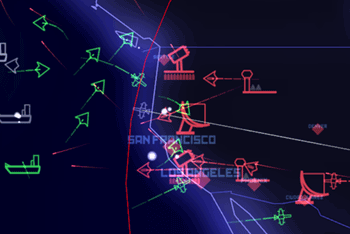
The intention was always to capture the feeling of senseless Armageddon and the claustrophobia of being buried deep underground, trying to win a war that simply cannot be won. Defcon was always meant to be an experiment in the creation of a mood. We wanted to see if we could evoke that vast and terrible detached feeling of genocidal mania.The graphics are abstract and detached. The soundtrack is amazing with ambient creepy angels overdubbed on top of sounds of people coughing. The slow pace of the game increases the horror; launch your nukes at Paris and London and Berlin, then wait five minutes for them to hit. There’s even a mode where the game is played over six hours in the background, while you’re busy doing something else. How creepy is that?—Chris Delay, in Dec 2006 Game Developer Magazine
The demo is 60 megs and will let you sample the ambience. If you like it, the full version is $17.50.
 I’ve talked before about how
Sonic Youth was one
of my few contacts with hipness when I was a nerdy high school kid.
I was excited to learn that their first album
release is finally out on CD. It was caught up in the legal mess
of SST records
and unavailable for a long time. Now it’s out and only $8.50 on Amazon.
I’ve talked before about how
Sonic Youth was one
of my few contacts with hipness when I was a nerdy high school kid.
I was excited to learn that their first album
release is finally out on CD. It was caught up in the legal mess
of SST records
and unavailable for a long time. Now it’s out and only $8.50 on Amazon.
Oh yeah, and it’s still awesome. It’s much less rock than most of their music, more of a droning rush of sound thing going on. The original EP is just five tracks; the rerelease includes a live set from the same year. Haven’t even listened to that yet, just excited to have the album I remember from high school.
The Burning Spear • I Dreamed I Dream • She Is Not Alone • I Don’t Want To Push It • The Good and the Bad
Visit AOLMobile.com today and throw a mobile snowball at a friend FREE!* It’s easy! Pick your snowball, enter your friend’s mobile phone number and click ‘Send.’ Snowball A Friend now!What could be more fun than giving a spammer my friends’ cell phone numbers? I wonder what other Valuable Communications AOL will decide to send them?
Part of my ignorance is because I’m not working in Java right now (and believe me, I don’t miss it). But it seems no one’s really too worked up about the release. The links on Digg are getting no attention. It’s on delicious with a paltry 61 links. There’s a few geeky articles on Google News, but it’s not exactly burning up the wires.
Maybe Sun just is downplaying this release. The list of improvements are not terribly exciting, despite some good stuff in the scripting department. Then again, maybe Java lost its groove. Sure has with me and the people I know.
It’s not good that US wine has 1/3 more alcohol. It’s a bit like the fashion for overoaked Chardonnay of a few years ago. It lacks finesse. Not to mention the effect of drinking that much more intoxicant.
Contrast that to FeedDemon, which after an upgrade requires me to go through again and configure it to not act dumb. Or World of Warcraft; today is addon upgrade hell as the new patch comes out. And managing client state between machines? Total pain.
One problem with Firefox 2.0: what’s up with the gradient fill on the tab bar? Hideous to have that embedded in my otherwise flat-coloured chrome.

Still it is awfully beautiful, and the music’s great, and there’s some nice symbolism for its own sake. If you’re a film geek it’s worth watching.
Today’s our last day in Paris. Guess which kind of postcard writer I am?
The one drawback is the place is very expensive. 110€ per person for the big tasting menu, and precious few bottles under 100€. (Note: this is much higher than listed on the web site. Hmm.) The non-smoking room was about half Japanese tourists and only one French table, I suspect their prices generally keep the locals away. Still, we had a perfect meal, so money well spent.
In the cathedral vein, I just finished a very good tour of Sainte Chapelle as guided by Vicki-Marie Petrick. Ms. Petrick is a PhD student of middle ages art with a bit of thespian flair. She did an excellent job of explaining the role of the church and its relics in bolstering Louis IX’s claim to the throne. She also gave a good explanation of the stained glass, in particular the Book of Judith window with its proto-feminist story. Her expertise was generously shared, I definitely suggest you take her tour if you are in Paris.
A good source for walking tours of Paris is Paris Walks. It’s a fairly casual outfit, interesting and entertaining and with a wide menu of possible tours. I took two, one in the Marais and one in the Left Bank. The guide deftly wove together history specific to the streets we were on with a general view of how the neighbourhood fits into modern Paris. Entertaining, a bit bookish, and a very satisfying 90 minutes. If you’re planning on visiting Paris take a look at their schedule and pick a couple that sound interesting. Then just show up and go for a walk, couldn’t be easier.

Paris has a zillion crêpe joints, but only a select subset are serious authentic Bretagne places. Like the Crêpe Dentelle, a casual little weekday joint in the 2nd near the charming market street Rue Montorgueil. The delicate buckwheat crêpes were deliciously buttery. The homemade salted caramel made for a delicious dessert crêpe. The cider by the bowl wasn’t my favourite. But for 11€50 you can get a full meal of three crêpes served by smiling pleasant people. What’s not to like?
On a friend’s recommendation we made a special trip to have dinner at l’Abbaye Saint Ambroix, a well regarded restaurant in the restored ruins of an old church. The food was good and the adjoining hotel was fine and I can definitely recommend it to any travellers in the area. But the whole evening felt a bit off. The music was loud and grating. Our drinks were wrong (really, does “mojito” sound at all like “amaretto”?). The food was rushed. Good butter but no butter knives made for awkwardness. The staff noisly started clearing the unused tables before the guests were done. Etc, etc. I’m being picky, but Ken and I enjoy a good restaurant experience so much that we’ve become aware of when it’s just not quite right. Either the Hotel Mercure chain buying the hotel has removed whatever owner took personal pride in the place or else Wednesday night is his night off. Either way it lacked the personal hospitality that can make French places so wonderful. Now I appreciate that personal service all the more.
All that being said, Bourges is a lovely town. It’s about 200km south of Paris, midway between the Loire and Burgundy, an old Roman town that was a wealthy power in the 17th century. It’s still a lively and healthy city. Too many modern buildings to be entirely beautiful, but the old city center is nice and the impressive cathedral has some excellent 13th century stained glass. And we found an excellent lunch at Le Bourbonnoux with the personal service and comfort we enjoy so much.
 Given the number of horrible people milling around inside Paris’ most famous
cathedral talking into their cell phones, they ought to rename the
place Notre Dame du miracle du téléphone portable.
Given the number of horrible people milling around inside Paris’ most famous
cathedral talking into their cell phones, they ought to rename the
place Notre Dame du miracle du téléphone portable.
Here’s a small list of hotels that I know to be agreeable. Rates are very approximate for a basic double room; in Paris demand pricing is practiced with fervor.
To be fair, a lot of American hotel sites have stupid “experiences” too. But in France even the informational sites are lousy. For example, Mappy, the main French map site (now obsolete, thanks to Google). Marvel at that front page, with 16 separate text entry areas.
But the king of awful websites is the SNCF, the online train booking. The have a site in English, which is awfully nice, only about a third of the links don’t work and give you French error messages. Here’s how to book a train:
I’m sure there are some wonderful French web sites out there, and I personally know some great French web designers. But the examples I keep finding are just awful.
 As nice as Paris is, my favourite experiences in France are in the
smaller towns and countryside. Life outside the big cities in France
is still quite sophisticated with excellent food and art and life.
But you also get some rusticness and relaxation.
As nice as Paris is, my favourite experiences in France are in the
smaller towns and countryside. Life outside the big cities in France
is still quite sophisticated with excellent food and art and life.
But you also get some rusticness and relaxation.
I made a special trip to Chartres for a guided tour from Malcolm Miller. Mr. Miller is something of a legend; he’s made a life’s study of the famous cathedral and has been giving guided tours for nearly fifty years. His book about the cathedral was a revelation for me. It explains in brisk detail the iconography of the stained glass and sculptures. He argues that the cathedral is like a library; now I have a hint of how to read the books. The windows are no longer a blur of red and blue with funny faces to me, I now see the narratives and the artistic imperative. His tour was excellent, a 90 minute sampler of his life’s work interpreting the cathedral delivered with delicious humour.
The tour alone was worth the trip, but Chartres turned out to be a revelation. The river is beautiful, the Saturday market is impressive, and Le Grand Monarque is a great old road hotel with excellent food. All in all a very pleasant overnight excursion from Paris. The train’s only an hour, you could go just for the day. But better to settle in a bit and enjoy the rhythm of Chartres life.
As usual, I took some photos.
The promise of SOAP and WSDL was removing all the plumbing. When you look at SOAP client examples, they’re two lines of code. “Generate proxy. RPC to proxy.” And for toys, that actually works. But for serious things it doesn’t. I don’t have the space to explain all the problems right now (if you’ve seen my talks at O’Reilly conferences, you know), but they boil down to massive interoperability problems. Good lord, you can’t even pass a number between languages reliably, much less arrays, or dates, or structures that can be null, or... It just doesn’t work. Maybe with enough effort SOAP interop could eventually be made to work. It’s not such a problem if you’re writing both the client and the server. But if you’re publishing a server for others to use? Forget it.
The deeper problem with SOAP is strong typing. WSDL accomplishes its magic via XML Schema and strongly typed messages. But strong typing is a bad choice for loosely coupled distributed systems. The moment you need to change anything, the type signature changes and all the clients that were built to your earlier protocol spec break. And I don’t just mean major semantic changes break things, but cosmetic things like accepting a 64 bit int where you use used to only accept 32 bit ints, or making a parameter optional. SOAP, in practice, is incredibly brittle. If you’re building a web service for the world to use, you need to make it flexible and loose and a bit sloppy. Strong typing is the wrong choice.
The REST / HTTP+POX services typically assume that the clients will be flexible and can make sense of messages, even if they change a bit. And in practice this seems to work pretty well. My favourite API to use is the Flickr API, and my favourite client for it is 48 lines of code. It supports 100+ Flickr API methods. How? Fast and loose. And it works great.
To be fair, SOAP can be forced to work. Using SOAP didn’t really hurt adoption of the APIs I worked on. But it sure didn’t help either. So what’s the alternative? I’m not sure. Right now I’d probably go the HTTP+POX route while trying to name my resources well enough that the REST guys will invite me to their parties. But XML itself is such a disaster and AJAX is starting to show the cracks in HTTP (like, say, the lack of asynchrony).
Truly, none of this protocol fiddling matters. Just do something that works.
I no longer work for Google; these opinions are very much my own.
It’s a straight-up brasserie, lots of closely set tables and a menu with food options from oysters to fresh fish to steak to my pasta with tandoori chicken. Many of the locals were eating seafood, including an enormous fruits de mer platter, so maybe that’s there special thing. The lunchtime crowd is fun, a bunch of Parisians enjoying a good meal without much fuss. And the service and food are a notch above the usual brasserie. Recommended, particularly if you’re in the area and want something truly Parisian.
 Auberge is French for “inn”, traditionally a homely little
place where you could get a room for a night and a home cooked meal.
There are precious few auberges left anywhere in France, let alone
Paris, so the name now implies “restaurant with cozy food”. Such as
the Auberge d’Chez Eux, a lovely casual little
place near
the Eiffel Tower in the 7th.
Auberge is French for “inn”, traditionally a homely little
place where you could get a room for a night and a home cooked meal.
There are precious few auberges left anywhere in France, let alone
Paris, so the name now implies “restaurant with cozy food”. Such as
the Auberge d’Chez Eux, a lovely casual little
place near
the Eiffel Tower in the 7th.
The southwest cooking is strongly on the “hearty” side, not sophisticated. But it’s delicious and honest, paricularly the homemade charcuterie and desserts. Our dinner last night included an assortment of homemade salads, a fantastic salade gourmande with cured duck breast and foie gras, an impressively rich stew of deer, and a whole pheasant cooked with morels and girolles.
The hazard of this place is they love serving way too much food. My first time there I ordered the charcuterie sampling, which ended up being 12 kinds of dry sausage, 6 kinds of hot sausage, and a little fresh boudin noir to finish it off. That was the appetizer; my main course of two duck legs was to come. This kind of excess is atypical for France, and frankly a bit unwelcome, but it’s done out of a generosity and joy of serving customers good food to make them happy. So you go with it, and just eat what you want, and it works out.
The wine list is surprisingly good; we had a lovely 1995 Madiran. And my friend Richard was crazy enough to finish his meal off with a glass of flaming prune eau-de-vie, a remarkably theatric presentation that ended up nearly burning his lips off. Everyone laughed, we ate a bit more dessert, and enjoyed the pleasure of a friendly auberge. It’s no wonder Chirac took Putin here for dinner.
 It’s not all elegant dining in Paris; today’s lunch was a hamburger, fries, and
coke at Restaurant
Quick, the French take on McDonalds. It’s expensive
by US standards at 5€90 for the basic burger meal.
How is it? Nominally a little
better than McD’s but nowhere near In-n-Out quality.
It’s not all elegant dining in Paris; today’s lunch was a hamburger, fries, and
coke at Restaurant
Quick, the French take on McDonalds. It’s expensive
by US standards at 5€90 for the basic burger meal.
How is it? Nominally a little
better than McD’s but nowhere near In-n-Out quality.
But what prompts me to document this ignominious meal is the current “Say Cheese” campaign. Special meals include a hamburger with three slices of cheese, the intense raclette, and some nasty looking goat cheese burrito. Yes, in a land with a fantastic variety of local artisinal cheeses, “now with more goo!” also sells.
One of the best known places there is Chez Marianne. It’s an overgrown traiteur; their primary business is selling premade salads, deli foods, etc. But over time it’s evolved into a restaurant with table service and is now quite popular at lunch. My assortment plate had hummus, tzatziki, roasted peppers in oil, feta, and a meatball. And some excellent pita bread. Way too much food, but good.
On our first visit to Au Plaisir Gourmand we had no idea what to expect. We had the nicest time. The woman who runs the place has a wicked sense of humour and knows when to use it. The crowning moment was at the end of the meal when she brought out a pat of butter with a birthday candle in it to both honour Ken’s birthday and tease him for asking for extra butter earlier in the evening. That kind of appropriate familiarity makes us very happy. Not to mention the great food, the 1947 Clos de l’Echo, the lovely cheese, or the 1953 Coteaux de Layon dessert wine.
So we made a plan to go back, in part to have a good meal and in part because we heard there was some danger of the restaurant being sold. Jean-Claude Rigollet’s cooking was as good as before; the veal with morels was absolutely perfect, my roast pigeon was excellent, good scallops with zucchini, a lovely lobster salad, etc. All perfectly prepared without being too fussy.
Sadly they were out of the 1947 Chinon, but the sommelier M. Bournand was kind enough to dig in the cellar and find a few bottles of Olga Raffault Chinon for us: a 1955 white, a 1955 red, and a 1959 red. The Loire is not as famous as Burgundy, Bordeaux, or the Rhone. But with expert help you can find excellent wine there. And a 50 year old Chinon wine can still be in great shape. The good aged whites tend to be sweet, coming full round in their age to an intensely mellow, elegant flavour that’s not intense like a Sauternes but more rich like a Burgundy. And the reds hold on remarkably well, more fruit than an old Burgundy or Bordeaux but still with that old books flavour that makes truly old red wine such a pleasure.
The best part of an experience like this is the expertise of the staff. The sommelier at Au Plaisir Gourmand knows more about his wine than pretty much any American sommelier I’ve ever encountered, despite his being well under 30 years old. The wines were in perfect shape, excellently selected, and reasonably priced. All five ~50 year old wines were great; a remarkable event. I’ve given up ordering old Burgundy in a fancy three star restaurant; I can’t enjoy something knowing it’s $20 a sip. But a good restaurant in the Loire, a careful wine list, and friendly staff mean you can enjoy a long fine meal with great wine.
Chinon is a lovely part of the Loire valley, both for its own history (lots of Jeanne d’Arc) and for being in the middle of chateau touring and wine. The Hotel Diderot is a fine inexpensive hotel in town with a charming building and fantastic homemade jams. Or for a luxury experience, my favourite place in France is the Chateau de Marçay;. You can get a cab to take you the 10km into Chinon for Au Plaisir Gourmand, but by all means eat at the Marçay too!
It’s been cold, so last night Ken and I went for fondue at Assiette aux Fromages. 15€ gets you more melted cheese than you can eat along with a nice bit of ham and salad. There’s lots of other things on the menu, some even not cheese-themed, but it’s clear you come here for fondue or raclette. And they do fondue well. We’ll go back if we have time.
PS: the blog title comes from an awful marketing campaign by the American Dairy Association. The theme was that any food could be made into a delicious meal just by adding cheese. I can’t think of a more succinct summary of the American approach to food.
My spamassassin setup clearly no longer works. What can I do? I’m currently using spamassassin with the baysean filter, Vipul’s Razor, pyzor, and nightly sa-update runs. Both Thunderbird and Gmail seem to do a better job filtering spam than this setup, so I must have something wrong.
We started in Marseille, the ugliest French city I’ve ever seen. Crazy Mediterranean traffic and nasty 1950s concrete buildings combine to make a beautiful bit of landscape quite unpleasant. It is an interesting old port though, and the Hôtel Passédat - Le Petit Nice was great with a truly fantastic restaurant. We also had a traditional bouillabaisse at Chez Michel, a hardcore fish place. Excellent, even if eating a quart of liquid, 4 fish, and a pint of mayonnaise as a side is perhaps a bit much.
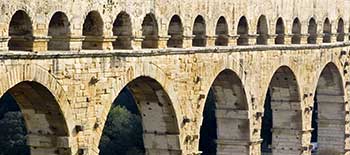
Along the way we visited the 12th century fortress ruins of Les Baux de Provence, the Roman aqueduct of the Pont du Gard and about twenty little Provençal villages. A very pleasant few days, and perfect weather in November.
There are constant strikes in every non-entrepreneurial industry in France. I’m sympathetic to workers’ rights, but there’s something galling about the persistance of strikes in a country with 35 hour work weeks, relaxed service expectations, significant social programs, and a huge unemployment problem. And for visitors it’s particularly frustrating to randomly find the Louvre is closed because there are no ticket takers or the Pompidou is closed for some mysterious reason. Are museum workers really so oppressed?
Apparently there were 482 strike notices for the French trains in a year. Don’t miss this blog’s sidebar for a list of other upcoming strikes. I hope you’re not having a baby after November 20!
 One remarkable thing in Paris is the quantity and quality of
street art.
I don’t mean crappy tag vandalism, but thoughtful and beautiful art
by folks like
Jèrôme Mesnager,
L’Atlas and
Space
Invader. Walking around Paris is fun for all the beautiful old
buildings, but look closer at some of the new stuff illicitly stuck to
the walls, too.
One remarkable thing in Paris is the quantity and quality of
street art.
I don’t mean crappy tag vandalism, but thoughtful and beautiful art
by folks like
Jèrôme Mesnager,
L’Atlas and
Space
Invader. Walking around Paris is fun for all the beautiful old
buildings, but look closer at some of the new stuff illicitly stuck to
the walls, too.
Flickr is a good place to find images of Parisian street art. The Paris street art group is good, as are the photos of yoyo (and his website), tofz4u, chais, vitostreet and others. But I’m really enjoying stumbling into them myself. Many of the installations are quite big and ambitious; the nights must be quiet.
I’ve been taking photos of street art when I can. I’m particularly taken by the Kufic stylings of L’Atlas; Arabic calligraphy is beautiful, and somewhat provocative in Paris. And I recently stumbled into a beautiful gallery at 23-25 rue Ramponeau in the 20th. There’s an artist workspace nearby, so I imagine this was semi-authorized.
Generally in Paris if you find a place where the staff cares about what they’re doing, you’ll eat well. As it was at L’Enoteca. My strongest memory is of the pasta with duck. Excellent fresh tagliatelle, shreds of duck nicely peppered. Simple, elegant, perfect. The Italian wine list is excellent and modestly priced to match the menus. It’s clear the owner has pride, and that translates to a good experience.
I started with the assortment of cured pork; some ham, rillettes, blood sausage, and dry sausage. All excellent, particularly the ham. Ken was happy with his wild boar terrine but the best starter was the simple lentil salad with bits of bacon. Perfectly prepared. For a main corse we had duck breast and sausages, all served with aligot. Aligot is a riffe on mashed potatoes, mixed thoroughly with hard cheese to an elastic consistency. Hearty simple fare, very satisfiying. We’ll be back.
PS: I’ve rolled the food posts back into my normal blog. No need for two feeds anymore.
So we’re cruising along for a few minutes and suddenly the guy lights up a cigarette. French trains have been non-smoking for several years. I’m a non-confrontational wuss, particularly in French, but this pissed me off. Here’s how the conversation went (in French, unless noted).
Excuse me sir, but this is a non-smoking train.My accent is so awful it’s immediately obvious I don’t speak much French. I think the game he was playing was to pretend he couldn’t understand me, so the fault was mine. Turning the question around on him fixed that; he could hardly admit he didn’t understand the sign. Either that, or my increasingly loud voice was attracting more attention than he wanted.
Huh?
This place is non-smoking.
grunt, sneer
(English) What, are you just an ass? You can’t smoke here.
leer. I can’t understand you.
(French) See the sign? Non smoking. Do you understand it?
silence
You cannot smoke here.
storms off, swearing
Anyway, off he went to smoke somewhere else. Next to a grandma, who also told him off. He jumped off the train at the next stop. And me? Apparently I know enough French to stare down a punk.
Mind you, this is on top of all the other fees they charge both me and the merchant. And it’s pure profit; their friction for a Euro denominated transaction is at most 0.1%. Why do they charge it? Because they can.
Surprisingly Wells Fargo is much better on ATM cash withdrawals. There’s a flat $5 fee, so at $1000 an ATM visit I’m paying 0.5% for eurocash. I guess I’m gonna have to start carrying a fat roll.
I’ve been twice in two separate years now and to be honest, the place suffers too much under the weight of its reputation. The clientele is 90% tourists, sapping the will and joy out of the staff there. The menu is classic bistro, which is to say a bit hackneyed. Everything is prepared well enough but nothing is particularly good. Nothing is bad either, and the service is very good. It’s just uninspiring.
Paris is so full of honest and earnest places that there’s no need to go to someone just making the motions. If you’re looking for a good traditional meal in Paris and you’re not sure how to find a place, by all means go to Benoit. It’s certainly good. But if you want something interesting save the evening for somewhere new.
The difference with Le Caveau is it’s very very good. The food is prepared with great care and excellent ingredients. The terrine du porc was homemade, they just brought out a big casserole and said “cut yourself as much as you want”. My duck confit was one of the best I’ve had in a very long time, with fanastically garlicky and leathery pommes sarladaise. Ken’s chicken breast with cream sauce and morels was perfect as well. Good wine list, too.
It’s rare to find a simple bistro that does so well. Benoit is where most people will be sent, and you’ll do OK, but Le Caveau felt more like the real thing to me. The location is phenomenal as well, in the middle of the touristy Cité island but in a quiet corner on a handsome square. It felt like the kind of place where all the Parisian ministers go for lunch. On a Saturday night it was very quiet.
Foremost, the non-smoking room is often the American room. French people don’t seem to ask for l’espace non-fumeur very often, so the folks who want to eat their meal without smelling noxious smoke often end up being Americans. And secondarily, good restaurants often have one waiter who speaks the best English; you’ll be assigned to his room as a matter of course. No insult intended, they’re just trying to make you (and themselves) happy.
So go with it. And when the table next to you starts bleating loudly about their diets and stock portfolios, enjoy the pleasure that they can overhear you commenting nastily about them.
Everytime we’ve walked by this place it was crowded with happy people. And the menu looked good. So tonight we went in and found a disaster in action. Ten minute wait to have anyone ask us about drinks or food. So we ordered food, asked for the wine list, then five minutes later are asked by the same person for our food order again. Lots of grumpy people sitting around demanding checks, service, etc. Clearly things were not going well.
The menu was ambitious but disappointing. My cod salad with capers was pleasant enough, Ken’s croustillant of chevre was unimpressive. And both of us were served salad out of a bag. Partridge was a welcome item on the menu but came out overcooked and in a muddy brown sauce. Ken’s steak was good meat, but again with the mud sauce. Desserts equally uninspired. Good? Earl grey tea flavoured creme. Bad? No other flavour.
The restaurant was packed with English speaking tourists, all smugly happy they’d found a sophisticated experience. The British forty-something gals across from us were drunk and taking two flash photos a minute. And the culmination of the meal service? The woman running the restaurant sat at a table in the middle of the dining room, patrons still having their meals, and proceeded to eat her own dinner and read a magazine. Shocking, unacceptable, and a good reason not to go back.
Sadly, about half the restaurants we go to in Paris seem to have similar lapses. I’ll endeavour to write more about the good half.
I don’t know what mistaken progressivism is allowing people to move in but it concerns me greatly. I come from a city with a significant problem of people living in the streets and it’s hideous. Downtown San Francisco regularly ashames me, particularly when I talk to visitors. Why would Paris let that happen to them? Particularly in a country with such extensive and expensive social support?
Judging by some of the signs I saw I gather there’s a political point being made about the right of people to live in the streets of Paris. Bullshit. People have a right to a roof, but not a right to a tent in a public space in the middle of the city. My impression is social support in France is more than adequate to care for people too sick or poor to care for themselves. What’s the problem?
 I’m feeling a bit homesick today. Nothing serious but I’m missing
my cat, burritos, dogshit-free sidewalks, and running errands without
linguistic adventures. But what I’m most homesick for now is an
American shower.
I’m feeling a bit homesick today. Nothing serious but I’m missing
my cat, burritos, dogshit-free sidewalks, and running errands without
linguistic adventures. But what I’m most homesick for now is an
American shower.
The French may have given the world the bidet, but they have alarmingly bad showers. Shower curtains and sprayers are considered optional. It’s common to find hotels with nothing but a tub and a handheld sprayer on a flexible hose. You cower in one corner of the tub, awkwardly holding the sprayer above you with one hand while trying to wash with the other. You rush and try your best not to spray outside the tub, but are inevitably ashamed of the swampy mess the bathroom has become.
A good American shower is a sybaritic pleasure. A solid watertight enclosure, allowing splashing and spraying with no fear. A large, high flow showerhead hung about 2 meters overhead, spraying out and down to soak you. The best showers are large enough that you can stand fully in the shower without the water touching you, but even the usual bathtub arrangement allows plenty of room for soaping, relaxing, lounging.
The grounds are very beautiful; excellent site architecture, placed on top of a gentle hill with expansive gardens stretching out on all sides. Great statuary too, although a lot of it was covered; made for some creepy photos.
I’m glad I checked Versailles off my to-do list, but I wouldn’t recommend it unless it’s a warm sunny day and you feel like a garden stroll.
Let’s say I buy a GPS device from Gargellan to help me be a tourist. It comes with all sorts of cool data telling me which places to go, where to eat, some nice walking tours with useful audio annotations, etc. The device itself is dirt cheap, say $50, but Gargellan sells me the data on a subscription basis for $5 a day. Sort of an iPod for GPS.
My fear is what restrictions that device and the data will have on it. Will I be able to merge in other data from openstreetmap or wikimapia to augment my tourist wanderings? Will I be able to export the walking tour I took to Flickr so I can easily annotate my photos? Am I stuck with the Zagat restaurant ratings that Gargellan made a deal to supply, or can I buy Michelin ratings too even though Gargellan doesn’t like Michelin?
If the GPS device market follows the music player market, I fear the answer to my questions will be “no”. Because Gargellan’s business model will demand that they not let me use the data the way I want. Cheap-device expensive-data is a very common business model, but it’s technically fragile because it relies on the data staying expensive. For the past ten years tech companies have increasingly been turning to DRM to try to keep that data expensive. And DRM sucks; not because I have to pay (I don’t mind), but because I in turn can’t do useful things with the data.
We can be purists and say we will only use non-proprietary devices and free data. But that’s an uphill battle. In the meantime commercial companies are going to be designing the hardware and software that ordinary people will be using. Will those products be awful closed platforms like cell phones? Or open friendly platforms like pre-trusted-computing PCs? Or somewhere inbetween?
I had a nice few days in the Loire followed by a nice few days in Bretagne and Normandie. Lots of detail to come, but I have to say now that travelling in the countryside in France is the best thing ever.
 The Canon i80 is good hardware. It’s a portable colour printer that
runs on batteries. It’s no longer made, but the
Canon i90 looks to be the successor.
The Canon i80 is good hardware. It’s a portable colour printer that
runs on batteries. It’s no longer made, but the
Canon i90 looks to be the successor.
I made all sorts of fun of Ken when he bought this printer. Who needs a portable printer? Turns out wedo. We’ve taken it to Zürich and Paris with it and it’s a huge convenience to be able to print train tickets, maps, photos, etc.
The print quality and speed is quite good. It does a good job on colour photos if you use good paper and it’s great at quickly printing off a few black and white pages. It’s reasonably portable but it’s not petite. About the same volume as a laptop, but thicker and shallower. The builtin battery is surprisingly useful; no need to find a second outlet just to print a page or two.
 Do not assume you can find a cab at 19:30. Even if it’s Wednesday, the
weather is lovely and you’re in the middle of the city.
Being dressed to the nines for
an evening at Pre
Catalan will not help. The Parisian taxi driver won’t be impressed by your
cufflinks. He already has a fare.
Do not assume you can find a cab at 19:30. Even if it’s Wednesday, the
weather is lovely and you’re in the middle of the city.
Being dressed to the nines for
an evening at Pre
Catalan will not help. The Parisian taxi driver won’t be impressed by your
cufflinks. He already has a fare.
What should have been a pleasant cab ride through the Bois de Boulogne towards one of the best restaurants in Paris ended up in a hellishly stressful hour plus search for a cab. We finally gave up and took the metro to Porte Maillot, nearer the restaurant and with a cab stand. Even there we waited 10 minutes.
Time to learn how to reserve a taxi by the phone.
The solution for dining was also easy, but alas has gotten harder. There is a serious restaurant inside the museum, on the second floor in a beautifully restored ballroom. Alas, the service has gone downhill significantly since last year; the lack of linen makes the place feel just a bit too much like a dismal cafeteria. The menu is still slightly ambitious and the execution is still just as uneven. Our filet of pork was great, the entrecote serviceable, but the mushroom terrine was watery. I can recommend this place for lunch, but only as a comfortable part of an extended visit to the museum. It’s a shame they gave up on the tablecloths and other trappings of a real restaurant.
Not always a good idea, but it can make certain pictures look better. I’ve done it to about 5% of my photos I put on Flickr. To make life easier I’ve created a Lab color pop action set for you to download. First you should try the method manually once to understand what it’s doing.
The bistro is run by a family from the Aveyron, but other than the advertised Aubrac beef I have no idea what that would mean for cuisine. The menu was quite pleasant though, straying far from the usual steak/chicken/fish dishes of the everyday Parisian bistro. I had a nice little filet of lieu jaune (pollack), a firm white fish like a cod served in a green herby sauce. Being in a hurry I appreciated the rapid service, but the fish came out a bit too quickly. I fear it was not prepared to order, but it was quite tasty. A little pichet of rich white wine, a homemade tarte tatin, and I was done with a very pleasant lunch 45 minutes and 28€ later.
BTW, across the corner is a pleasant patisserie where I bought lovely croissants a few years ago.
We did eat well. We were steered the first night to L’Huîtrière, a seafood place built at Brussels gone-100-years docks. Excellent fresh fish, comfortable room, nice dinner. I was a bit disappointed with our second dinner at L’Maison du Boeuf, not because anything was bad about it but because for a place of its reputation (and price!) you expect excellence, and it was merely very good. The best surprise was Aux Armes de Bruxelles, an excellent old world place with gentileness and charm smack in the middle of Brussels tourist hell. I had moules frites just because I felt obligated, but my friends did much better with careful lobster preparations with cream sauce. Excellent place, I strongly recommend.
I believe in the afternoon / early evening this doubles as a place for a quick glass of wine for the young gay men that suddenly appear all over the Marais. Tres gentile.
Some favourite dishes.. A blanched tomato and fresh goat cheese salad, the classic hangar steak with shallots, and a surprisingly robust penne with chorizo. They also feature andouillette and it looks good, but I’m just not quite brave enough. Last time we were there we had a fantastic chocolate tarte, way better than anything else like it in Paris. Creamy and eggy, rich with chocolate but not too dense. Yum.
I’d say this place isn’t worth a particular trip, but if you’re tired of the Parisian experience you can get a bit of Auvergne feel for a cheap price. Nice outdoor space in back, too.
While the cooking is great the service is a bit uneven; it almost feels like they hired untrained staff. But they’re nice and attentative, just a bit clumsy, so go with it and it’s fine. The entire restaurant is non-smoking, a welcome thing.
PS: I promised to write more, and I will, but got sick of writing up the places I didn’t like.
I still use zmodem on occasion to transfer files from my Windows laptop to my Linux server. With all the firewalls and security crap it’s a lot of effort to do a proper TCP/IP file transfer, but all I need is an open terminal session and rz/sz and I’m set.
 Bread is serious business in France, but not all bread here is good.
Even the simple baguette has huge variation. Now
thanks to my friend Marc I
know how to articulate the difference between the good and the
bad.
Bread is serious business in France, but not all bread here is good.
Even the simple baguette has huge variation. Now
thanks to my friend Marc I
know how to articulate the difference between the good and the
bad.
A good baguette starts with an open crumb, an airy interior texture with different sized holes. This structure is the result of careful handling and longer proofing and is one of the visible marks of a good baguette. Of course what really matters is the taste and texture, but the easily-visible crumb structure (miette) is a good indicator.
I’ve been buying baguettes all over town as an experiment. And almost every shop has mediocre baguettes, including the fancy gourmet store (1.05€), the place with fabulous croissants (0.90€), and the permanent boulanger in Place Maubert (0.90€). But the best bread I’ve had so far comes from just around the corner on the tourist-swamped streets of Ile St. Louis (0.80€). It has enough flavour you can enjoy it plain, good chewy bite, and yes, the open crumb.
The trick in Paris is to buy things from specialists, not supermarkets. This means going to several different stores on a shopping trip and figuring out which boulanger has the best bread, which cheese shops are better at mountain cheeses vs. soft cow cheeses, and careful produce inspection.
My favourite place to shop is the Marché Maubert, a three days a week outdoor market. Some 30 different vendors selling fruits, vegetabls, meats (calves brains!), cheeses, pastas, middle eastern specialities, and, oddly, suitcases. The two or three permanent shops there are quite good as well. My Parisian restauranteuse friend Evelyne was kind enough to go shopping with us the first time and show us the ropes. Quite easy; afterall, the vendors want to sell to you as much as you want to buy.
Paris has about 40 of these markets; the mairie publishes a good list. So far I’ve mapped about half of them: see this map or download the KML.
ride metroThe Paris metro is actually pretty easy; just buy “un carnet” from the agent, 10 tickets for 10.90€. But living here you want a monthly pass; Here’s the walkthrough on how to do it. WARNING: SPOILERS.
The metro requires a ticket.
buy ticket
From whom?
buy ticket from machine
This machine does not accept your credit card.
buy ticket from RATP agent
“Je ne vous comprende pas. Parlez vous Français?”
jump turnstile
The gendarmes are approaching. Run?
Paris has weekly and monthly Metro passes (abonnement). As a visitor you want the Carte Orange (a photo ID card, free) along with a coupon (a metro ticket you reuse). The coupon choices are a coupon hebdomadaire (one week, Mon-Sun, 16€) or a coupon mensuel (1st-31st of the month, 52.50€). You probably want the cheapest ticket, zones 1-2 (for the whole Metro). Residents are being encouraged to switch to Navigo, but that requires a local address and bank account so skip it.
Buying the monthly pass turns out to be easy. Just go to any ticket seller in a metro station and say you want a Carte Orange. He’ll hand you a blank photo ID card for free and then sell you the week or months’ coupon. Stick a one inch square photo on the card and use the provided adhesive to seal it up. You have to write your card’s number on your coupon; that prevents you from sharing your coupon with someone else.
Every city I’ve lived in has had a different process to buy a local transit pass. In Paris there’s no special effort to get the card, you get it anywhere and assemble it yourself. There are photo booths in some bigger metro stations.
Either way, it’s a lot of money for a shirt compared to $1.25 in the US. But then again the shirts are hand ironed, the staff is being paid a living wage, and the experience is altogether more personal. But I feel certain it’s possible to get a shirt done right for, say, $5. if you just knew where to look. My Parisian friends just have their cleaning lady iron their shirts. Cleaning lady; how do I hire one of those?
Paris has so many surprises. Today’s walk took me on a tour of the 5th. Along the way I discovered the Arenès de Lutèce, a 2000 year old Roman amphitheatre. And the lovely little Place Monge, a small village feel in the middle of the city. And the tomb of St. Genevieve, a 5th century saint whose bones were burned by the democracy-loving revolutionaries in 1793.
And on and on, so much in this city to find. The invaders are my breadcrumbs.
Flickr is owned by Yahoo so it’s no surprise they’re not using Google maps in the geocoding interface. But it’s bad for users. I’m taking some very site-specific photos in Paris now and my current geocoding solution involves Google Earth, URLs as comments on placemarks, and a bunch of XML hacking. Ick.
I’ve been a bit at loose ends in Paris, not sure what to do with myself here. But then I relax a bit and the city comes to me. After lunch yesterday at Les Marroniers in the 4th (casual cafe, good sandwiches) we walked a bit and found a Sunday exhibition of the national police. Equestrian demonstrations, acrobats on motorcycles, zip-lines for children.
And then on we walked to the eastern tip of our island, to the garden featuring a statue of the now-forgotten artist Antoine-Louis Barye. Then from there past the public shower for the indigent (on the most expensive real estate in Paris), and on to the St. Louis church whose open door invited us in to an organ rehearsal of Buxtehude and Bach.
When you slow down, most every street in Paris offers some sort of pleasure to the visitor.
 With many thanks to Jason Kottke
for the recommendation, I just finished enjoying a lovely pain au chocolat from
Boulangerie
Malineau in the Marais about
five blocks from me. Crisp, nicely layered, and warm, just a
bit too buttery.
A superior
pastry, even for Paris.
With many thanks to Jason Kottke
for the recommendation, I just finished enjoying a lovely pain au chocolat from
Boulangerie
Malineau in the Marais about
five blocks from me. Crisp, nicely layered, and warm, just a
bit too buttery.
A superior
pastry, even for Paris.
One wonderful thing about Paris is the diversity of bakeries, cheese stores, butchers, etc. Everyone seems to have specific favourites; this place is good for pain ordinaire, this one for croissant, this one is more convenient. So much to learn.
 I knew the Adobe Reader update process
was bad, but I
didn’t know how bad until I accidentally installed 7.0.0 somehow on my
laptop. It proceeded to download little updates to get me up to the
current 7.0.8, and then apply them one by one. It took five
reboots to upgrade Reader entirely.
I knew the Adobe Reader update process
was bad, but I
didn’t know how bad until I accidentally installed 7.0.0 somehow on my
laptop. It proceeded to download little updates to get me up to the
current 7.0.8, and then apply them one by one. It took five
reboots to upgrade Reader entirely.
That’s five more reboots than necessary, and four more than reasonable. Reader insinuates itself into your system at boot time and inside MSIE, so they have a hard time upgrading it. But applying multiple patches and reboots is really dumb. Dear Adobe: people put old versions of your installer on their CDs. You should support them well.
Some help for you. PDF Download does its best to prevent PDF from ever loading inside Firefox and corrupting it. Adobe Reader SpeedUp fixes a lot of problems in Reader and lets you disable autoupdates. And Foxit reader just hit 2.0. I don’t like the rendering in this Adobe alternative, but it is an option.
 Yesterday’s afternoon had one of those happy random experiences that
make being in Paris wonderful. We went out for lunch and some grocery
shopping, and on the way inbetween got pulled into the
Musée
Carnavalet over
in
the 3rd. The lovely courtyard
is what brought us in curious, but since it was free that day we went
inside to look.
Yesterday’s afternoon had one of those happy random experiences that
make being in Paris wonderful. We went out for lunch and some grocery
shopping, and on the way inbetween got pulled into the
Musée
Carnavalet over
in
the 3rd. The lovely courtyard
is what brought us in curious, but since it was free that day we went
inside to look.
The museum collects works of art in and about Paris, focussing on 18th and 19th century stuff. Lots of minor fine art works by lesser known artists, along with some amazing decorative arts. It was interesting going to a museum that had a lot of art, not all very good. Seeing bad impressionism helps put good impressionism in context! Maybe all museums should have a few ringers, bad pieces to keep you on your toes.
Anyway, lots of beautiful things, and the old mansions the museum is in are lovely. I liked the Paris focus of the collection, a different way of organizing things.
Like Degreés de Notre Dame, a restaurant with a pleasant outdoor seating area next to a modest hotel. Like most French restaurants of this type it serves the usual fare along with a speciality. In this case, Moroccan food. My tagine was fantastic, richly spiced and sweetened with raisins and plums. Ken’s warm goat cheese salad was also excellent, although his couscous was a bit bland. Mostly we liked the place because they seemed to really care about serving good food and making people happy.
Nothing exciting, but made well it satisfies. The chicken skin should be crisp, a little brown gravy from the drippings, the fries crisp and hot and just oily enough to not quite soak up all the gravy. Which, alas, is not quite what I got at neither Le Village Ronsard in the 5th nor Le Dôme in the 7th. Sunday night chicken is a risky proposition, and while the Monday lunch was better it wasn’t made with much love. Just have to keep trying!
 The headline reads “Bush Uses 9-11 to Argue for Iraq War”. That pretty
much sums up the whole problem with Bush and the Iraq War, doesn’t it?
The headline reads “Bush Uses 9-11 to Argue for Iraq War”. That pretty
much sums up the whole problem with Bush and the Iraq War, doesn’t it?
Having an apartment of your own is a wonderful thing. We rented a place right in the middle of the city on the Ile St. Louis. Being central is great, but even better we’re just a bit east of the tourist center, making the Marais more “our neighbourhood” than the Latin Quarter or the 2nd. Feels a bit more real. Also the island itself is incredibly quiet and calm. Few cars, a nice respite from the moped madness of the rest of the city.
I need help with the photography. I’m surrounded by clichés, buildings or classic Parisian images. What I really need is someone to give me exercises and critiques.
My salade du chevre chaud was a surprise; the salade is served separate from the cheese, a fresh mild crottin that looked more like a poached egg. Very nice, a bit heavy. The salmon main course was excellent; fresh and well cooked if a bit plain. Dessert, a fresh strawberry soup, just the thing for the end of summer. Ken enjoyed his rabbit terrine but was a bit unimpressed with the veal cutlet and girolles. The Languedoc rosé we chose (Peyre Rose) was excellent if a bit strong for the day. A deep color, almost a red, and strong for a rosé (14%!). Excellent wine, just not the perfect choice at the time.
Our waiter was quite friendly and made the experience all the more enjoyable. Definitely a comfortable place for a tourist to visit, but being a bit up the Seine in the 4th it wasn’t overwhelmed by Americans in shorts. Not cheap but not terrible, three courses will cost you about 30€. A good choice if you’re in the Marais.
One of my goals in Paris is to get friendly with a local cheesemonger, to be able to go in and say “what’s really good today?”. Cheese is a living complex thing, not to be shrinkwrapped and sliced to individual servings. Time to find that in Paris.
Morpheus stretches his arms to you in the President Centre Hotel’s comfortable soundproofed rooms. The grand air of a parking valet, thoughtful and personalized service, cosy bar.
Ken and I made the mistake of both ordering some dry cured sausages. Which is what we got, giant chunks of sausage with no proper knife to cut them. Good enough charcuterie but not exceptional, and too much of it. Our steaks and frites came out better, particularly my bavette, but other than the fried shallots there wasn’t much to dress the steak. Very plain food. If I had a bit more courage maybe I could be telling you how good the andouilette or tête de veau are, but having had those French soul food adventures once I’m not in a hurry to do so again.
If I’m in the area again I’d definitely stop in for a quick bistro lunch, but not worth a special trip. I’m still unsure about whether this restaurant is the same as the Ma Bourgogne on Bd. Hausmann in the 8th. I was there a few years ago, that place was marvelous.
The one thing I do remember was the gentleman sitting next to us, a regular. In his mid 60s, very large, slight difficulty moving. But well loved by the staff despite (or because of?) his tendency to flirt with the young male staff. His eyes followed every young man in the room, not rudely, just enjoying the scenery while dining. Tres gentile. He helped us get the waiter’s attention a time or two, was friendly, but alas my French isn’t good enough for casual conversation. I did get a good smile from him when I made a mildly intimate gesture with Ken, letting our friend know we were fellow travellers. Paris is good for people.
Ken and I both had wild boar (sanglier) for our main courses. Very nice, if a bit plain in preparation. I confess I can’t remember much about our first courses except that Ken’s beignets of chestnut flour didn’t work as well as we’d hoped. I think I had snails. But I distinctly remember the fantastic selection of Corsican cheeses we had to finish the meal, the perfect accompaniment to the dark red vin de Corse.
There are so many good restaurants of this caliber in Paris, I’m not sure this one is worth a special effort to visit again. But it was a good dinner for us.
Last year I got dovecot IMAP security working. I don’t really remember how, but I seem to be doing plaintext authentication (bad) over a TLS connection (good). I also remember it taking several hours to set up.
This year’s project, necessitated by a DHCP-happy ISP, is SMTP authentication so I can send email. What a pain! these instructions are the best I found, but it left out a few important steps. Like you have to install libsasl2-modules by hand, and the password database copy in /var/spool/postfix/etc/ has to be readable by postfix, not just root. All that took an hour to make work; I gave up trying to get SMTP over SSL working too. Ugh.
Why is all this server setup so hard? Both dovecot and postfix support way too many security options, none of them easy. And then various clients don’t support various authentication options (Outlook: I’m talking about you). It should all just work out of the box.
The menu is a bit ambitious for a casual place. Ken had an eggplant gratin with curry flavouring along with a rich, solidly prepared beef burgundy. I had an excellent set of snails in little puff pastry with pesto and a lovely millefeuille preparation of fish. Well executed, simple, not terribly expensive. We’ll be back.
Ken and I both had gaspacho, passably good but nothing special. Ken’s duck confit was undercooked but the skin was nicely crunchy. My breast of goose was absolutely fantastic, unctuously oily with just enough vinegar in the sauce to balance. We liked the place, but in retrospect maybe the food was just ordinary.
The food is good and solid. They have a southwestern France bent (cassoulet, etc), but the menu is generally typical brasserie fare with some well considered specials. And while 37€ isn’t cheap for a three course menu it’s not bad for the quality and location. Ken and I always seem to end up here on our first night in Paris (it’s near the hotel we favour) and for that, it satisfies.
Ken’s a smart guy and a professional software engineer. But he’s not a Windows hacker. So when he needs to do something odd on the Windows box he patiently does what he knows will work. In this case, retyping 100 URLs.
After showing him where the Favorites folder was and how to mail himself a zip file, we pondered what had gone wrong. It’s simple, really. Other than asking someone how would you ever figure out how to do something weird like copy bookmarks from one computer to another?
We can solve this specific problem with a tool like Google Browser Sync. But in general how do we make software obvious to use, both for its intended purpose and for the weird little things you need to do once a year?
The flaw in the above workflow is it doesn’t put the geotag data in your raw image originals. RoboGeo supports DNG but not CR2. Ugh. Keep the GPX files around.
The hardware quality is good. Same solid keyboard, rugged screen hinge, ugly industrial design of Thinkpads for years. Temperature and power management seem good. The screen isn’t as bright as I’d like; I don’t have the “FlexView” option, maybe I should have gotten it. The laptop lacks S-Video or DVI output. But basically it’s a good solid machine and I like it.
The software is surprisingly good. By which I mean there’s almost none. The only non-system stuff is a bunch of Google software that uninstalls very simply (or may actually be useful!). And the IBM ThinkVantage suite of system tools is not too bad. You have to convince it not to turn your wireless off every 3 minutes and you have to disable the mysterious “BEEP” driver, but overall the laptop works.
Now the big problem; customer service. The online order system is awful and buggy and confusing. And then Lenovo screwed up somehow and sent me a machine with a bad part. The promised replacement took four weeks to arrive and the salesguy who was my contact mostly avoided returning my phone calls. Bad customer service, a bad omen for Lenovo’s taking over the business.
I’d probably buy another Thinkpad. Depends if build quality is maintained.
The recruiter must not have gotten my email because he called me. I explained again why I wasn’t interested in talking with him and was shocked to hear an immediate response to the criticism that his company was unethical. Not “we’re misunderstood” or “we’ve changed”. No, he told me they were in a competitive market and couldn’t worry about stepping on toes while building a business.
I don’t know what was more sad; the answer or the fact he had it at the ready. I’m reminded of this crazy story about it’s like to work at a malware provider. Google has taken some knocks for its “don’t be evil” policy. But the good thing is it immediately sets the internal debate at the right point. Not “can we get away with this” or “do we need to do this to build our business” but rather “is this right?” That’s the place to start.
But as the founder of a failed utility computing company I just don’t get how Amazon’s going to benefit from offering these services. The problem is the commodity pricing. If Amazon completely sells a server they gross about $900 a year. Say it costs $300 / year to buy and run a server and they fully sell out 10,000 machines, then Amazon nets $6M / year. Amazon made $360M last year, so this best case scenario would be a 2% earnings improvement. Nice, but worth the distraction to their primary business?
I love that Amazon is offering this service; it seems very valuable and useful to people like me. But unless it’s a long term viable business for Amazon it’d be foolish to build a product that relies on their service. I guess we’ll see how it plays out. Sun’s version of this was looking really bad last year, but then again the signup process at Sun is 1000 times harder.
It’s a bit late for a pony request, but I sure wish geocoding interfaces had a notion of uncertainty along with location. Ie: latitude, longitude, and radius. A photo geocoded to “San Francisco, CA” is different from a photo geocoded to “659 Merchant St. San Francisco, CA”. The former has a radius of about four miles. The latter, 20 feet.
Tagging your photos via a map interface gives a natural radius: a few pixels’ width in the map the user clicked on. GPS devices have a natural uncertainy measurement, too. So the data’s available, why not store it?
First, on the existential question, it seems in practice percent encoding really can create distinct names. Try:
In reality this is just a quirk of Apache’s handling of %2F, but since it’s the default behaviour for the #1 web server out there that’s a strong example. As for the theory, this wikipedia article claims that percent encoded reserved characters does create distinct names whereas percent encoded unreserved characters is just aliasing the same name. So escaping / would make a new name but escaping something like 0 wouldn’t. Confusing, huh?As to the practical problem of PATH_INFO being unescaped basically everyone told me “yeah, CGI’s a hack like that”. So going with the hack I’ll just use the REQUEST_URI variable Apache sets. It’s not documented anywhere I can find but it seems to be an unadulterated literal copy of what the client requested, from which I can do careful parsing. For my service clients will need to know to percent-escape any / or ? in their URLs. And I’ll just hope nothing else in the network decideds it’s OK to unescape things on me.
Some other suggested workarounds: length-delimit the subject URL so you know where it ends, have a magic string delimiting the end of the subject URL that you hope doesn’t appear in any legitimate subject URL, or put the subject URL at the end of the request URL so that it ends where it ends. Any of these solutions could be made to work, I was just looking for the principle.
The PlayOn folks have a nice graph of time to level in World of Warcraft as a function of level. I redrew it as level as a function of time. This view highlights the fact that your reward frequency diminishes over time. Early on it takes 2 hours of play to level up. But the rewards come more and more slowly to where you’re playing 10 hours per “ding!”.
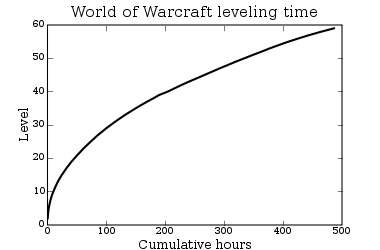
Maybe the time spent makes the rewards just seem more valuable? Level 60 feels like a big accomplishment given the time involved. But then, that’s totally artificial. Or maybe the game developers cynically know they can get away with less frequent rewards because there’s so much sunk cost. Players spend so much time getting to 44 that they’ll spend longer for 45 because they’re already invested.
 The French for raccoon is raton laveur. Literally, the
“washing rat”.
The French for raccoon is raton laveur. Literally, the
“washing rat”.
The French for pie chart is camembert.
So my question is, how do I correctly encode someurl? Let’s say it’s http://google.com/ I’m reversing. I’d think the request would contain a percent-quoted URL, something like
Is there a good way to talk about URLs inside URLs? If you know the answer, mail me. I promise to share.
 One of the highlights of our trip to Australia was
Tasmania. Tassie is quite different from mainland Australia; it’s
very fertile
lush, mountainous, and cool. It’s also wild and largely
unsettled. The whole west half of the island is covered in rugged mountains
rainforests, reminded me of the Olympic Peninsula.
One of the highlights of our trip to Australia was
Tasmania. Tassie is quite different from mainland Australia; it’s
very fertile
lush, mountainous, and cool. It’s also wild and largely
unsettled. The whole west half of the island is covered in rugged mountains
rainforests, reminded me of the Olympic Peninsula.
Hobart is the main town in Tasmania, but honestly it doesn’t offer much to the tourist. But the nearby Port Arthur is fascinating; its the ruins of the last and most notorious prison of the Victorian era.
We also took the five hour drive across the island to Strahan, a small tourist town (and former prison) on the west coast. The drive across was amazing, wild and empty roads with enormous forests. Absolutely beautiful. Strahan is the terminus of the West Coast Wilderness Railway to Queenstown, a mining town fascinating for its hideousness. The destination’s not the point though; the trip itself is on a fantastically restored rack steam railway with beautiful engines that puffs up the rugged mountains through beautiful rainforests. Strahan is definitely worth a special trip, for either the first class package on the train or a boat trip up the rivers into the rainforests. You’re at the end of nowhere and it’s beautiful.
There’s a 4+ year old security hole in many XML parsers called XXE, the Xml eXternal Entity attack. Take a look:
About 3/4 of the XML applications I’ve encountered out there will blindly do as ordered and load the URIs. The app will load the password file, at which point a clever hacker can usually induce the application to send it back to them (as an error message, for instance). Even better it will load the HTTP URL. Yes, many XML applications will load any URL you tell them to. From the app server. Nice, huh?
XXE is an old bug, but it keeps coming back because most people using XML would never think their little XML parser can be instructed to start opening network sockets. Acrobat had this bug just last year. XML parsers usually have obscure options to secure them, but many have them off by default. Why are we using a data format where this is possible at all?
Turns out it’s easy on a Debian system. Install the packages python-flup and libapache2-mod-fastcgi. Then write a python2.4 program like this:
The one badness is that modifying your Python code won’t force a code reload, which sucks for development. If you name your program “foo.cgi” Apache will invoke it as normal CGI and Flup supports that too, so that’s what I’ll do for now. Even if it behaves differently.
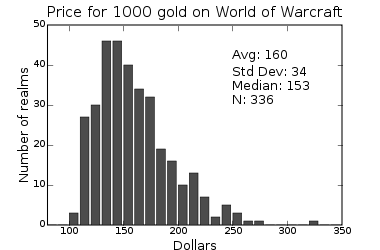
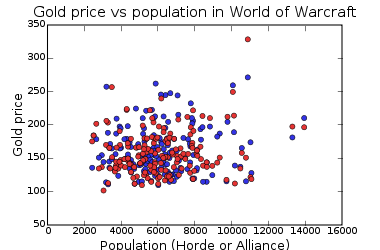
I got the price data from IGE and realm ages and populations from the WoW census.
The 2d rendering is slow. I wrote a quicky program to generate a trivial graph with 4 points then render that plot to an image 10 times in a row. Depending on the backend it can take almost a second to render a graph! Here’s the milliseconds it takes to render a single plot using each of the various matplotlib backends:
GD: 440
Agg: 650
Cairo: 850

SVG: 60
PS: 90
There’s also the no-op backend Template, 50ms. That’s as fast as matplotlib is ever going to be. I’m disappointed by GD performance; it’s not doing antialiasing or anything. Also surprised just how fast the SVG rendering is. I hope that’s a viable publication mechanism some day; right now MSIE doesn’t support it and Firefox misrenders it.
Please reference the following publication when using this collection: G. Pass, A. Chowdhury, C. Torgeson, “A Picture of Search” The First International Conference on Scalable Information Systems, Hong Kong, June, 2006.That paper is readily online: Google search, ACM citation, author PDF download.
The first author is Greg Pass, an AOL employee. Can’t find a web page for him but here are some papers he’s published. The second author is Dr. Abdur Chowdhury, “AOL Chief Architect for Research at AOL”. Ouch. Third author is Cayley Torgeson of Raybeam Solutions.
I gave the paper a quick read. It’s an analysis of usage patterns of search engines: query frequencies, user behaviour, scalability requirements, etc. I didn’t see any particularly surprising analysis but it’s a summary of a lot of interesting hard-to-come-by data. I have a feeling that the AOL employees who released the search logs were honestly just trying to be good researchers and share their data. Only in this case they blew it. Now I feel a little bad for them.
The goal of this collection is to provide real query log data that is based on real users. It could be used for personalization, query reformulation or other types of search research.
cannot sleep with snoring husbandI’m glad the leak happened; now everyone can see just how sensitive search data is. And valuable, too. Search logs are the private corporate property of companies like AOL to use (or misuse) as they want. Or for the US government to subpoena. Is that the best world for us?
god will fulfill your hearts desires
online friendships can be very special
friends online can be different in person
men need encouragement
men need a womans love
men like women with curvy bodiesWe’re just at the beginning of the technology to mine the database of intentions. Thanks to AOL, now everyone can play along at home and try their hand at analysis.
recipe for coconut cream pie
how to flirt with a man
signs of skin cancer
a pimple that wont heal
insomnia after hysterectomy
Ken and I have talked often about living in Europe, either full time or part time. We really enjoyed being in Zürich last fall but in the end decided it wasn’t quite the city for us. We’ve spent enough time in France as tourists to know we like it, so time to take the next step of actually living there for awhile.
If you’re in Paris or think you may be visiting there sometime this fall, drop me a note!
However, sometimes it’s funny. I present to you kitenwar.com. It’s “for resources and information on Kitchenware and Iraq Iran War”. The top 5 ads are labeled kitchenware, Iraq Iran war, cookware, war on terrorism, and cutlery. Some other related searches: depleted uranium and hairless cat.
These particular ads seem to be coming from Yahoo/Overture. Not sure who owns the domain. What I was really looking for was kittenwar.com.
 The Internet used to be a silent experience. Now
thanks to embedded audio, streaming video, podcasts, MySpace music,
YouTube, etc my daily Web trawl is interrupted every three minutes
some noise. All I want to do is peacefully listen to my Erik Satie and read
some stuff. Is there any escape
from noise?
The Internet used to be a silent experience. Now
thanks to embedded audio, streaming video, podcasts, MySpace music,
YouTube, etc my daily Web trawl is interrupted every three minutes
some noise. All I want to do is peacefully listen to my Erik Satie and read
some stuff. Is there any escape
from noise?
Link to annoying sound I briefly embedded.
 IZArc is still good software.
I wrote awhile back about
this compression utility that replaces WinZip, 7-Zip,
WinRAR, and any other file archiver you may use. It’s free, fast, and
has great Windows shell integration so you almost never need to
actually use the GUI. All you could want.
IZArc is still good software.
I wrote awhile back about
this compression utility that replaces WinZip, 7-Zip,
WinRAR, and any other file archiver you may use. It’s free, fast, and
has great Windows shell integration so you almost never need to
actually use the GUI. All you could want.
For some reason no one seems to know about this program, so I’m writing about it again. The homepage is currently featuring a heartbreaking plea for donations so he can afford to buy a copy of Visual Studio 2005 and release a Unicode version of IZArc. If you happen to work in Microsoft dev relations maybe you can find a free copy to ship him?
It mostly works, but it’s got rough edges. Syncing is transparent and effective although I have mysteriously lost a couple of cookies. It syncs most of the data you care about except extensions and toolbar layout. Data is encrypted on the client, an essential feature. It’s kind of ugly: the browser button is too big and it pops up annoying alerts if you run simultaneously on two machines.
But there’s one crippling flaw; it adds about five seconds of startup time everytime you launch Firefox. They must be getting a lot of complaint because it says right on the download page “we’re working on it”. Seems simple enough to fix, just don’t sync every time.
What I find most interesting about this is if you squint, Google Browser Sync looks a whole lot like another piece of Microsoft’s Passport/Hailstorm vision. I have no idea what Google’s planning in this area, but it seems obvious to me that people want to centralize a lot of personal data. Google’s proven they can build products that scale and I’d trust them with my data more than any other company. More like this please!
The American approach is to extend its jurisdiction throughout the world. In the case of online gambling, by arresting people when they change planes in your country. David Carruthers (former CEO of BetOnSports) was arrested, held without bail, and charged with racketeering along with several of his staff. His company seems to have folded completely, promptly firing him and not appearing to support his not guilty plea.
Countries need to enforce laws on the Internet. But of all the things the US could worry about, why online gambling? And nabbing people while they’re in transit through your country seems awfully authoritarian.
 Eve has an unusual skill system. In a typical MMOG like World of
Warcraft your character levels up skills and power as you play. Kill
more monsters, get more experience, get levels. The time it takes to
level in WoW is fairly
predictable, but players are rewarded for being online and
grinding more often.
Eve has an unusual skill system. In a typical MMOG like World of
Warcraft your character levels up skills and power as you play. Kill
more monsters, get more experience, get levels. The time it takes to
level in WoW is fairly
predictable, but players are rewarded for being online and
grinding more often.
Eve isn’t like that. In Eve your skills level whether you’re online or not. And you don’t level faster based on what you do; it’s entirely based on the clock. If I set my character to train Battleship level 3, it will take 36 hours to get there. It will take the same time whether I’m busily shooting NPCs in my Battleship or not, indeed whether I’m even logged in.
At first blush this sounds crazy; where’s the reward for playing? But it works very well. I never do some boring repetitive action to level up; skills train at their own pace. I can take a break from the game for a few weeks and not feel like I’ve lost anything. People with way too much time to grind don’t gain a big advantage over more casual players. And older characters are uniquely valuable; they’ve had the most time to accumulate skills.
In WoW a primary goal is levelling up; in Eve it’s just something that happens. That frees the player to concentrate on more complex goals like “develop a traderoute in Megacyte that makes me rich”. I’m not saying Eve’s better, exactly, but it’s different. And it works.
 Online games are popular because they are social experiences. So it’s
that the most popular online game, World of Warcraft, has such poor
social tools. I just picked up the game
again after
16 months and if anything, the social tools are worse now than
ever.
Online games are popular because they are social experiences. So it’s
that the most popular online game, World of Warcraft, has such poor
social tools. I just picked up the game
again after
16 months and if anything, the social tools are worse now than
ever.
The basic social goal in the game is to find people to play with. And for that, you need to join a guild. But how does someone new find a guild? The main way seems to be you get randomly spammed by people saying “join my guild?” Needless to say, the quality of that experience varies. The better way to find a guild is to randomly group up with people you run across until you find someone you like, then stay with them. So pick-up groups are essential.
Here’s where WoW got worse. The #1 tool for finding a pick-up group is the “looking for group” channel. It used to be chat there was local to your current zone so you were talking with people roughly your level doing the same things. But a recent patch made the channel global for the whole server. Now the channel is full of random spam and a bunch of people asking for groups way beyond my level.
The spam is bad (there’s even a spam filter mod), but the bigger problem is the lack of a place to find people doing things similar to me. The patch has destroyed locality and LFG is now useless.
The other main problem is there’s almost never a reason to actually do things with other people until you’re level 60. The only group goal for newer players is doing quests together, but it’s hard to find quests in common in the first place and the moment someone plays for an hour when their friend is offline they get ahead and the friend can’t catch up. Very awkward.
Then again at 6.5M users WoW is doing something right. My theory is there’s just enough social contact to keep people happy, but it’s really the scripted content and Pavlovian level rewards that keep people going.
               Author tags  Viewer tags
FlickrCentral  7.5 (9.1)    0.1 (0.4)
Interesting    8.0 (6.4)    0.7 (2.2)
What’s it all mean? Not much. The average FlickrCentral photo has 7.5 tags and the average Interesting photo has 8.0 tags. Well within the standard deviations, not a good predictor. Photos in Interestingness do have measurably more viewer contributed tags but that’s not a surprise; photos in Interestingness have more viewers.
So not an interesting result, but I love how easy it is to do this kind of data mining with Flickr.
(For the record, I compared the top 100 interesting photos for each day so far in July, 1900 photos, with the 500 most recent photos in FlickrCentral).
 The best import videogames are the ones that are relics from bizarro
world. Consider the NDS game Osu!
Tatakae! Ouendan, a rhythm game in an anime style with plotlines
lifted from Mentos commercials. Basically, the gameplay is you tapping
the screen in time to the J-Pop music so that your men in black facist
costumes cheer ordinary people along in their daily struggles.
The best import videogames are the ones that are relics from bizarro
world. Consider the NDS game Osu!
Tatakae! Ouendan, a rhythm game in an anime style with plotlines
lifted from Mentos commercials. Basically, the gameplay is you tapping
the screen in time to the J-Pop music so that your men in black facist
costumes cheer ordinary people along in their daily struggles.
I just finished the level where you cheer along a horse so he wins the race and catches the bank robber on the motorcycle. Somewhere along the way the bank robber gets on a skateboard and then your horse is swimming away from the sharks. But in the end it’s OK because thanks to your rhythm skillz your horse kicks the robber with his hind legs and then holds up his roll of Mentos in victory. Or something like that, a bit may be lost in translation.
The main gameplay is straight-up rhythm, tap the screen with the catchy beats. This video gives you an idea. The game is Japanese only right now but is being remade for the US market as Elite Beat Agents. I bought an import copy anyway to revel in the weird otherness of the full-on Japanese experience.

First, the obvious questions. The rotoscope animation effects work. Everything has this shifting unreal quality that fits the story very well. And technically, it’s well done. Also the casting is great, except Keanu Reeves. I had hopes Keanu would be OK in this role; his woodenness could just be taken as schizoid lack of affect. But no, he’s just dull. Robert Downey Jr steals the show. And Winona Ryder hardly has to work to sell lines like “I snort a lot of cocaine”. Yeah, doll, we know.
Linklater’s script lets us down a bit; the movie makes even less sense than the book in critical parts. In particular some crucial scenes are left out that help you follow who’s who. I love how disorienting Dick’s books can be where you’re not quite sure you’re following the author’s narrative so you go back and reread a section two or three times. But in a linear and concrete medium like film the story needs to be clear and Linklater doesn’t quite get it. I wonder if he just had to cut two or three crucial scenes because of time or budget.
But the most important thing about the story is the depressing banality and alienation of bright people hopelessly fucked up on drugs. And the film captures that very well. Some of the early doper scenes are sort of funny, giggling along with Woody Harrelson. But as time goes by it gets more and more horrifying and depressing. I was particularly pleased that the film ends with Dick’s own eulogy for his friends lost to drugs.
This has been a novel about some people who were punished entirely too much for what they did. ... These were comrades whom I had; there are no better. They remain in my mind, and the enemy will never be forgiven. The “enemy” was their mistake in playing. Let them all play again, in some other way, and let them be happy.
The basic rule with French is you don’t pronounce the last letter. Paris is pronounced pair-ree, no s. Vieux is pronounced vyoo, no x. Vous is voo. Etc. Sometimes you have to skip multiple letters; ils parlent, for instance, is pronounced identically to il parle, roughly eel parl.
But those hidden unpronounced letters are in the mind of every French child, even if they don’t usually use them. Particularly because of liason where the lazy French tongue sticks consonants in things. Vous parlez has no s sound but vous avez does (vooz-avey) to avoid having two vowels in a row. The liason rules seem relatively simple and phonological, but they do require you to learn the “extra letters” even if you don’t often need them.
Things take a turn for the weird with pronoun agreement. There the “extra letters” sometimes play a role for grammatical reasons, not phonological.
Je le leur ai donnéBoth mean “I gave it to them”; the difference is whether the “it” is a feminine noun or a masculine noun. There’s an e at the end of donné in the feminine sentence so the verb agrees with the pronoun. But you don’t pronounce that e, so you can happily ignore it in spoken French.
Je la leur ai donnée
Except, there are a few verbs where the pronomial ending does change pronounciation.
Je le leur ai offertIn the first sentence offert is prounounced oh-fair, without the t. Second sentence? oh-fairt. So not only do you have to remember that the participle is spelled with a generally-silent t, you have to remember that the feminine pronoun requires an e on the end of the participle, thereby making the t pronounced.
Je la leur ai offerte
It seems very odd that the grammar is dictating pronounciation, not just phonology. My teacher tells me French native speakers get this rule wrong all the time; I’m sure I will too. But it sure is fascinating.
 I have a great love for Vernor Vinge’s
sprawling scifi novel A Fire Upon the
Deep. It’s kind of a mess, mixing in so many different plots
and concepts that it’s more like three novels. But it’s full of
good space opera and flows well. And like the other early Vinge
work True
Names it benefits from a deep well of brilliant ideas: the
singularity, ASCII Usenet as interstellar communications medium,
telepathic doggy group minds, ... I liked that book so much that
every time Vinge publishes a new one I buy it right away and read it.
I have a great love for Vernor Vinge’s
sprawling scifi novel A Fire Upon the
Deep. It’s kind of a mess, mixing in so many different plots
and concepts that it’s more like three novels. But it’s full of
good space opera and flows well. And like the other early Vinge
work True
Names it benefits from a deep well of brilliant ideas: the
singularity, ASCII Usenet as interstellar communications medium,
telepathic doggy group minds, ... I liked that book so much that
every time Vinge publishes a new one I buy it right away and read it.
Alas, his new novel Rainbow’s End is as disappointing to me as Deepness in the Sky was. It just never quite gets off the ground. The protagonist is an old man rejuvenated by sci-fi miracle medicine, having to adjust to modern technology by socializing with young teenagers. The premise holds promise but the resulting character interactions are wooden and devoid of feeling. The main plot is a mess, something about warring factions and espionage and the menacing but terribly named YGBM technology. But unlike Fire Upon the Deep this mess doesn’t ever turn into anything compelling. There are a few clever scifi concepts tossed in but they stick out and are not integrated well. “Hey! Look! I’m talking about Trusted Computing on this page!”. I managed to finish the book, but it felt like a duty.
I don’t normally write reviews of things I don’t like; what’s the point? But after reading Cory’s gushing praise over on BoingBoing I had to offer my own disappointment. That, and I hold out the hope that someone will point out to me that the book is actually brilliant and I’m an idiot.
Thank you,
Nelson
 I’m not much of a sports fan. But I’ve watched a couple of World Cup
games in the past few days and find it makes for compelling
television. Why? Because they play uninterrupted. 45 minutes of game,
15 minutes halftime, 45 minutes of game. No delays for substitutions,
no TV timeouts, even an injury only delays play for about 60 seconds.
So you get a constant flow of sport rather than 3 minutes of play
punctuated by 3 minutes of filler and commercials. Much more enjoyable
than American football or basketball.
I’m not much of a sports fan. But I’ve watched a couple of World Cup
games in the past few days and find it makes for compelling
television. Why? Because they play uninterrupted. 45 minutes of game,
15 minutes halftime, 45 minutes of game. No delays for substitutions,
no TV timeouts, even an injury only delays play for about 60 seconds.
So you get a constant flow of sport rather than 3 minutes of play
punctuated by 3 minutes of filler and commercials. Much more enjoyable
than American football or basketball.
 One of my favourite nigiri sushi is unagi. I learned
yesterday the French word for eel is “une anguille”. Which sounds
pretty close to “unagi”. Did Japanese borrow the word from French? I’d
have assumed the word would be older than that in both languages.
One of my favourite nigiri sushi is unagi. I learned
yesterday the French word for eel is “une anguille”. Which sounds
pretty close to “unagi”. Did Japanese borrow the word from French? I’d
have assumed the word would be older than that in both languages.
And the radioman says
it is a beautiful night out there
in Los Angelesyou live in Los Angeles
and you are going to Reseda;
we are all in some way or another going to Reseda
someday
to dieand the radioman laughs because
the radioman fucks a model too
Most contemporary gameplay design is about complete control.
Designers, level builders, and testers spend hundreds of hours making
sure that their game plays exactly the way they intend. When players
figure out something unintended it’s usually a glitch or an exploit.
Eve Online is great at giving players a lot more freedom than that,
both on purpose and by accident. Buddy lists and instajumps are two
kinds of accidents.
In Eve you’re supposed to add your friends to your “buddy list” so you can chat to them more easily. But the buddy list turns out to be way more useful for tracking enemies, because the game helpfully tells you if your “buddies” are online. Did that pirate you’re chasing log off? Add him to your buddy list and get an alert the moment he logs in again. Are you at war with Evil Mercenary Corp? Add all 100 of their members and watch for when they’re offline and at their weakest. I’m confident when the Eve designers added buddy lists they didn’t intend for them to be a surveillance tool against your enemies. But it is one, and so the game is a bit more complex.
InstaJumps are an unintended consequences of the design of the travel system. When you dock at a station or jump through a stargate you first warp there quickly, arriving 15km short of your goal. Then you fly slowly through those last 15km until you can dock or jump. You’re invulnerable when warping, but in the 30-60 seconds you fly that last 15km you’re very vulnerable to attack. However, Eve lets you warp to bookmarks in arbitrary points in space. So if you have a bookmark for a spot 15km past your destination then you can warp to that instead, landing 15km short of the bookmark or right on top of the goal. No more vulnerable slow flight.
Having good instas is an essential tactical preparation. They’re a huge pain to make and maintain. People sell them for a lot of money on the open market and good corps spend a lot of time copying libraries of instas. It all feels like a horrible hack, but instas have become an essential part of the game because it simulates local knowledge of the terrain. Having a good BM set is like knowing the lay of the land. It gives you an upper hand over any unprepared marauding invader. It may have all been unintended, but the result makes the game more interesting and developers are on record as saying they’re OK with the situation.
Designing a game requires defining all the laws of physics for a new universe. It’s nearly impossible to get it right. Traditional game design tries to optimize by tightly constraining the rules and testing the hell out of it before release. The Eve developers took a different approach, building an open ended system with lots of possibilities and then refining it over time to optimize it. They’re remarkably good at it and it makes for a remarkably complex game.
When downloading a large file (500 megs), it downloads it to some random spot in a cache somewhere and then when it’s done, copies the file to its actual destination. On this screwed up laptop the copy is taking longer than the download. Why copy at all?
When the on-disk cache gets too big it bugs out in weird ways. The most notable symptom is intra-page links (via #foo in the href) fail. You click them, you go to the top of the page, not the anchor. Doesn’t this bother anyone else?
A similar bug; if you have too many URLs in your browser history IE stops colouring the ones you’ve visited differently. Only fix is to flush the browser history.
Most of these bugs have been in IE for at least three years. Where the hell is the fix? Oh yeah, Microsoft achieved a monopoly in browser share and abandoned development for two years. Good thing someone came up with a real alternative.
Poor Sun. It’s been painful to watch the company’s seven year slide into irrelevance. But their mishandling of Java is the worst story of all. Yes, they built a fine programming platform that created a few profitable server businesses (you know: IBM, BEA.) But their open source strategy has been a fiasco. I still shudder at the memory of the 1988 SCSL 1.0, Sun’s first attempt at open source licensing. It was so complicated that it managed to tie up lawyers and developers for years arguing about what it meant.
There’s a chance that if Sun had embraced open source back then the Java platform would have been adopted and loved by the open source geeks. Instead they fled to create newer technologies: Python, Ruby and Rails, PHP. Now Java seems increasingly irrelevant; a necessity sometimes, but a frustrating middleground between C++ and a nice scripting language like Python or Ruby. I wonder if anyone will care about Java’s future by the time Sun figures out a workable open source license?
PS: please don’t email me to say “Sun had to restrict Java licensing because Microsoft was going to corrupt the platform OMG suxx0rs!”. That threat ended years ago, and if Sun really hamstrung their own technology out of fear of Microsoft then they’re dumber than they look. Anyway, it’s really all about Sun vs. IBM.
Traffic analysis is a very powerful technique. All you need to know are when calls are made, from whom, and to whom. Apply a little statistical analysis and out comes an amazing picture of social networks. Want to know which hookers Cunningham has been using? NSA knows. Want to catch the White House jamming phones during an election? All you need are call records.
NSA used to be limited to foreign surveillance only. It was a necessary balance on a secret organization with so much leeway. It’s clear now that restriction is gone. So, apparently, is any sort of judicial oversight via the FISA court. In addition to this traffic analysis revelation, we also have the warrantless domestic wiretaps (with low yield) and the EFF lawsuit against AT&T’s cooperation with NSA (which will presumably be killed because it’s “a state secret”). Where does this stop?
You should assume all your Internet traffic patterns are also being analyzed; it’s even easier to do than phone calls. Please support the ACLU and the EFF.
The Gruyère issue also has a fantastic article on tropical fruits in Homestead, Florida, the southernmost big town in Florida short of Key West. While all commercial US fruit suffers greatly from the industrial farming process, tropical fruit is the worst off since the stuff is practically rotting before it’s really ripe. But in Homestead they grow the stuff and if you’re there you can eat it truly ripe and fresh.
The article goes into detail about two establishments. First is Robert is Here, an overgrown roadside fruit stand that specializes in a huge variety of unusual and well grown fruits. Even more exciting is the Fruit and Spice Park, a sort of all-you-can-eat arboretum. 35 acres of well tended trees, most with edible fruit. Visitors are welcome to eat anything on the ground. Both places sound like a great way to try out a variety of exotic fruits. And a welcome change from industrial mangoes that taste like nothing.
 I love non-dance electronic music,
glitchy groups like
Autechre
and Pole
and mellow stuff like
Vladislav
Delay and Boards
of Canada.
Electronic music is notoriously difficult
to categorize, so it’s
often hard to find new things.
I love non-dance electronic music,
glitchy groups like
Autechre
and Pole
and mellow stuff like
Vladislav
Delay and Boards
of Canada.
Electronic music is notoriously difficult
to categorize, so it’s
often hard to find new things.
And I really like the new thing I just found, music published by Thinner, a German electronic music label that’s put out 80 releases over the last 5 years. The catalog currently totals 60 hours and 5.5 gigs of MP3. I’ve never heard of most of their artists, but I stumbled into them because of their Vladislav Delay release. They characterize themselves as “dub inspired electronic music”. No idea what the hell that means; there sure isn’t any Scratch Perry going on, but it’s mostly mellow and noodly electronica that’s interesting and without an annoying 120 bpm pulse. The online album covers have some great animated graphic design, too.
The best thing? It’s all free! CC licensed. As I write this I’m listening to track 1 from Digitalverein. It’s easiest to download the entire zip for a release. You may note the release naming is consistent for easy download scripting.
 Today’s paper brings an obituary for
Henriette
Avram, a pioneer in computing and informatics. She led the
development of
MARC, the standard
electronic library card catalog system used in the US.
Today’s paper brings an obituary for
Henriette
Avram, a pioneer in computing and informatics. She led the
development of
MARC, the standard
electronic library card catalog system used in the US.
MARC is an amazing accomplishment, 35 years of being the primary repository of library catalog information. The main technologies are a simple tagged data format, an encoding, and a variety of communications channels. The social system is very effective, a Wikipedia-like collaborative network of people creating and sharing MARC entries for new materials.
By modern standards MARC is pretty clumsy. Three digit tags? Come on! And where are <all> the < pointy brackets/> </all>? But none of that matters; MARC is an information system that was basically designed right and continues to have longevity thanks to its social capital.

 FeedDemon
2.0,
the RSS reader, is somewhat bad software. The upgrade
to 2.0 went well enough, but there are so many irritating usability
quirks that I dislike it. It’s no worse than 1.5 was, but
no better.
FeedDemon
2.0,
the RSS reader, is somewhat bad software. The upgrade
to 2.0 went well enough, but there are so many irritating usability
quirks that I dislike it. It’s no worse than 1.5 was, but
no better.
Well, one thing is worse: it frequently guesses wrong on character encodings. So I’m reading garbage like “don’t”. I know enough about the dog’s breakfast of feed encodings to know this is a nasty problem. I don’t care. The browser’s going to have to guess to get it right. Here’s a hint: the € and ™ characters never belong in the middle of a word. Turns out this only shows up if you use Mozilla as the HTML widget; IE doesn’t have the problem. FeedDemon is clear that Mozilla is experimental only, so my bad.
But the main problem is the keyboard control. It’s a three pane reader, but each pane has different keyboard controls. There’s no visual indicator of where focus is and it seems to move around even without me clicking the mouse. So you never know what pressing a key will do. Is PageDown going to scroll the browser view? Or do something mysterious in the list of feeds? Is there any way to make the “spacebar moves to next unread item” work reliably? I can’t do it.
The default keystrokes for “mark feed read” and “mark group read” are the contorted “Ctrl-Shift-A” and “Ctrl-R”. Yeah, that’s convenient to press frequently. I thought I’d be clever and reassign those to “A” and “R” but I’m not allowed to. I guess the theory is I may want to be typing text into a form while reading blogs? Um, no.
More than most software, a feed reader needs to have really good ergonomics. FeedDemon fails that test. Time to look for something new for Windows.
What are you thinking, reporting on N.S.A. wiretapping or secret prisons in Eastern Europe? Those things are secret for a very important reason, they’re superdepressing. And if that’s your goal, well, misery accomplished. ...Video here, 26 megs and 15 minutes. You can stop at 07:30 though, it goes to a stupid canned clip that never gets better.Let’s review the rules. Here’s how it works. The president makes decisions, he’s the decider. The press secretary announces those decisions, and you people of the press type those decisions down. Make, announce, type. Put them through a spell check and go home. Get to know your family again. Make love to your wife. Write that novel you got kicking around in your head. You know, the one about the intrepid Washington reporter with the courage to stand up to the administration. You know, fiction.
 The EFF recently
discovered that AT&T is illegally helping NSA intercept US
citizen’s
communications passing through their networks. Vast government
hoovering of private data is nothing new, but it is illegal and
dangerous and must be stopped.
The EFF recently
discovered that AT&T is illegally helping NSA intercept US
citizen’s
communications passing through their networks. Vast government
hoovering of private data is nothing new, but it is illegal and
dangerous and must be stopped.
On Friday evening the US government announced they will try to halt the lawsuit based on the military and state secrets privilege. That privilege is an extraordinary power the government has to prevent a lawsuit by claiming it will lead to the disclosure of essential military secrets. I’m sure that privilege is necessary in some very limited cases, but it’s a very dangerous power that should not be applied frivolously to stop a civil liberties investigation.
So now we have the US government preventing the investigation of illegal government action by declaring that the actions of AT&T, a complicit private corporation, are military secrets. It’s hideous. You can do something. Support the EFF and the ACLU. They are particularly effective at fighting government abuse of citizen liberty.
The hero of this story is Mark Klein, a former AT&T technician. He blew the whistle on AT&T after observing secret installations in an AT&T central office in San Francisco. They were literally splitting the fibre, copying all traffic. How long will it be before he’s sued or imprisoned for violating trade secrets or state secrets?
Candle lights may burn until 10 PM.I love how efficient this information is. It’s the first day where it sounds like things are under control.
No building permits needed for temporary shelter.
Fires not permitted indoors until chimneys are inspected.
All contributions to Relief Fund sould be sent to Joames D. Phelan, chariman of committee, Pine and Fillmore streets.
Within two days street cars will be running on four important routes. Transportation free.
Prepartions are being made to resume electric lighting at once in a considerable portion of the unburned section north of Market street.
No San Francisco banks will move out of city.
Superior courts have resumed business.
Standing walls in business district are being dynamited.
Telephone service has been resumed.
It is thought that there is no danger of an epidemic. Sanitary situation is improving.
Embargo on shipping lifted.
Sewers found to be in better condition than supposed.
One example of Eve Online’s emergent
gameplay complexity is the economic system. MMOG economies are
generally marked by hyperinflation, simplistic valuations, and
little opportunity for generating wealth except killing things. By
contrast Eve is a complex and balanced economy.
Hunting NPCs, mining, mercenary PC killing, trading, hauling,
and manufacturing are all reasonable ways to generate wealth.
There are three things of value in Eve: currency (called ISK), minerals, and ships/ship parts. Players generate wealth by mining minerals and hunting NPCs for ISK bounties. Ships are for the most part built by players out of minerals. Minerals and ships are traded on the regional markets where prices are set by the players. Demand for goods varies by day, week, and location, so there are plenty of people who make a fine living doing arbitrage.
Eve markets have a locality that makes the economics even more complex. The 66 regional markets are disconnected, so players can’t easily see the prices across the entire universe. I’ve made a fair amount of ISK by buying stuff cheaply in one region and selling it in a more expensive region, exploiting the information inefficiency. There’s also a locality effect caused by the difficulty of moving goods around. There’s no mail or NPC courier service, stuff has to be moved by people. This takes time and risk, so prices tend to vary quite a bit in different areas depending on local conditions.
Eve seems less prone to inflation than most MMOGs. There are plenty of sources of wealth in Eve, but there’s also a giant sink: PvP ship battles. When a ship is blown up it’s value is destroyed. So even experienced characters worry about wealth. There’s even a mild RTS element to the game with alliances wars over several weeks causing attrition of corporate coffers.
My war profiteering of last week was successful. The invasion of my station never happened, so I got to keep the cheaply acquired minerals. The dreaded BoB Alliance did raise a lot of hell (see this 300MB video) and have been blowing up so many ships that prices of minerals are going up all over the universe. Unfortunately now that our guests in my region are gone no one is buying my goods; I’m debating whether to hoard my minerals until market conditions improve or just haul them somewhere and sell them at a profit.
FeedDemon continues to be good software. I finally got around to
upgrading to 2.0 today. I don’t care about the online synchronization
feature, but some of the bugs in 1.5 were annoying me. The upgrade
could not have been smoother. Download, install to a new directory,
and it automatically imported my subscriptions, reading state, UI
preferences, and license key. Couldn’t be simpler.
The CIA fired a top intelligence analyst who admitted leaking classified information that led to a Pulitzer Prize-winning story about a network of secret CIA prisons, government officials say.Yes, a fine investigation into the latest shameful American prison scandal. In our corrupt society it’s not the torturers that are punished, it’s the whistleblowers.
 I finally found a solution for Oblivion running poorly on my PC;
upgrading
DirectX 9.0c to the
April
2006 version. No idea how this 9.0c is different from the older
9.0c that was on my machine, but it’s smoothed out the framerates
significantly. Much more success than trying to various tweaks.
PCs are such a mess; Oblivion definitely runs better on the Xbox 360.
The updater for Adobe Reader is bad software. It pops up
an irritating window everytime I try to read a PDF telling me to
upgrade, interrupting whatever it was I was trying to do. I finally
succumbed and clicked “update”, at which point it pops up a second window
to show download progress. You can hide that window (where it bizarrely
goes to a tray icon, not the tray), but when it’s done it pops up
again and pops up a second window asking if I want to now install the
software. Sure, I’ll install, and guess what? Now it wants me to
reboot! So I click “don’t reboot” and just for revenge it pops up one
more Reader window, empty this time.
I finally found a solution for Oblivion running poorly on my PC;
upgrading
DirectX 9.0c to the
April
2006 version. No idea how this 9.0c is different from the older
9.0c that was on my machine, but it’s smoothed out the framerates
significantly. Much more success than trying to various tweaks.
PCs are such a mess; Oblivion definitely runs better on the Xbox 360.
The updater for Adobe Reader is bad software. It pops up
an irritating window everytime I try to read a PDF telling me to
upgrade, interrupting whatever it was I was trying to do. I finally
succumbed and clicked “update”, at which point it pops up a second window
to show download progress. You can hide that window (where it bizarrely
goes to a tray icon, not the tray), but when it’s done it pops up
again and pops up a second window asking if I want to now install the
software. Sure, I’ll install, and guess what? Now it wants me to
reboot! So I click “don’t reboot” and just for revenge it pops up one
more Reader window, empty this time.
In summary: a minor software update causes 4 windows and a tray icon to pop up and requires three mouse clicks and a reboot to install. Smooth going, Adobe. Somewhere inside Reader there’s a good document engine struggling to be free, but it sure is buried behind a lot of crap.
I was going to say it’s hard to imagine what it was like to have a whole city destroyed in the course of three days. But no imagination required; it happened last year in New Orleans. The stories about San Francisco’s recovery talk about the optimism and “city that knows how” spirit that quickly restored San Francisco to greatness. I hope New Orleans can pull that off too, but it seems a more cynical era now. New Orleans is still nonfunctional and there are grave doubts that adequate levees can be built before the 2006 hurricane season. It all seems quite pessimistic.
I hope that I don’t live to see a great quake come through San Francisco. Odds are one will. My friends and I are pretty much unprepared. The best I’ve done is print out some earthquake preparation tips; maybe I should get around to actually getting a kit together? But the first 3 days are a crapshoot; it’s the idea of rebuilding the whole city again that gives me chills.
 I really miss the food in Santa Fe.
Particularly New Mexico chile. Milder and more
flavourful than most chile peppers,
they’re used whole as the main vegetable in dishes or in large
quantities as a spice.
I really miss the food in Santa Fe.
Particularly New Mexico chile. Milder and more
flavourful than most chile peppers,
they’re used whole as the main vegetable in dishes or in large
quantities as a spice.
My favourite chile is Chimayo red chile. The little town of Chimayo is famous for three things. El Santuario de Chimayo is a country pilgrimage church with dirt you eat to heal you of your sicknesses. Rancho de Chimayo is a great New Mexican restaurant. And the red chile grown in Chimayo is the best in the world, rich tasting and mild enough you can use it in great quantity.
Happily you can order Chimayo chile online cheaply: grocery store brand Bueno Foods will ship you 3 pounds for $20. That may sound like a lot of chile, but you can easily use 1 ounce per person making dinner.
Oblivion
is out and doing great in the reviews. I like it OK, but despite the
fantastic physics and AI it’s not bowling me over.
It just runs too slow and the writing is too simplistic.
Still, it’s one of the best games that will come out this year.
The best thing about Oblivion is how rich and intricate the world is. And so Oblivion has given birth to a bunch of blogs of people writing about the random stuff that happens to them in their (virtual) lives. This first person blog is the most amusing, along with this nerdy blog and this tech tips oriented one. Spoilers abound.

I’ve recently become a war profiteer. My corporation built a couple of space stations and controls a small territory in lawless 0.0 space. That’s a big deal, few corps have done that. We have some guests who use our stations who recently heard a rumour that we were about to be attacked by a dreaded enemy alliance. Rather than risk losing everything our guests have decided to cut and run.
That’s when I saw my opportunity to become a cold blooded merchant. Because they’re leaving in a hurry, our guests have an urgent need to upgrade their engines and sell what they can’t carry. So I’ve been filling the market need, selling parts to the fleeing pilots for 10x what they cost to make and buying their minerals for 1/10 their value. It’s a ruthless sort of opportunism, but I’m the only one willing to take the risk so I set the prices. If I pull this off I’ll triple my wealth; if my station gets taken over I’ll end up losing about half. I’ll know how it works out in a few days.
What’s fantastic about this little story is that no one wrote it for us; it’s all a natural consequence of the rich and complex game design. Players can build space stations, but they are at risk of being conquered by other players. Players can build wealth by mining minerals, but it’s hard to haul minerals around. There’s an open market where prices are set by other players. Put this all together and complexity emerges; in this case, my war profiteering.
That’s just one small example; Eve is full of stories like this. It’s a refreshing change from the entertaining but simplistic scripted gameplay of mainstream MMOGs like World of Warcraft. If you want to try it out, there’s a 14 day free trial. It takes awhile to find the fun parts, so if you play for a few days but can’t find anything enjoyable email me.
Is any of it true? I tried to verify one item by doing a search for [“Dick Cheney” “hydrogen peroxide”]. Right now there are 602 results on Google, very few coming from the Something Awful post. Alas, none that I see confirm the story. Tomorrow there will probably be a few thousand hits on every search engine and it will be impossible to do a search to try to find an independent source.
A better example is Quaoar, a planetoid discovered in June 2002. The day the discovery was announced there were exactly 3 results on Google for the word, all about the original mythological name. Now there are 300,000 results. For awhile I tracked the growth of search results for the word to see how fast it spread. Quickly, it turns out.
It used to be that major search engines had updates roughly once a month. So it’d take about two weeks before a new piece of information was easily findable on the web. Now a significant portion of all three major search engines updates every day, sometimes even faster. Information is accelerating.
 My fancy quiet PC has
been running hot. I thought it was Oblivion’s fault, but
when I opened up the case I saw how filthy my high tech vacuum cleaner
had become.
My fancy quiet PC has
been running hot. I thought it was Oblivion’s fault, but
when I opened up the case I saw how filthy my high tech vacuum cleaner
had become.
Removing a couple of grams of dust from the heatsinks and fans brought the max CPU temperature down from an alarming 82°C to a merely scorching 66°C. I never thought filth would make that big a difference.
IZArc is good software. It’s a
Windows compression program that replaces WinZip, 7-Zip, WinRAR, and
whatever other nightmareware you might have installed.
File compression is commodity software. You only need two things: a humane UI and decompressors for whatever files you may come across. IZArc is the first program to have both required features. It supports all the formats you might care about (in particular: zip, rar, ace, 7z) and it’s got a nice clean UI. I never even launch the program anymore, it’s boiled down to a single shell extension command: “make new folder and extract contents”.
Oh yeah, and it’s free. $25 suggested donation, but no more guiltily skipping nag screens if you are cheap.
 A lot of my photos from Australia
have bright blue skies with dark trees in front of them. Like
this.
One thing that irritates me when editing them is the tree branches have noticeable blue tints.
A lot of my photos from Australia
have bright blue skies with dark trees in front of them. Like
this.
One thing that irritates me when editing them is the tree branches have noticeable blue tints.
The problem is the branches are only a couple of pixels wide. And digital cameras aren’t true colour sensors, but rather a Bayer filter mosaic of red, green, and blue sensors. So there’s some aliasing in the mosaic pattern in the colour sensor. The raw convertor has to be particularly clever to figure out the true colours in the image. To put it another way, a digital camera sensor is going to have a very hard time with colour features only a couple of pixels wide.
Here’s a comparison of four raw convertors: Canon’s Digital Photo Professional, Rawshooter Essentials, Adobe Camera Raw, and DxO Optics. To keep things consistent I used full defaults for each convertor. So ignore the exposure and overall colour, just look for bleed. To my eye the DxO image has the least bleed. The blow-up doesn’t look as sharp in DxO, but I think that’s actually more faithful to the reality.
Tinkering around I think I can get the best-looking image out of DxO. It has lots of fancy camera body and lens-specific corrections and, apparently, a smarter demosaicing algorithm. But this kind of pixel-peeping doesn’t make me a better photographer. And DxO is a pain in the ass. So I’ll just stick with Photoshop. Still, the technological differences are interesting.
Today’s my last day as an employee of Google. I’ve been on leave since December, so it’s not
really a big change this day. But now the decision’s made.
It feels a bit strange leaving such a great and productive company.
But I’m ready to do something new with a smaller group of people. No
idea what that would be yet. I’m also working towards living in France
for a few months this fall.
So goodbye, Google, and thank you for a fun and interesting job. While I worked for you I built two APIs for your customers: search and AdWords. I did a bunch of Java webapp work, object-relational mappings and servlet infrastucture and the like. I particularly enjoyed being able to meddle and consult on various products as they were being born. Thanks!
The new RPG Oblivion is
a
fantastic game. Intricate, sprawling, beautiful. The incredible
lighting, physics, and detail brings the strongest PC to its knees.
It seems to be the first game that really shows the
Xbox 360 off to full potential.
The developers (Bethesda) are selling small content updates for download for both PC and 360, about $2 an update. Unfortunately the first product, the “Horse Armor Pack”, looks to be nothing but some graphic models that had been heavily promoted in prerelease screenshots. Fans are pissed off, vowing not to buy something they feel should have been in the game they already paid $50 or $60 for.
It’s too bad Bethesda’s plan is starting out this way. Selling microcontent add-ons for games is a brilliant and consumer friendly business plan. Neverwinter Nights has done it successfully with new adventures for sale for $5 to $10. And a bunch of alternative games are doing it, like Doubloon Oceans in Puzzle Pirates. Some day there will even be commercial markets for fan-generated content, although so far only The Sims and Second Life have begun to make that work. It’s all part of the transition of games to a software service rather than a shrinkwrapped package. It will happen.
Alas, Bethesda has introduced this concept poorly to their customers. The next two products (Orrery and Wizard’s Tower) look better, containing actual story, although I’m irritated to learn that apparently the fantastic Mage’s Orrery I keep hearing about in-game is something I’ll have to pay extra for.
Bethesda is positioning all this as an experiment. Good. I hope they decide to become less miserly. Selling microcontent add-ons to games is a great idea, but you have to be generous about it.
 AVG Free is good software. It’s
simple, effective anti-virus protection that’s free for home use. The
commercial version starts at $20/year/machine. Easy download and
install, seems to do the basics well. The UI is a bit clunky but how
often do you operate your anti-virus software?
AVG Free is good software. It’s
simple, effective anti-virus protection that’s free for home use. The
commercial version starts at $20/year/machine. Easy download and
install, seems to do the basics well. The UI is a bit clunky but how
often do you operate your anti-virus software?
I’ve been a loyal Symantec Norton Antivirus user for years, paying $25 a year to upgrade. But those upgrades kept adding new features I didn’t want and made the product bloated and slow. The trouble started with the worm blocking that made opening network connections 100x slower. NAV 2006 has had several installation and update bugs and more features I have to turn off like the email scanner. The final straw was that its daily update makes my computer slow, pops up a window that steals focus, and apparently can’t be rescheduled to a quiet time. Bye.
So now I have 10 or 20 megs more RAM free and my computer boots faster too. Let’s hope AVG really does protect well; all the reviews say it’s great.
The 2006b update contains the news that Indiana has now standardized their adoption of DST. It also has the fact that this year, Melbourne is delaying the adoption of DST one week to accomodate the Commonwealth Games. But that’s all practical stuff; what’s fun about zoneinfo is all the learned and detailed comments about local time jurisdictions. Paul Eggert is particularly eloquent.
Shanks writes that Michigan started using standard time on 1885-09-18, but Howse writes (pp 124-125, referring to Popular Astronomy, 1901-01) that Detroit kept
local time until 1900 when the City Council decreed that clocks should be put back twenty-eight minutes to Central Standard Time. Half the city obeyed, half refused. After considerable debate, the decision was rescinded and the city reverted to Sun time. A derisive offer to erect a sundial in front of the city hall was referred to the Committee on Sewers. Then, in 1905, Central time was adopted by city vote.This story is too entertaining to be false, so go with Howse over Shanks.
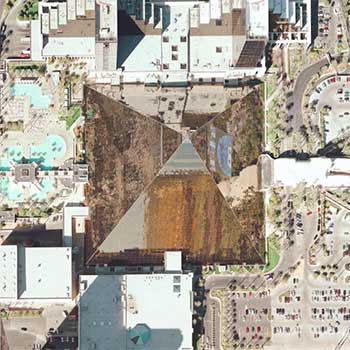
The capacity for uncoordinated third-party contribution makes the PC and Internet highly generative ... Generativity can mean excess and outright disruption. ... I think a watershed in the security space -- for example, a mass-distributed virus whose payload wipes out hard drives -- could change consumer sentiment so that a controlled information environment is appealing to many more people.Spyware, adware, and other horrible scumware crap is a major plague on computers. But it hadn’t occurred to me this might cause a consumer demand for more walled gardens and restricted networks. I’m increasingly thinking we need to move the Internet towards an architecture that is more secure and less anonymous, I just hope we can do it in a way that doesn’t concentrate power in the hands of a few large companies.
Are we really expected to believe the official story that Abu Ghraib was just a few bad apples on the night shift? What about other torture prisons like Camp Nama? What about the persistent reports of CIA involvement? What about direct approval of torture by the Secretary of Defense?
The NYT has a bit of the story today.
Some military experts said one reason there had not been attempts to pursue charges up the military chain of command was that the military does not have anything tantamount to a district attorney’s office ...I fear the US has become a place where we think it’s OK to torture people. Bush-induced hysteria about terrorism combined with one too many seasons of 24 makes us think that near-drownings, beatings, and terrorizing people with animals is just fine. Only 1/3 of Americans say torture is never right, so why bother prosecuting?Several generals and colonels have received career-ending reprimands and have been stripped of their commands, but there is no indication that other senior-level officers and civilian officials will ever be held accountable for the detainee abuses that took place in Iraq and Afghanistan.
Marc’s distilled a lot of what we learned in a fantastic essay titled Entrepreneurial Proverbs. It speaks very directly and honestly from actual experience; no whitewashing, no glossy business case history. Starting a company is dirty, demanding, and hugely rewarding. I’m excited to see how Marc does with his new venture.
They call Australia “the
lucky country”. Never have
I travelled somewhere where the people are so generous, easygoing,
and happy. “No worries, mate” is the cliché expression all over
Australia but it carries real meaning.
Some quick first impressions. Australia is more like the US than any place I’ve travelled, including Canada. Only more American than the US; less crowded, bigger city sprawls, more informality. It’s a very prosperous place, beautiful and comfortable. And it’s not all flat and hot; I never saw desert, just lots of rainforests.
Melbourne was my favourite city, comfortable and cosmopolitan with a European street cafe culture. Sydney is beautiful but so much like San Francisco we felt like we hadn’t left home! Tasmania is amazingly wild and wonderful and the countryside in Victoria is charming with lots of great 19th century history apparent.
There’s nothing like international travel to make you ashamed of US politics. The folks I met were all very friendly and polite about it, but Bush is deeply disliked there. The Sydney paper doesn’t pull any punches with its headlines, either; “Revelations add to picture of US torture”. What a horrible legacy.
 College campuses in the US are being asked to foot the bill to allow
law enforcement to eavesdrop on their students’ online conversations.
College campuses in the US are being asked to foot the bill to allow
law enforcement to eavesdrop on their students’ online conversations.
In 1994 the US passed CALEA, a law requiring that telephone companies architect their systems so it’s easy for law enforcement to tap digital phone calls. In 2004 CALEA was expanded to apply to the Internet, in particular voice-over-IP calls and other aspects of Internet communciation. Then the FCC got in the act, saying in August 2004 that CALEA would apply to pretty much anyone providing Internet access.
Which leads us to college campuses which, among other things, provide Internet access to their students. Now these campuses may not only have to help the government spy on their students and faculty, they may have to pay the bill! Just what you need on a non-profit budget.
Not only is this extension of wiretap privileges a violation of citizen privacy, it’s a wasteful expense. EDUCAUSE is defending the academic institutions, filing briefs with FCC saying the requirements are too onerous. The whole concept of CALEA is wrong-headed, but the expense argument may actually work.
 Parking at a meter in SF costs at least $1.50/hour.
You need eight quarters in your
pocket to stop for lunch. Who has that kind of change?
Parking at a meter in SF costs at least $1.50/hour.
You need eight quarters in your
pocket to stop for lunch. Who has that kind of change?
Awhile back SF upgraded all its meters to take stored value smart cards. Now, two years later, you can finally buy the cards! The places to buy them were a well kept secret, but recently it was disclosed you can buy them at Muni sales counters. Why not online? beats me.
The implementation seems pretty good; you put the card in a meter, the meter tells you your balance, and then the longer you keep the card in the meter the more (virtual) quarters you drop. Simple enough. I note my non-refundable card is set to expire at the end of this year. It’s all a “trial program”, you see. I just wanna park!

What I find astounding is that some aspects of this business are so lucrative that American companies are trying to make them legitimate. It’s shameful that a company with such an awful history as an adware provider was able to raise $40 million in venture capital.
You know your aunt’s computer, the one with the porno ad software you can’t remove? The people who knowingly finance and install that software belong in jail.
In addition to Photoshop there are a lot of other HDR tools out there. Photomatix is one really easy to use standalone tool with a free trial for Mac and Windows. It seems a bit more fast-and-loose than Photoshop’s nerdy careful approach, well suited for exploration. I particularly like the “Exposure Blending” tool where you can throw a bunch of photos into it and quickly come up with a single tone-mapped JPG. If you want to play with HDR and Photoshop seems too difficult, check out Photomatix.

A photograph is properly exposed if the camera has the right aperture, shutter speed, and ISO film/sensor sensitivity to capture most of the light coming in from the scene. The actual science is complicated (the magic word is EV), but the way photographers talk about it is in terms of “stops”. If a scene is twice as bright then you need one less stop in the camera to make your photo. Conversely, opening up a stop doubles the amount of light recorded.
Shutter speed is one way to adjust stops; if you double the length of the exposure you double the amount of light captured. Common hand-held exposures in one stop increments are 1/30s, 1/60s, 1/125s, 1/250s, 1/500s. My Canon 350d lets me adjust shutter in 1/3 stop increments such as 1/30s, 1/40s, 1/50s, 1/60s. So I have to click the wheel three times to double the amount of light recorded.
Aperture (or, confusingly, “f-stop”) is another way to adjust exposure. Opening the lens aperture one stop will double the amount of light coming in. The numbering is a bit confusing because of the geometry; doubling the f-stop number will cut the amount of light coming in by one quarter, two stops. Common one stop increments for aperture are f2, f2.8, f4, f5.6, f8, f11, f16. My Canon 350d lets me adjust aperture in 1/3 stop increments such as f2.8, f3.2, f3.5, f4.0. So just like when adjusting shutter speed, I have to click the wheel three times to double the amount of light recorded.
Finally, the third way to adjust exposure in a camera is to change the ISO sensitivity of the digital sensor (or film). Doubling the ISO will make the sensor twice as sensitive to light, which is about the same as doubling the amount of light recorded. Common ISOs in digital cameras are 100, 200, 400, 800, 1600. My 350d only lets me adjust ISO in full stop increments (not 1/3), so every time I “click the wheel” (or push the button) I’m doubling the amount of light recorded.
That’s a lot of detail, but what it boils down to is:
A modern camera with light metering means you can mostly be ignorant of this stuff, just put the camera in P mode and click the wheel to trade off shutter speed and aperture for artistic effect. But now I understand just what I get by bumping up one ISO level: I can cut the exposure time in half. And this information is a foundation for more complex topics. The next thing I’m trying to understand is dynamic range; just how wide a range of EV various scenes have, how many EV levels my camera can capture in a single photo, and how many EV I can print or view on a screen. This article is a good start.
 Ken and I love to travel but sometimes we have trouble thinking of
interesting new places to go. The book 1000
Places to See Before You Die is a great source of ideas. Just
like it sounds: a list of places worth seeing in the world.
Parks, gastronomy, archeological sites, etc.
Ken and I love to travel but sometimes we have trouble thinking of
interesting new places to go. The book 1000
Places to See Before You Die is a great source of ideas. Just
like it sounds: a list of places worth seeing in the world.
Parks, gastronomy, archeological sites, etc.
For example, California’s entry is twelve pages on Death Valley, Yosemite, the Monterey Peninsula, the Pacific Coast Highway, the Golden Door spa, Hotel del Coronado, the Getty Museum, Hollywood, the SF Cable Cars, Chez Panisse, and Wine Country. I could quibble with a couple of these suggestions, but if you’ve never been to California that’s a pretty good place to start. And the book has suggestions like this for the whole world. Tanzania? Bhutan? France? All here.
It sounds a bit cheesy, but the book is well executed and full of interesting ideas. And the short format makes it ideal for occasional browsing. Fun book.
Ken and I have a trip planned
to Australia. Many thanks to everyone who wrote in with
suggestions! Australia is a very popular place.
If you think you want to visit, read
In a Sunburned Country. It’s great light
travel reading, with lots of insight, and will definitely make you
eager to visit.
We’re the type of travellers who have to have every night’s hotel planned before we leave. Unfortunate for spontaneity but good for avoiding stress. Here’s the plan:
Photoshop CS2 makes HDR easy for normal people. Some intro material on HDR can be found in this tutorial and this article. The HDR Flickr Group is fun, too.


We walked around the coast and mostly just relaxed, took photos. On the way back we drove through the Alexander Valley and stopped in Navarro Vineyards for wine and Healdsburg for lunch. California is a good place to be.
Bonus tip: Microsoft has a RAW Image Thumbnailer PowerToy that lets the file browser make thumbnails of your RAW images, just like JPGs. Works great.
 43 Folders cracks me up. Not only does this tips-for-living blog have
an article
about reducing stuff to carry, it has multiple wiki
lists
and a meaningful pull quote from
an Washington Post article
about how the crap we carry reveals the existential crisis of modern
living.
43 Folders cracks me up. Not only does this tips-for-living blog have
an article
about reducing stuff to carry, it has multiple wiki
lists
and a meaningful pull quote from
an Washington Post article
about how the crap we carry reveals the existential crisis of modern
living.
Reading their lists reminded me of how happy I became when I got rid of my inch-thick wallet and started carrying a tiny card case instead. Mine carries cash, a driver’s license, two credit cards, an ATM card, and a piece of paper with essential info like health insurance policy codes and emergency phone numbers. I get a little sense of peace everytime I remember how little I have in my pockets. The Tumi product is great quality, too.
 Qoop is a clever service that
prints books of your photos. It has amazing integration with Flickr.
Go to Qoop, look at your Flickr photos and choose which to print,
enter a credit card and a few days later a nicely bound
book of pictures comes to your house. Couldn’t be simpler.
Qoop is a clever service that
prints books of your photos. It has amazing integration with Flickr.
Go to Qoop, look at your Flickr photos and choose which to print,
enter a credit card and a few days later a nicely bound
book of pictures comes to your house. Couldn’t be simpler.
I ordered a book of 168 of my photos from Switzerland. The 8x10″ book format is great; easy to flip through and look at pictures, easy to put on a shelf to preserve. Qoop also offers posters and calendars and soon, postcards.
The print quality is a compromise. The perfect binding and paper quality are terrific. But it’s not a photo printer, it’s more like a high quality color laser printer. The color matching isn’t great and sometimes the ink is a bit uneven. But the books are relatively inexpensive (my order came to 40 cents a photo) and a heck of a lot nicer than printing a bunch of 5x7″ and pasting them in an album. Their customer service is very friendly and responsive, too. I’ll definitely be ordering more books.
I’m amazed at how convenient the process was. I assume the core enabler here is the Flickr API which allows Qoop to get at my photos. More web services like this, please!
 Logging into services online is a mess; different usernames and
passwords at different sites, different standards of trust and security.
But it’s just as bad in the financial world.
Logging into services online is a mess; different usernames and
passwords at different sites, different standards of trust and security.
But it’s just as bad in the financial world.
For many financial transactions a signature is sufficient. For some, you have to have the signature notarized. The notary’s job is to verify your ID, maybe take a thumbprint, and take $10 from you. Somehow this adds security. I learned today there’s a different kind of signature authentication, the Medallion Signature Guarantee. It’s commonly used to authorize stock transactions. Banks charge $10; crazily enough they’re apparently assuming liability for your authentication.
Today the Washington
Post gives us the breakdown on the results of Bush’s illegal
wiretap program. 5000 Americans
were spied upon; 10 of them were sufficiently suspicious to merit
further investigation. One in five hundred. But according to the
article, the conventional legal standard is that one in two wiretaps
need to bear fruit to meet the requirement of probable cause.
Now it’s
clear why the Bush Administration knowingly violated the law; they couldn’t meet
its requirements. It’s good to be the king.
I know we’re all suffering outrage fatigue here, but this extension of executive power is a serious threat to orderly US government. It has to be stopped. I just got a letter from the ACLU saying they’re raising $1,000,000 to work a ninety day ad campaign on the wiretap issue and the Patriot Act. The ACLU is one of the few effective organizations acting here, but they need money.
 It goes without saying, but Jimi Hendrix rocks. Earlier today I was
listening to King
Crimson and was sadly thinking “was all 60s music this awful and
pretentious?”. Then I queued up Are You
Experienced? and on came the sublime “May This Be Love” (aka
Waterfall) and my faith was restored.
Blues
influenced rock? Good. Progressive rock? Bad.
Next up: Little Wing.
It goes without saying, but Jimi Hendrix rocks. Earlier today I was
listening to King
Crimson and was sadly thinking “was all 60s music this awful and
pretentious?”. Then I queued up Are You
Experienced? and on came the sublime “May This Be Love” (aka
Waterfall) and my faith was restored.
Blues
influenced rock? Good. Progressive rock? Bad.
Next up: Little Wing.
The rumour is that Super Noah’s Ark 3D came about because id leaked them the code as revenge for carebear changes Nintendo demanded of the SNES port of Wolf3D. The story’s probably too good to be true, but none the less we can still enjoy spectacle of a Christian games company making an unauthorized SNES game that’s a knockoff of an ultraviolent and hugely innovative game. Truly the great ripoff.
Venture funding works like gears. A typical startup goes through several rounds of funding, and at each round you want to take just enough money to reach the speed where you can shift into the next gear.Few startups get it quite right. Many are underfunded. A few are overfunded, which is like trying to start driving in third gear.
The usual suggestion for an excellent all-around zoom is the Canon 24-70 f2.8L. But it’s very expensive and at 950 grams, too heavy. An alternative is the Tamron 28-75 f2.8. It’s got the same basic specs as the Canon, but a third the price and half the weight. Folks seem to love this lens.
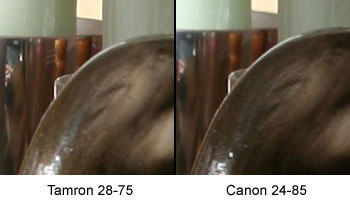
This comparison is a bit weak; it’s hard to really measure lenses. But I’ve got an example that convinces me this lens will work out. See the Flickr set for all of the photos.
 I accept that games have copy protection. I do not accept invasive
copy protection that damages my system. Starforce works by installing a
driver in your operating system, way down with kernel-level
privileges. No way.
I accept that games have copy protection. I do not accept invasive
copy protection that damages my system. Starforce works by installing a
driver in your operating system, way down with kernel-level
privileges. No way.
What troubles me is how squirrely the process is for removing Starforce. Their user page explains how to remove it, but the solution is to send you to a scary looking third party which has been “granted a sole right to distribute the StarForce Removal Tool utility”. Their page then proceeds to try to upsell you into some never-heard-of-it anti-spyware program. Fake anti-spyware is a #1 way to get actual spyware on your computer, so the whole thing smells suspicious. I think it’s actually legitimate, but how could I be sure? Why would a company contract out distribution of their uninstall tool?
I don’t think Starforce means badly here, I don’t think they’re criminal. Just dumb. I was reminded of all this by Starforce’s ham-handed attempt to legally strong-arm Cory into removing some criticism from his blog. What jerks. Time to join the movement to boycott Starforce. Fortunately, not many games use Starforce, mostly some crappy second tier titles. I got it installed thanks to Sniper Elite, a lousy game anyway.
 Usually high tech gizmos are a failure in the kitchen, but the Thermapen
is an exception. It’s a true instant read thermometer: stick it in the
food, wait two seconds, and you know the temperature to within one
degree. The display is easy to read and it folds for
storage.
Usually high tech gizmos are a failure in the kitchen, but the Thermapen
is an exception. It’s a true instant read thermometer: stick it in the
food, wait two seconds, and you know the temperature to within one
degree. The display is easy to read and it folds for
storage.
It’s expensive at $85, but it’s so much better than conventional cooking thermometers it’s worth it. The difference is it uses a scientific quality thermocouple instead of a cheapo thermistor.
 The Nintendo DS has a
host of creative and innovative games. One
standout so far is
Nintendogs, the
Tamagotchi-like puppy simulator. My 9 year old nephew dearly wanted it
for Christmas, so I got myself one too.
The Nintendo DS has a
host of creative and innovative games. One
standout so far is
Nintendogs, the
Tamagotchi-like puppy simulator. My 9 year old nephew dearly wanted it
for Christmas, so I got myself one too.
The first ten minutes of the game are terrific. The graphics are super-cute. The animations and sounds are perfect, I was giggling and smiling and had puppy love. But, after a few days it gets old, and now I hate my virtual dog. He’s disobedient, can’t learn tricks, and has fleas.
The problem is the gameplay is terrible. The contest minigames are mindless. Training your dog is frustrating; it feels more like the game is training you to speak to its poor microphone. You can go for walks in the overworld, but the major play there is picking up puppy poop. And you have to play the game every day or your puppy starves and you feel guilty. I don’t need the responsibility.
It may be that I’m just too old and cynical to love my virtual puppy; I’ll ask my nephew how he likes the game in a few weeks. I just wish it were a better game!
 We cannot expect corporations to safeguard civil liberties. A
corporation’s job is primarily to make money; it’s government’s job to
protect liberty.
We cannot expect corporations to safeguard civil liberties. A
corporation’s job is primarily to make money; it’s government’s job to
protect liberty.
Three recent issues support this view. First is Bush’s illegal use of NSA against US citizens. It hasn’t been reported in the press yet, but we have to assume that US telecom companies are complicit in implementing the wiretaps. It’s standard industry practice going back to the telegraphy days. Second is the DoJ’s blanket request for search logs. Three of four search engines turned data over without argument; only Google has resisted. Finally, there’s Google’s decision to implement Chinese censorship. Google’s doing the best it can in an awkward situation, but ultimately China is too large a market to stay out of entirely.
In all three cases companies were placed in the position of having to defend their users’ privacy and civil rights against government intrusion. And in each case, there’s disappointment. While companies and their employees sincerely try to do the right thing, you don’t see a lot of outright corporate civil disobedience. Companies have too much to lose to defy government orders entirely.
The real battle is one level up, in the legal system. We can’t expect companies to disobey laws, even unjust ones. Instead we need to change the bad laws and enforce the good ones. And since so much US law is written by corporate lobbyists, as consumers we need to create market conditions so that companies have an incentive to make laws that protect civil liberties. It’s awfully indirect, but that’s the way a capitalist civil society works.
As always, my views are my own and do not reflect my employer.
 Thanks to the Internet you no longer need a dictionary or encyclopedia
in your home. Web sites like Wikipedia are often better, and
versions of traditional dictionaries and encyclopedias
are usable online.
Thanks to the Internet you no longer need a dictionary or encyclopedia
in your home. Web sites like Wikipedia are often better, and
versions of traditional dictionaries and encyclopedias
are usable online.
But you still need a good atlas. There’s no substitute for large pages with high resolution printing. And while programs like Google Earth do things no print atlas can do, a paper atlas comes with a wealth of interpretive content.
Interpretation is what makes the DK Great World Atlas so terrific. It’s got maps, sure. But it’s also got satellite photos, and images at night, and bits of text highlighting how a place fits together both geologically and sociologically. The editorial content is excellent and the printing is beautiful. It’s expensive at $63, but well worth it.
If you’re atlas-happy a good supplement is the DK World History Atlas. This book is like those flip charts you had in grade school showing migrations across Europe, only global, detailed, and not condescending. It’s more a book you read than a collection of maps, and interesting for that.
 The best thing about taking a
break is having the freedom to do things I want at whim. Like go to
Australia. So I just got plane tickets to go from March 1 to March 21.
Any suggestions for what to do? Please
email me.
The best thing about taking a
break is having the freedom to do things I want at whim. Like go to
Australia. So I just got plane tickets to go from March 1 to March 21.
Any suggestions for what to do? Please
email me.
We’re arriving in time for Sydney Mardi Gras, so that’s the first main activity. I’m excited to go to Kangaroo Island and maybe Uluru / Ayer’s Rock. We love wine country. I love deserts; Ken not so much. I’d like to learn more about Aboriginal culture and language. We’re OK driving on the left. We’re not big beach people.
So what should we do? Planning a trip is hard work. My mother used to be a luxury travel agent, I regret the death of that business. I’ll summarize the suggestions that work out well. Advance payment: the Great Australian Novel.
I’d thought this was entirely obvious, but today the New York
Times reports:
With a campaign of high-profile national security events set for the next three days, following Karl Rove’s blistering speech to Republicans on Friday, the White House has effectively declared that it views its controversial secret surveillance program not as a political liability but as an asset, a way to attack Democrats and re-establish President Bush’s standing after a difficult year.So let’s say it simply. The US government should not spy on Americans without warrants. There needs to be some sort of judicial oversight, at least something as toothless as FISA. The Bush Administration’s unilateral decision to use NSA to spy on American citizens is illegal and a frightening extension of executive power.
I suspect no one reading this weblog entry will be surprised I feel this way, and I hope most of you agree with me. But when someone keeps saying 2+2=5 or that Iraq and Al Qaeda were linked you have to remind yourself that it’s 4.
 One of my favourite cities in France is
Strasbourg, in Alsace where the French
speak German. Or formerly, where the Germans spoke French. Alsace is really
its own thing, and a great place for it.
One of my favourite cities in France is
Strasbourg, in Alsace where the French
speak German. Or formerly, where the Germans spoke French. Alsace is really
its own thing, and a great place for it.
The most picturesque part of Strasbourg is La Petite France, the former tanneur quarter that has preserved its canals, locks, and half-timbered houses. I could spend days just lazing away in the little streets. In the rest of town, the cathedral is incredibly impressive. As a bonus it features one of the finest working medieval computers, the Astronomical Clock (details). Worth a special trip. And the Musée Alsacien is one of the best folk culture museums I’ve been to.
Strasbourg is a great food town. Au Crocodile is the famous Temple of Food there; very good, but a bit shallow for my tastes. The Bierstub Ami Schutz is great if you want cozy Germanic fare prepared with French finesse. Couldn’t be a more comfortable place for a good dinner.
But the real food revelation for me was Flammeküeche; pizza if pizza were made with German ingredients and French skill. An impossibly thin cracker crust cooked in a super hot oven, a creamy sauce with bacon for flavouring, and just a bit of onions and sharp cheese. My favourite was at the Académie del la Bière, served with a selection of hundreds of beers (and free WiFi).
I have photos online, mostly of the charming houses and canals. And one of this crazy plaque in Place Gutenberg commemorating the printing press.
 I don’t know how I stumbled into it, but I’m really glad to
have found the comic book Transmetropolitan. It’s a
hysterically cynical post-cyberpunk comic featuring the gonzo exploits of
Spider Jerusalem writing his newspaper column
“I Hate it Here”. And his filthy assistants, his two faced
chainsmoking cat, The City, its transgenic inhabitants, and the
collision between cybertopia and the grim
meathook future.
I don’t know how I stumbled into it, but I’m really glad to
have found the comic book Transmetropolitan. It’s a
hysterically cynical post-cyberpunk comic featuring the gonzo exploits of
Spider Jerusalem writing his newspaper column
“I Hate it Here”. And his filthy assistants, his two faced
chainsmoking cat, The City, its transgenic inhabitants, and the
collision between cybertopia and the grim
meathook future.
The writing by Warren Ellis is great, profane and hysterical and incredibly creative. Darick Robertson’s art is beautiful, fantastically colourful and insane. Comic books rule.
Terrible goddamn place. Some days it’s like some bastard nailed a ticket for the bus tour down to fucking Hell to the front of my brain. For every wild everything depends on it first week of being madly in love kiss on a streetcorner, for every beautiful woman stopping to feel the sun on her face and every child dancing in clean rain, there’s a kid living in its own shit in a dumpster somewhere while Daddy sells his ass for milk money, tanks breaking down unwanted houses just to stop homeless people squatting there ... Time was this place didn’t make sense and I could live with it. Either it’s changed, or I have.I wasn’t cool enough to buy the actual comic books, but happily Vertigo has published everything as graphic novels. Amazon has them for about $10 a volume, each containing about 6 issues.There’s all the good things on this ticket, and pure fucking evil too. And all the same, I’m going down with you.
 In a Christmas-related mishap I ended up with a Nintendo DS with Mario
Kart. Which is a fun game, but what really suprised me is the little
thing does
Wi-Fi! It took just a minute or two to set up and suddenly I was
racing against a stranger from Japan over the Internet. Amazing.
In a Christmas-related mishap I ended up with a Nintendo DS with Mario
Kart. Which is a fun game, but what really suprised me is the little
thing does
Wi-Fi! It took just a minute or two to set up and suddenly I was
racing against a stranger from Japan over the Internet. Amazing.
Looks like only a few games support it so far. And the TCP/IP software isn’t in the system, but rather in the game; that explains why support is limited. But it works! Total surprise to me.
I’m on leave of absence from Google. I’ve mostly been not working
since Christmas and will decide in the next couple of months whether I
want to return to work at Google or do something new.
I’ve really enjoyed working at Google. There’s no other company that comes close to Google in its ability to do big things on the Internet and I think the company has an exciting and powerful future. But lately I’ve been frustrated by things that I can sum up as “it’s a big company now”. I’ve been there awhile and it’s time for me to take a break.
My immediate plan is to relax a bit. I already took one short trip to the California gold country and another to Vegas; I may go check out Slab City soon. And maybe go to Sydney for Mardi Gras. Basically, I intend to enjoy the first long stretch of time without responsibility since 1996.
Longer term I don’t know what I’ll do. I really admired Bloglines and Flickr as smart startups, doing something on that scale is appealing. Then again, Google offers an amazing platform from which to change the Internet. For the next few weeks I’m just going to chill about it, reset.

 A short trip is one where you charge all your gadgets’ batteries
before you leave, but you don’t pack the chargers.
A short trip is one where you charge all your gadgets’ batteries
before you leave, but you don’t pack the chargers.
 There’s a