| ||

Mon 2025-06-30
Sat 2025-06-28
Fri 2025-06-27
Wed 2025-06-25
Tue 2025-06-24
Mon 2025-06-23
Sat 2025-06-21
Thu 2025-06-19
Wed 2025-06-18
Mon 2025-06-16
Fri 2025-06-13
Search
Archives
2024
12 11 10 09 08 07 06 05 04 03 02 01
2023
2022
2021
2020
2019
2018
2017
2016
2015
2014
2013
2012
2011
2010
2009
2008
2007
2006
2005
2004
2003
One good site
MDN
Nelson Minar
Blog licensed under a Creative Commons License
|
Subnautica is one of the best games I’ve played in a long time. It marries a good narrative with excellent gameplay and a rare balance of complex game systems. It’s beautiful too and a nice mix of the pleasure of a well scripted game embedded in what looks like a complex naturally generated world. The rest of this post has lots of spoilers. It’s been five years since the game came out but if you haven’t played it yet I urge you to consider stop reading this post and play it instead. 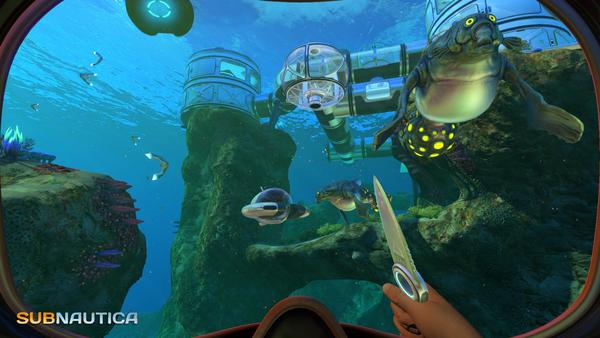 My first comparison for Subnautica is Firewatch. Yeah, it’s a weird comparison, but it’s more than just a similar rendering style. Both games have a very strong narrative arc, a beginning to an end. Both games plop you alone in the middle of an unknown world with mysteries to explore. And both rely on a sense of wonder, occasional fear, and beauty. But while Firewatch is a great story it’s barely a video game, it’s the quintessential walking simulator. Subnautica manages to deliver both an excellent scripted story and have great gameplay. The primary gameplay loop in Subnautica is survival crafting games. It’s often compared to Minecraft, Don’t Starve, No Man’s Sky. It’s a fair comparison, a lot of your time in Subnautica is spent finding resources and using them to progress along a tech tree so you can explore more dangerous and rewarding parts of the game. But those other games often end up becoming very resource heavy, rewarding collecting enormous amounts of materials for mass production. Subnautica’s crafting game is much tighter. You only need a few items of each type to build something and you typically only build one thing of that type: one weapon, one upgraded oxygen tank, one Seamoth. You do end up making a lot of food and water but even that is nicely constrained; about a third of the way through once you get one planter full of Marblemelons you’re basically set for life. I love the subtlety of the tech upgrade tree, how awkward the advanced items are. Most games give the player a power fantasy, by the time you get all the best gear in Minecraft you’re god-tier power. But in Subnautica you never get anything very powerful. You basically never get weapons or armor that let you feel safe from the sea monsters, you are always running or hiding from them. The big crafting achievement in the game is the Cyclops, the big submarine. But it’s fantastically clumsy to manoeuvre and strangely vulnerable to attack. You end up spending the second half living in the Cyclops but it always feels like such an escape to jump back out and just swim free or use the Seamoth. Exploration in the game is greatly improved by the balance between generated and scripted world. When the game first came out a lot of people thought the game was procedurally generated; that was the hot topic (thanks to Minecraft and No Man’s Sky) and the world is so beautifully detailed. But no, in fact the whole world is static, it plays the same for everyone. Not great for replayability but excellent for game design. The orderly progression through biomes and depths gives them a game a lot of story telling structure. You never quite feel led by the nose but you work your way through signposted encounters: the Aurora, the Degassi bases, the Lost River, the very deeps at the endgame. That exploration is also where I had a little trouble. The game deliberately is disorienting; you’re never given a map and the mini-map like sonar images are not useful for navigating. All you get are beacon landmarks you place yourself. And the game is a 3d underwater maze, with the second half of the game entirely in cave systems! I finally gave up and used a fan-made map of the Lost River because I’d gotten a little stuck and confused. That was a big help to me. Getting lost is a big part of the game, I don’t mind that being a gameplay element. But video games are such a limited medium we don’t get to use our real-world navigation skills much. That’s why games always have HUDs and minimaps, they replace your innate sense of direction. I felt that lack a little here. Being lost in the depths of the ocean is part of the fun of the game, the occasional fear. But what really accentuates that is the sound design. The creature noises are fantastic; you’ll be cruising along picking up quartz crystals and thinking you’re safe when you hear the most terrifying moan off in the distance. Stereolocated, and you can hear it’s getting closer. Such terror! Being in the Cyclops and hearing all the creaks of the hull, the thumps as fish smack into your ship. It’s a trick as old as Das Boot but it works remarkably well in the game. Last note of appreciation for me, the end of the game. Most games like this by the time you reach the end both the player and the game designers are worn out. They’ve shown you all they have and you’re grateful just to read the final boss fight and end screen. Not Subnautica. First there’s no boss fight, that’d be totally wrong for a game with basically no fighting. Instead you have a boss… communion? Final crafting challenge? It’s great. And then, at least the way I played it, there’s a wonderful anticlimax. You’ve solved all the mysteries of the planet and are finally ready to escape but you still have to craft the rocket and take off. Which means one last trip to the surface, one last crafting challenge. I really enjoyed the feeling of scavenging my existing base and submarine for materials to use. That shield generator was hard earned and essential to my submarine survival but now I wouldn’t need it on the planet any more, time to reuse it for the rocket ship to escape. And even that rocket ship had a lot of grace notes; an elaborate launch sequence and the ability to create a time capsule. A very thoughtful farewell in a place most games would just have a single "you win" button to press. Subnautica really is a masterfully crafted game from start to end. Depth, complexity, beauty. A good story and great gameplay systems to support it. Quite an achievement. I’m back to playing World of Warcraft. I picked it up back in March starting with the Covid lockdown. (I’m far from the only one!) Partly for something to do, partly to play with a family member. It’s been great! 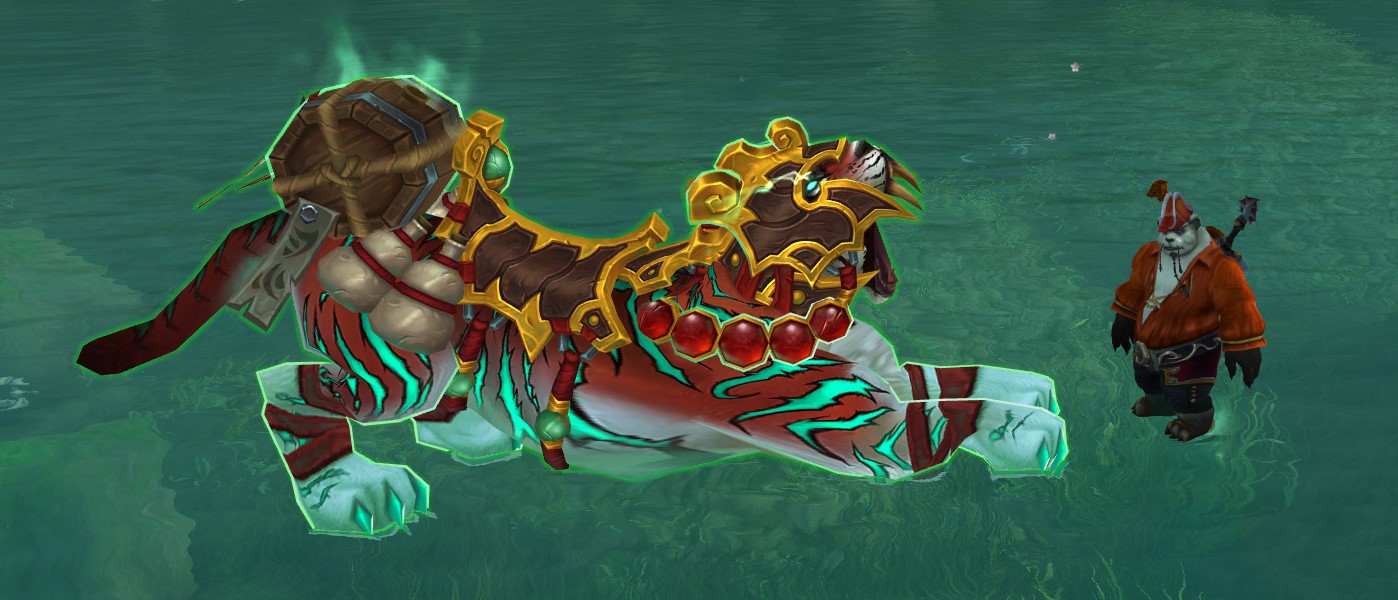 I quit playing WoW in 2009. Coming back the main feeling is it’s very much the same game. Compelling mix of basic MMO RPG power growth, lots of fun side activities, social raiding, PvP. It’s all there and all just about the same. It’s a credit to Blizzard that they’ve kept the game more or less on an even keel all along and it’s comforting and familiar. The big improvement is the game is way more casual-friendly. In the old days you’d level up to max level and then all that was really available to you was raiding, big serious events with 25 or 40 people. You really had to be in a raiding guild. Over time they added more activities; PvP seasons, reputation grinds, etc. But the real game (and real gear) required raiding. 2020 WoW has all sorts of progression paths. Raiding is still there, but a heavy emphasis on social tools means PUGs (pick up groups) are more viable. There’s even an automated "Looking for Raid" tool that will let you see a simplified version of the raid content very easily. There’s a path for 5 person dungeons in the Mythic dungeons, with ever-increasing difficulty levels. There’s even a solo progression in the Visions of N’Zoth. PvP also has significant progression and gear attached to it. All of which means they’ve made the high end content way more accessible to everyone. It’s a great change. (And lest you miss the old hard stuff, Mythic Raids still basically require a guild and serious dedication.) Some things haven’t improved. Crafting is still dumb and mostly pointless. A lot of the top end gameplay is grindy, do the same thing every day for 3 weeks to increment a progress bar. The graphics are incredibly dated; partly to keep system requirements low, but also because they don’t want to re-do all the old graphics for modern systems and it’d look weird to have a mix. Which is a shame; the dress-up doll game in WoW suffers significantly compared to FFXIV. The hidden strength of WoW in 2020 is all the depth of content. They’ve got 16 years of content in the theme park now and it’s almost all accessible. You can still go back and do Molten Core if you want. It won’t be a gameplay challenge, but it’s still fun to see and there’s rewards like rare mounts to encourage you. I’ve really enjoyed exploring all the content I missed in the intervening years, including some really great systems like the Garrison. (Why did they abandon that?!) There’s no other MMO that can boast this much content and it’s great fun to discover some old neat toy to surprise your friends with. And that’s the other reason WoW is still compelling; friends and guildies. The cooperative social aspect of MMOs is nearly unique in online gaming and Blizzard has done a good job reinforcing it. My new guild isn’t the most hardcore or accomplished but we have some strong players, it’s mostly nice people, and we have a code of conduct that keeps the jerks out. I continue to be concerned about the shallowness of online game friendships just like when I quit in the first place, but it’s a fun way to wile away a few hours. For the past 4+ years I’ve played a lot of League of Legends and written about it here. Last week I quit entirely; no longer playing the game, unsubscribed from all the reddits, not watching the broadcasts. I’m still running Logs of Lag but I’ve added a new link to the page that I suspect Riot Games will not be happy with. The big story is Inside The Culture Of Sexism At Riot Games, a meticulously researched and detailed story about sexual harassment of employees at the company. Riot apparently is the worst kind of bro-culture and the problem starts at the top. This story was swiftly confirmed by a variety of personal reports. Riot Games responded a few weeks later with the smarmiest of PR-crafted replies. They pinky-swear they’re going to do better by having some introspective discussions and some training. In the meantime what they’ve actually been doing is retaliating against current and former employees with aggressive legal threats. And firing highly visible employees who aren’t toeing the PR line. (I know the work of both Lehman and Klein; Riot lost some very smart people.) Video game culture in America has a huge problem of sexism and racism. Tech companies often have sexism and racism too. But I’d somehow hoped that Riot Games was better. The individuals I know there are decent people. But the company culture created by the founders Marc Merrill and Brandon Beck is disgusting and childish. I want nothing to do with it. I got an Oculus Rift on a whim this week when they dropped the price of the bundle down to $400. This is my first experience with VR in a few years and 10+ since I last used a high quality rig. I’m impressed, the sense of being present in virtual space is incredibly compelling. But as everyone says the problem is there’s no great VR-specific content yet. The hardware is good. Lag-free head and hand tracking. Sensor calibration is a hassle. Windows setup was remarkably painless. The touch controllers are essential. It allows you to have virtual hands. Definitely want “full room VR”: several tracking sensors and a 5x7’ clear space to walk around in. Sitting still and having the view pan is instant nausea but walking around a stationary virtual room is better. Even with the calmest software I get tired and headachy after about 30 minutes. Eyestrain maybe? VR sickness makes for a viscerally negative experience. As for software, I’ve only played around for a few hours, so no deep opinions. Oculus’ own tutorials / demos are very good, the intro Dreamdeck demo had me shouting for joy. The best game I’ve played so far is Superhot VR; I’ve not played the normal version but the VR variant is really compelling. Subnautica made me sick in about five minutes, although it is very pretty. Thumper is pretty in 3d but I’d rather have a flat screen and excellent speakers. Google Earth VR was surprisingly disappointing; the imagery isn’t quite good enough. I haven’t tried Job Simulator 2050 yet, it’s quite popular. I’m also curious to try The Climb.  I took a quick look at the porn industry; all they’re offering is 3d videos and some minimal “fondle boobs with your glowing virtual hands” interaction, so they haven’t figured out VR apps either. The fact that "Waifu Sex Simulator" is one of the most popular apps gives you an idea of the target market. So it’s a fun toy, but given the fatigue and lack of compelling content I’m not sure how long I’ll be using my Oculus Rift. We’ll see. What I really want is some easy way to build data visualizations in 3D, maybe using WebGL or something. I haven’t looked hard but my impression is that’s not fully baked yet. Watch Dogs 2 is a very good video game. I think it’s nearly as good as GTA V or Sleeping Dogs and better than many other open world roamers. It fixes nearly all the problems in the original Watch Dogs and finds the fun in the game design.  My favorite thing about the game is the setting, the tech industry in the Bay Area. I live in San Francisco, I’ve worked in two of the offices featured in the game, I’m constantly running in to things in the game that remind me of where I live. They’ve done a remarkably good job on the re-creation of the Bay Area. Like not only do the buses in San Francisco look like SF Muni buses, but the buses in Oakland look different because of course they should, they’re AC Transit buses. The world quality extends to the game writing, both incidental stuff like random NPC dialog and significant things like the main story writing. The main story is pretty good. It’s not great, I’d say it’s weaker than GTA V, but it’s still pretty good. Some of the characters are great and some of the set pieces are excellent. The biggest criticism I have is something a lot of reviews pointed out, which is there’s a conflict in tone between “we’re a fun hacker gang pulling pranks” and “we’re a group of murder hoboes launching grenades at FBI agents”. There’s an event that happens in the game that could explain the shift but the writing doesn’t quite pull it together. It’s not a huge problem. Most importantly, the
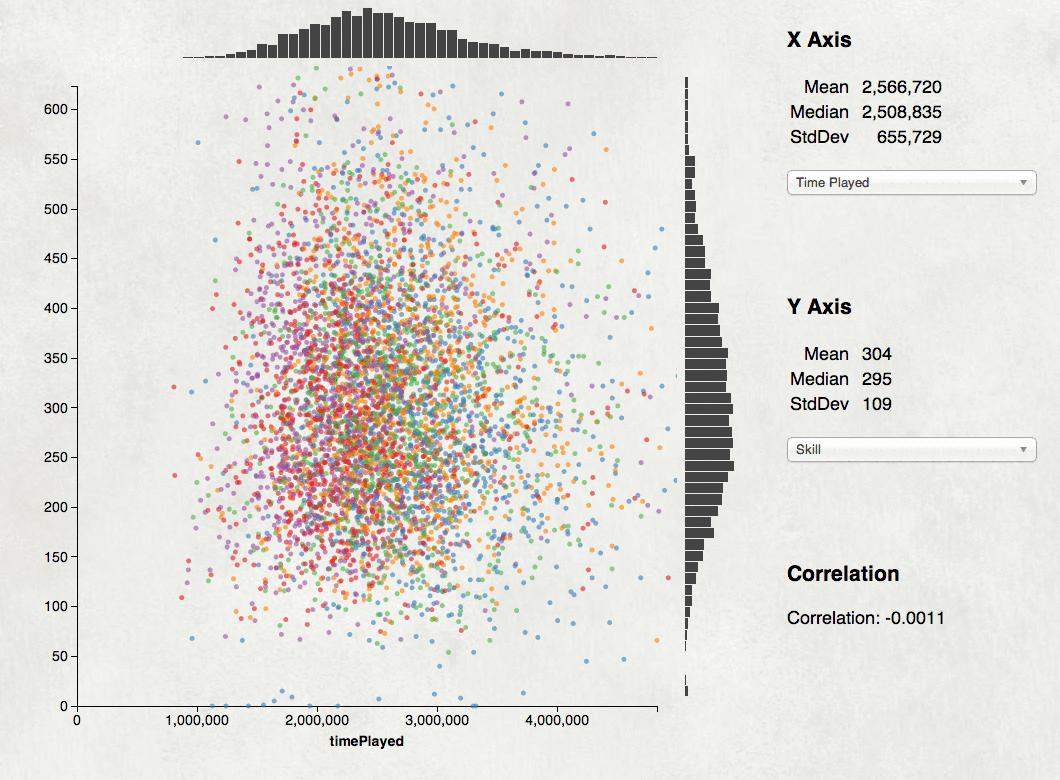
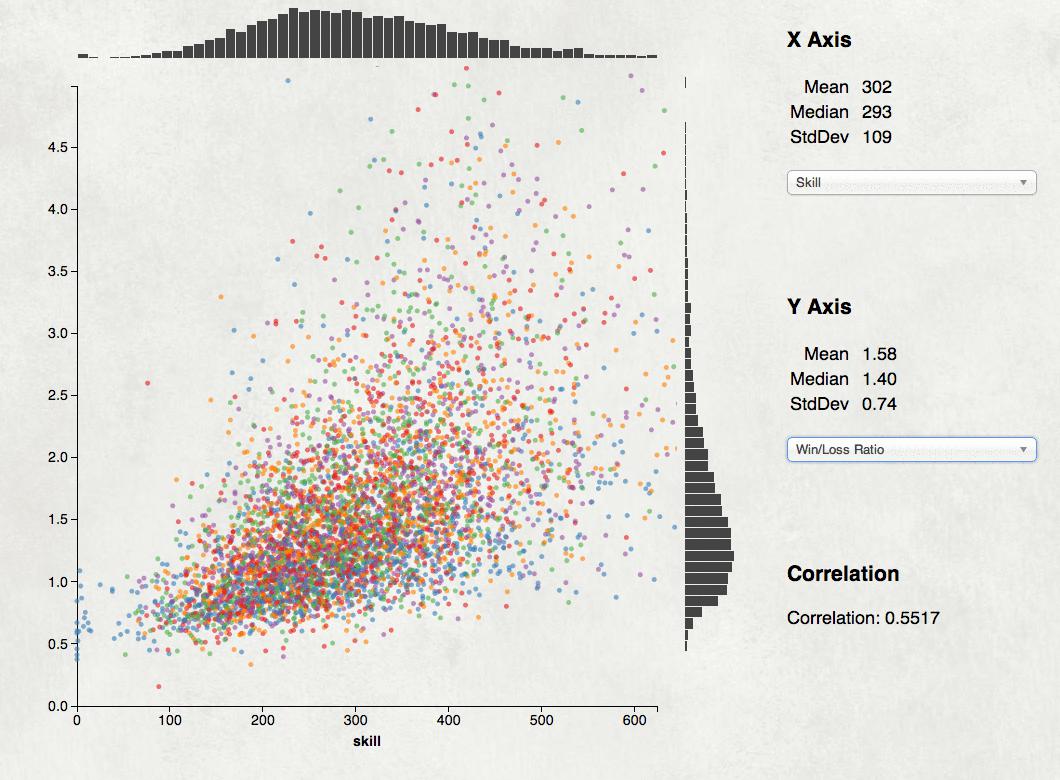
gameplay is fun. The It’s a really good game! I have some screenshots and video clips on Twitter. Just finished another game visualization project, graphs of stats for the top 5000 BF4 players. It makes scatterplots for the player population of statistics like skill score vs time played, win/loss ratio vs. skill, and kill/death vs. win/loss. Lots of details in this Reddit post. 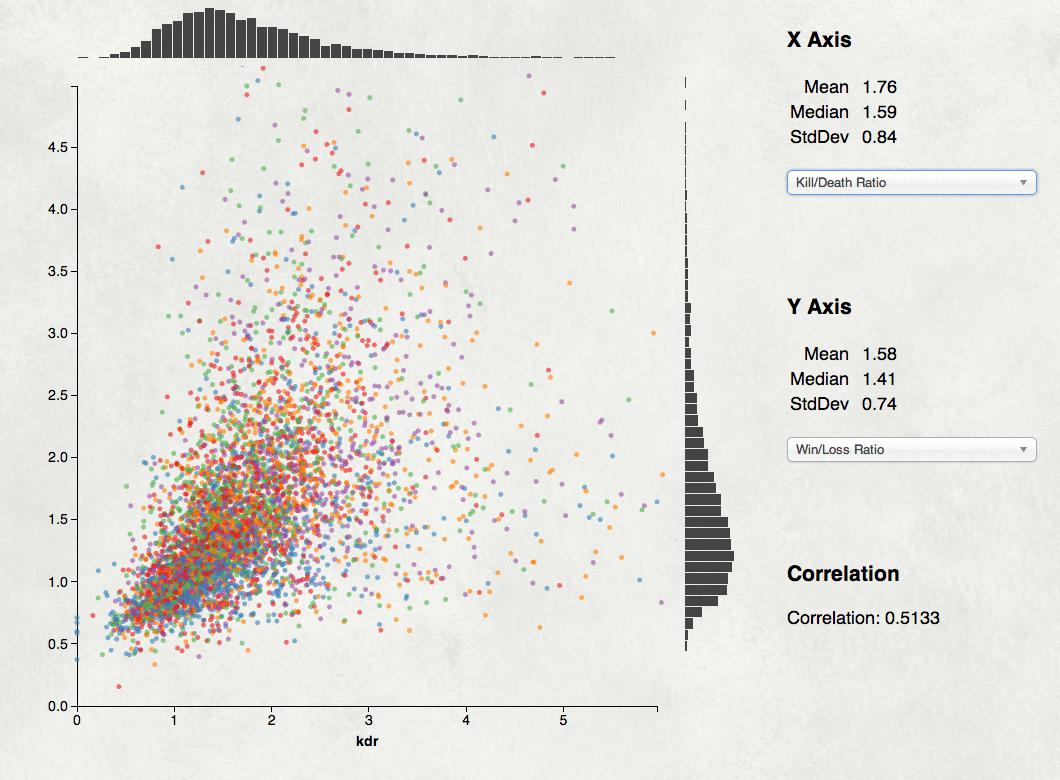 Another fun D3 project; scrape a bunch of data, cook it into a 2 megabyte CSV file, then do custom visualizations. I like the way the scatterplot came out and may re-mix it as a generic data exploration tool, a sort of GGobi lite in your web browser. Drop a CSV file into your browser window and get a simple tool for exploring it for correlations. It’s frustrating trying to get attention for projects like this. All I know to do is post it to the relevant subreddit and hope for the up-votes, but that’s pretty random. My Reddit attempt for the LoL lag tool failed, and a site I worked about 50 hours on has had a total of a few hundred visitors after a week. Discouraging. I just released Logs of Lag, a small project I’ve been working on. It’s a netlog analyzer for the game League of Legends. You drop a log file from the game on it and the tool gives you a nice report. Not a huge thing, but it’s been useful to me already. 
The webapp is another of my line of client-heavy programs. It all runs in static files, no server needed at all, the parsing and rendering is all done in the browser. I really like this style of programming, it’s fun and interactive and easy to scale. I did end up making a simple CGI server for storing log files so that people could share reports with friends. I may yet rewrite that to just use S3 as a filestore and bypass my server entirely. The code is on GitHub. The indie game industry has been shifting in the past few years to a pre-funding model. Gamers pay for games before release, either via Kickstarter campaigns or by buying games in alpha release or Steam Early Access or the like. A lot of neat games have been funded this way (see: Minecraft) but I worry it’s bad for game consumers. We’re no longer being asked to buy a game, we’re buying something completely ephemeral, the idea of a game. We hope that maybe someday the game will be released and we can play it. And we get no guarantee of a quality finished project. (See Clang, which cynically claimed their unplayable alpha tech demo counted as a game release). Games are no longer really released, they are put out as an “alpha”, then a “beta”, then laughably a “gamma”. Really, why bother even finishing a game if people will pay you for your game anyway? Avoid the whole review cycle! The most predatory of these “buy the game that does not exist” things I’ve seen yet is Star Citizen. They have collected $44 million for a game where you fly around spaceships in a giant procedurally generated universe. Except that universe doesn’t exist and last I heard the only code you could actually run lets you look at a rendered spaceship sitting motionless in a hanger. Nevertheless, people are paying hundreds of dollars for special rare spaceships in the hopes one day they can fly them. The Star Citizen project is not a game, it’s a marketing campaign for a game. I sure hope it turns into a real game some day or a bunch of people are going to be disappointed. It’s many, many months behind schedule, to the extent there even is a schedule. Why bother shipping when you can just keep collecting money? adapted from a Metafilter
comment
Sports fans had a choice yesterday: watch the Super Bowl or watch League of Legends via Twitch. I figured the Super Bowl would easily win out and no one would watch the eSport, but boy was I wrong. 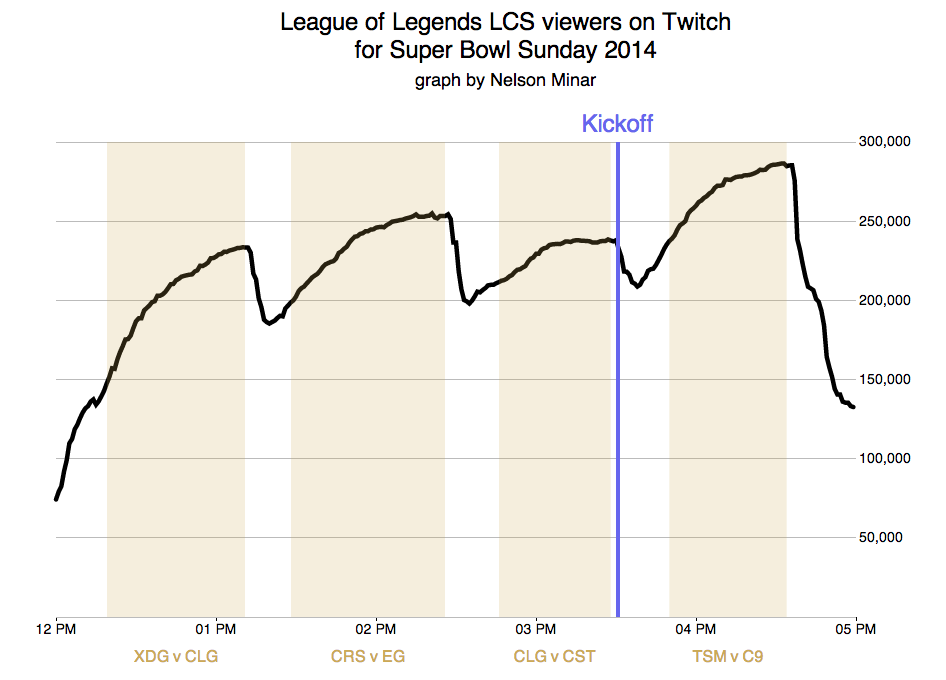 Above is a graph of League of Legends viewers of the 4 LCS tournament games on Super Bowl Sunday. (I made the graph from Twitch’s published data; there are viewers on other services, but Twitch is the majority.) About 230,000 people were watching on Twitch, a typical day for LCS. The surprise is viewership peaked at 286,000 for the last game at 4pm, half an hour after the Super Bowl started. No noticeable viewer falloff at the 3:30pm kickoff either; just the usual slump after the previous match ended. Why didn’t the Super Bowl cut into the League of Legends audience? It helped that the final game was an anticipated matchup between two of the best teams with a strong fan base. The stereotypical gamer nerd is not a sport fan, so maybe there was no conflict. On Reddit people noted that a lot of LoL fans are Europeans not interested in the Super Bowl. (There’s an enormous Asian audience too.) Some folks said they’d just watch both at the same time. I’ve come to really enjoy watching League of Legends tournaments. It’s an enormously popular game, 27 million people play daily and 32 million (8.5M peak) watched last season’s championship. Riot Games has invested heavily in making the game into a sports event. The broadcasts are a lot of fun to watch with smart announcers, good storytelling, and exciting gameplay. I’ve generally been a skeptic that eSports would become a phenomenon but League of Legends is winning me over. If you’ve never watched LoL before, yesterday’s TSM v C9 game was pretty good. The whole 44 minute broadcast is worth watching but here’s a 5 minute highlight reel. The game is a bit complicated but basically it’s two teams of five players fighting to control the map. Here’s an overview of the game with a lot more detail. Lots more recorded games on /r/LoLeventVoDs. A bit of nostalgia today for Netrek, one of the best online games ever. It’s from the early 1990s and is an important game design precursor to team based online games. Also its netcode was a huge breakthrough in real time Internet gaming. 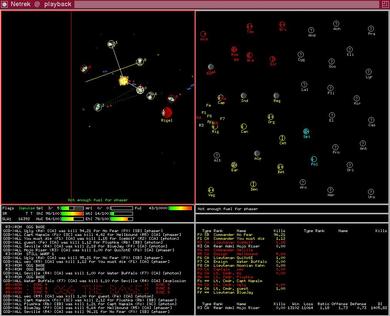 The game design is brilliant. It’s an 8v8 team game. You mostly play in the upper left window, a Spacewars-like game where you fly your spaceship around and zap other players with your phasers and torpedoes. But the real game is in the upper right, the galactic overview map. The goal is to fly to planets and take them over by beaming down armies while fighting off the enemy players. That combination of high level strategy and local tactics is a hallmark of RTS games like Starcraft, MOBA games like League of Legends, and squad FPS games like Battlefield. I’m not saying Netrek invented that whole idea (Netrek itself was based on PLATO Empire), but it took 5–10 years before mainstream games became as interesting as Netrek. There were even classes in the game, different types of spaceships for different roles. The network code was also hugely innovative, particularly the UDP code from 1992. Back then the Internet was overloaded and slow, 56 kbit/s links were common. Andy McFadden rewrote the original TCP netcode to use UDP and suddenly the game became way more playable on congested links. The key insight is UDP lets the game client decide what to do about packet loss rather than relying on TCP retransmits. Netrek could afford to lose the occasional packet; you might not see a torpedo coming your way but then again you didn’t have to wait 3 seconds for that packet before seeing the 25 other torpedoes launched afterwards. Weirdly most contemporary games use TCP (despite drawbacks), although League of Legends at least is UDP. Netrek partly benefitted from the great community of the academic Internet of the early 90s. I’ve run into a few old Netrek buddies in our later careers as working software people: Andy McFadden and Jeff Nelson at Google and Stephen von Worley of DataPointed. I wonder if any of the Netrek folks went on to work in the gaming industry? Thanks to Brian Dear
for info on PLATO
|
|