| ||

Mon 2025-06-30
Sat 2025-06-28
Fri 2025-06-27
Wed 2025-06-25
Tue 2025-06-24
Mon 2025-06-23
Sat 2025-06-21
Thu 2025-06-19
Wed 2025-06-18
Mon 2025-06-16
Fri 2025-06-13
Search
Archives
2024
12 11 10 09 08 07 06 05 04 03 02 01
2023
2022
2021
2020
2019
2018
2017
2016
2015
2014
2013
2012
2011
2010
2009
2008
2007
2006
2005
2004
2003
One good site
MDN
Nelson Minar
Blog licensed under a Creative Commons License
|
The Some Bits weblog is over 10 years old now, my first posts were in October 2001. The topics haven't changed much: that first month was a random mix of technical content, tech news, cultural commentary, politics, and Victorian urinals. The format has changed, I used to write more short single link posts. Activity level has varied; here's a calendar view of posts, one box per day.
My weblog is an old school blog, a public diary of things that personally interest me. I mostly write as a way to summarize what I'm learning about something new like living in Paris or flying airplanes. Sometimes I post to influence others with an opinion about Klout or Facebook or SOAP or the like. On rare occasions I troll. But even though this blog is mostly written to satisfy myself, I do write it for an audience. It takes me most of an hour to write these short messages. (See my secret work blog and defunct game blog for much less edited stuff.) I love the old school blog format. I've got a big list of RSS feeds for other blogs like mine; some recently active favorites include Justin Watt, Jason Kottke, and Rafe Colburn. The list is much longer with less active people Mike Migurski or Andy Baio; I love it when a blog post pops up after six months of silence. I regret that "blogging" for most of the world now means crappy journalism; pro-blogs with 20+ posts a day salted with ad targeting keywords is tiresome. The ease of Twitter's short format has definitely sucked some of the energy out of personal blogging. But as Anil says, if you didn't blog it, it didn't happen. Go ahead, write something, it's not hard! Even if no one but yourself ever reads it it's worth your time. For hosted blogs these days I like WordPress.com. I keep meaning to check back on how Blogger is doing, too.
I've taken a lot of crap for my various blog posts about how TechCrunch is not journalism. So I'm feeling a little vindicated today that the CEO of TechCrunch's parent company agrees with me, in the newspaper of record of all places:
We have a traditional understanding of journalism with the exception of TechCrunch, which is different but is transparent about it. The new CrunchFund is the big drama of the blogosphere today. If you've followed Arrington's career it won't surprise you, of course he thinks he can be the editor of a major tech publication while also investing in tech companies. He did it for years, with varying levels of disclosure quality. It's part of the package along with the shoddy editing, the ignorance of basic concepts like off the record, the crazy personal vendettas. Arrington's a blogger. A very effective, powerful blogger. He's not a journalist. (Not that he disagrees: NYT, TechCrunch comments). The frustrating thing is there is some actual good journalism at TechCrunch. I feel bad for the good reporters there: apparently they feel bad, too. I'd like to call out MG Siegler (aka parislemon) in particular for regularly writing well researched stories with insight and accuracy. Maybe a real news outfit will hire the good folks out of TechCrunch. Both the Wall Street Journal and the New York Times have excellent blog-style tech coverage with proper journalistic methods and ethics. They should hire everyone away from the AOL clown car as soon as their acquisition lockups expire.
I wanted to give a thank you to Lyndon Asuncion, propietor of the "Some bits of Art" blog. He'd registered somebits.wordpress.com awhile back but wasn't using it and very kindly gave me the name when I asked. I'm planning on moving this blog over there soon and this was an important first step.
Some bits of Art is a nice work blog, btw, he's a video game artist in Seattle. I like his work on this house.
One of the oldest and most useful features of my blog is my Linkblog. That's it over in the sidebar, you can
see it here
or subscribe to the RSS. Not much to the HTML view, it's just a delicious page, but really it's a blog. I post several links to it every day and the descriptions are written for an audience, you. These days it's got better content than this main blog of mine.
Next MediaLinkblogging is an old blog form, arguably as old as blogging itself with Jorn's pioneering Robot Wisdom. I read several linkblogs every day: Waxy, fakeisthenewreal, Jeremy Zawodny, iamcal, David Carlton, and an aggregation at HotLinks. (Jason Kottke and Anil Dash both used to be masters, but have rolled their links in to their main blogs.) It strikes me how much linkblogging is like Twitter. A short, informational message you broadcast and then forget. Easy to create, easy to read, information lite. Linkblogs are different from Tweets in that they pivot around the link, a single chosen URL. And they're not really suited for reading on a mobile, usually the linked site is a full web experience. I like linkblogging as a medium, I wish more people did it.
Once again we're reminded that TechCrunch is not journalism, just a
rumour and speculation blog unwilling to do the work required to get
stories right.
Around 1am July 7 TechCrunch posted What the Hell Happened to the Free Version of Google Apps. The first sentence asserted "The free version of Google Apps is history.". And later, "they just killed the Standard product entirely." The sourcing was Arrington's own observation that the link to the free option was gone from the web page. And the post said "We're emailing Google for comment." (Note the present tense; did he email just when the post was published, in the middle of the night?) The story turns out not to be true. An update appeared on TechCrunch several hours later from Google explaining "In experimenting with a number of different landing page layouts, the link to Standard Edition was inadvertently dropped from one of the variations". And there the link is, back again on the front page. In other words, TechCrunch rushed to publish a story before bothering to check any facts. Not doing any investigation, not giving the subject a chance for comment. Just speculating on the basis of one observation. It's nice for TechCrunch to at least update the story with some actual facts after publication (including a snarky retraction) but the damage has already been done. For a second and much uglier example of TechCrunch's journalistic practice, there's the story of whether last.fm colluded with the RIAA to expose its users to prosecution. TechCrunch said they did, last.fm strongly denied it, then TechCrunch came back with a followup three months later. This second post from TechCrunch isn't bad, it has actual sourcing (albeit anonymous) and a bunch of detail. Only last.fm and CBS both denied it again. And TechCrunch is so compromised there's no way to know what to believe. The story is completely tainted. (The Guardian did a great opinion piece about this debacle.) Why do I care? Because I care about journalism and I care about truth. And because TechCrunch is influential and is taking over the role that tech journalists used to fill. And the process they follow doesn't safeguard the truth. The Google Apps and Google PC false stories just cause confusion. The last.fm story did real harm to their business. Journalistic practice comes out of decades of experience in acting ethically and working to get the story right. It kills me to see an important blog throw all that out.
Update: Arrington responded
to my criticism in Techcrunch comments. He's now asserting
"It was a removal of
the links to see how conversions to paid went." He also told me to "Go
kick a cat or something. You'll feel better afterwards." Guess he's
having a bad day.
I've been writing this blog for over six years always to satisfy an
audience of one: myself. But I'm vain and am curious what parts of my
blog others like. Thanks to Google Analytics I now know my most-linked
posts:
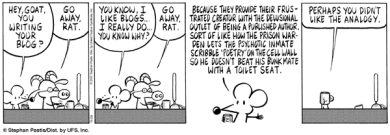 Hey, Goat, you writing your blog?From today's awesome Pearls Before Swine, a comic strip from Stephan Pastis.
Erick Schonfeld's
TechCrunch
blog post today tries to cover the new $199 Linux PC being sold at Wal-Mart:
Our Crunchgear colleague John Biggs has an item in the NYT today about Wal-Mart's $200 Google PC that runs a version of Linux called the Google Operating System.There are two important facts wrong in this first sentence. It's not a "Google PC", it's the gPC. And it doesn't run the "Google Operating System", it runs gOS, a project of Dave Liu. In fact, as near as anyone knows Google has no involvement with the development or marketing of this PC. TechCrunch reporting otherwise is a significant error. Journalists make mistakes too; why's TechCrunch blog post not journalism? First, the story TechCrunch posted is really just a quote from someone else's story with a bit of unsupported speculation tacked on. Fine for a blog post, not good journalism. Second, despite lacking any original reporting it still gets fundamental facts wrong. Real journalism involves editors who should catch something so embarassing before going to press. Either this post wasn't edited before publication or else the editor didn't think it'd be important to verify something as significant as an entry by Google into the consumer PC market. On the good side, the blog post comments are great. The third comment gets the story right and there are links further down to good coverage on Wired and ZDNet. User comments are something blogs do better than journalists. I feel bad picking on TechCrunch for the second time in a week. The issues I'm pointing out aren't just them, it's a lot of blogs. TechCrunch is just a highly relevant target given their influence. People increasingly think of TechCrunch as being like news reporting. It's not. It's an excellent blog. Some blogger want to do actual journalism? Go research who's collecting the ad referral revenue from ad clicks via gOS' browser. I don't know, but I'm betting it's not Mozilla. A disclaimer of sorts: I haven't worked at Google for over 18 months. I have absolutely zero inside knowledge about gOS, Everex's products, or any Google plans for creating hardware or operating systems. I'm just reading TechCrunch.
I stirred up some trouble with my
post about TechCrunch misusing the term "off the record" or
burning their sources.
Some reactions:
Brian
Ford,
John
Gruber,
JD Lasica,
Scott Lawton,
Dave
Winer,
even Valleywag.
Nothing from TechCrunch themselves. I'd love to hear Arrington explain
what "off the record" means to him. He's probably been too busy
having off the record conversations in Hawai'i.
Most of the discussion has been about my provocation that "blogging is not journalism". Unfortunately it's a hackneyed discussion, my fault for using a false dichotomy to rile my readers (call it yellow blogging). Of course there's a continuum between stream of consciousness blogging and authoritative journalism and it stretches across media. Traditional journalists aren't perfect. And unsourced rumour blog posts can be amazing scoops. What bothers me is when blogs do reporting in ignorance of decades of established journalism ethics and practice. Journalistic rules have value. How you treat a source is important; burnt sources stop talking. Authoritative sources make a story much stronger; otherwise you're just blogging rumours. And avoiding or disclosing conflicts of interest matters; if not, you appear biased. It's great that blogs are aggressively reporting rumours and stories. But please, bend the rules of journalism thoughtfully. One advantage of the blog world is that bad reporting can be corrected by other blogs. Even so, I believe powerful blogs like TechCrunch have special responsibility to be careful in their reporting given their influence and appearance of authority. As Winer notes it's rare for someone in the tech world to publically criticize TechCrunch because of the threat of repercussion.
I like TechCrunch, it writes
interesting blog posts about
stuff I care about. But it's a great example of how blogging is not
journalism.
TechCrunch has a strange habit of blogging things where the only source is off the record. Ie, from today's Valleywaggish story about a manufactured MySpace scandal. How old is he really? We first heard 40. We dug a little online and came up with nothing. But then we got a senior person at MySpace to talk to us about it off record at the Web 2.0 Summit last week: this person confirmed that he's really "36 or 37" and that MySpace has been trying to keep this quiet for some time.Or a few weeks ago, about Google and Facebook Notwithstanding that NDA, we've now spoken with three of the attendees off record to get an understanding of what Google is planning. Google's goal — to fight Facebook by being even more open than the Facebook Platform. Anyone talking to media knows that telling a journalist something "off the record" means you're telling them so they know it. It's not going to stay secret. But it also clearly means that the comments aren't to be used a primary source. The point of "off the record" is to steer a journalist the right way so they can dig in deeper and get the real story from a real source, on the record. TechCrunch, though, just reports stuff "off the record" directly. Remember that next time you're being chummy at a party with Arrington. Blogs are great for discussing current events, particularly shades and nuance from multiple angles. And I like juicy rumour sites. But real journalism has a strong code of ethics, a responsibility to source reports, and careful editorial review. TechCrunch isn't even trying to do that. |
|