Some Bits: Nelson's weblog

Dry January

I’m planning to do Dry January again this year: no drinks for the month. Last year was the first year I did it and I found it really helpful.

The main thing I learned last year is I could drink less. It’s the longest I’d gone without alcohol in a long time and I wasn’t sure at first I could. It helps that the goal was simple and short term.

I felt better pretty much immediately, more energy. And the calorie reduction was welcome, although I did end up eating more instead. Sometimes I felt like I was missing out on some fun. But mostly I found I could socialize, including a weekly happy hour at a bar. It also gave me new perspective on how much alcohol changes social interactions.

One thing that helped in the evenings was having fancy non-alcoholic aperitifs on hand for the ritual. I quite like Ghia, a bitter soda. NYT has a lemon tonic I like making. Non-alcoholic beer has also gotten very good, it tastes just like regular beer.

I find myself looking forward to doing it again this year.

Tex Mex Gravy

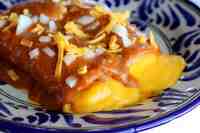
Cheese enchiladas are some of my favorite old school Tex-Mex food. Corn tortillas, orange cheese, smothered in a beefy thick gravy. The gravy is not like a typical Mexican enchilada sauce: no tomatoes or tomatillos. Instead it’s more of a Southern gravy like you’d put on biscuits or serve with turkey, but spiced with chile, cumin, oregano, and garlic powder. The key thing is it’s made with a roux. And a lot of roux, it really is a thick gravy. You never see this sauce in California or New Mexico and I suspect not in Mexico itself except maybe at the border. But it’s everywhere in Texas. it’s a defining element of Tex-Mex cuisine.

There’s an early recipe for the Tex-Mex gravy in the 1908 Gebhardt Chili Powder Company cookbook. This cookbook was written for Americans for whom Mexican food was exotic. It was written mostly to sell their chili powder, a spice blend of mild chiles (probably ancho), cumin, oregano, and garlic powder. (I made a PDF of the book from these scans.)

Salsa de Chili—Chili Gravy
This may be made of any brown or meat gravy by adding to each one-half pint of gravy, one teaspoonful of Gebhardt Eagle Chili Powder, stirring thoroughly and cooking for ten minutes. This makes a very rich sauce for fried eggs, cooked rice, baked beans, etc.

Note it doesn’t mention enchiladas. There’s no enchilada recipe in the copy of the book I have. But this is our Tex-Mex gravy! Although it’s awfully light on the spice.

Robb Walsh’s Tex-Mex Cooking has a modern version of the same gravy, see the NYT version. It’s a 4:1 mixture of chicken broth to roux with Tex-Mex spices added. Walsh’s recipe says

The lifeblood of old-fashioned Tex-Mex, chili gravy is a cross between Anglo-brown gravy and Mexican chile sauce. It was invented in Anglo-owned Mexican restaurants like The Original.

Phnom Penh street food tour

One of the best things on our trip to Cambodia in March was a street food tour in Phnom Penh led by Urban Forage. They provided a great guide and a tuktuk and driver. It was an amazing chance to try all sorts of casual snacks and meals, the kind of stuff that always looks so interesting but too intimidating to try on my own. Places were vetted for food safety for delicate Western stomachs and our guide did a great job teaching us about the food.

It was so fun and delicious! There’s some photos here and here. Cambodian food is roughly similar to Thai and Vietnamese food, but is its own thing.

First up was the “famous grandma noodle shop”, a home cooking restaurant with the kind of fish noodle soups I loved in Cambodia. This place was a restaurant with a choice of items but also very casual. We had both a chicken noodle soup and the fish noodle soup, both “curry” flavored but clearly Cambodian, not Thai. The rice noodles are super fresh, made that morning, kind of gelatinous and stuck together. The soup had such deep delicious flavor. And lots of fresh ingredients to liven it up: limes, basil, a bunch of unfamiliar herbs like fishwort.

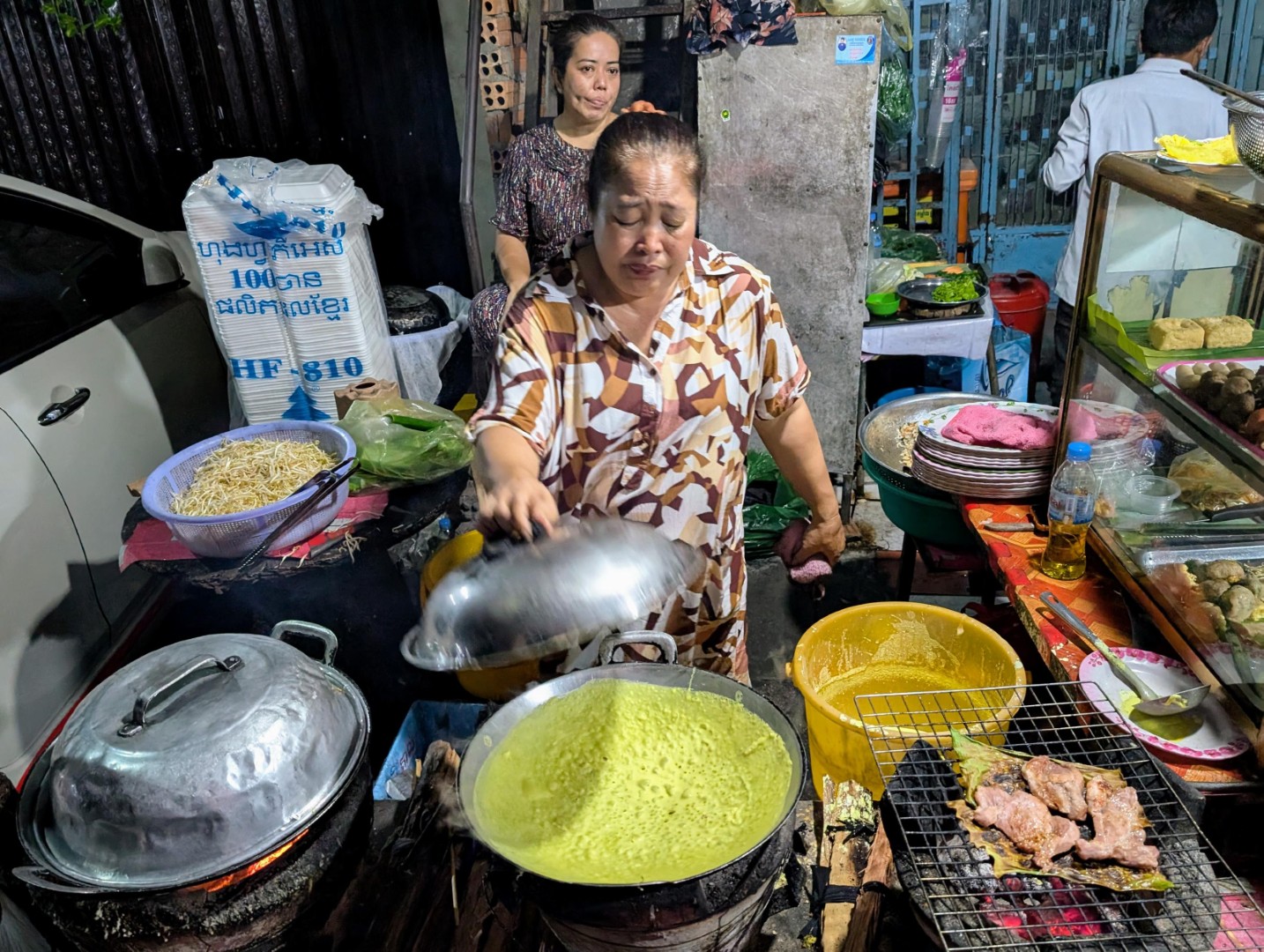
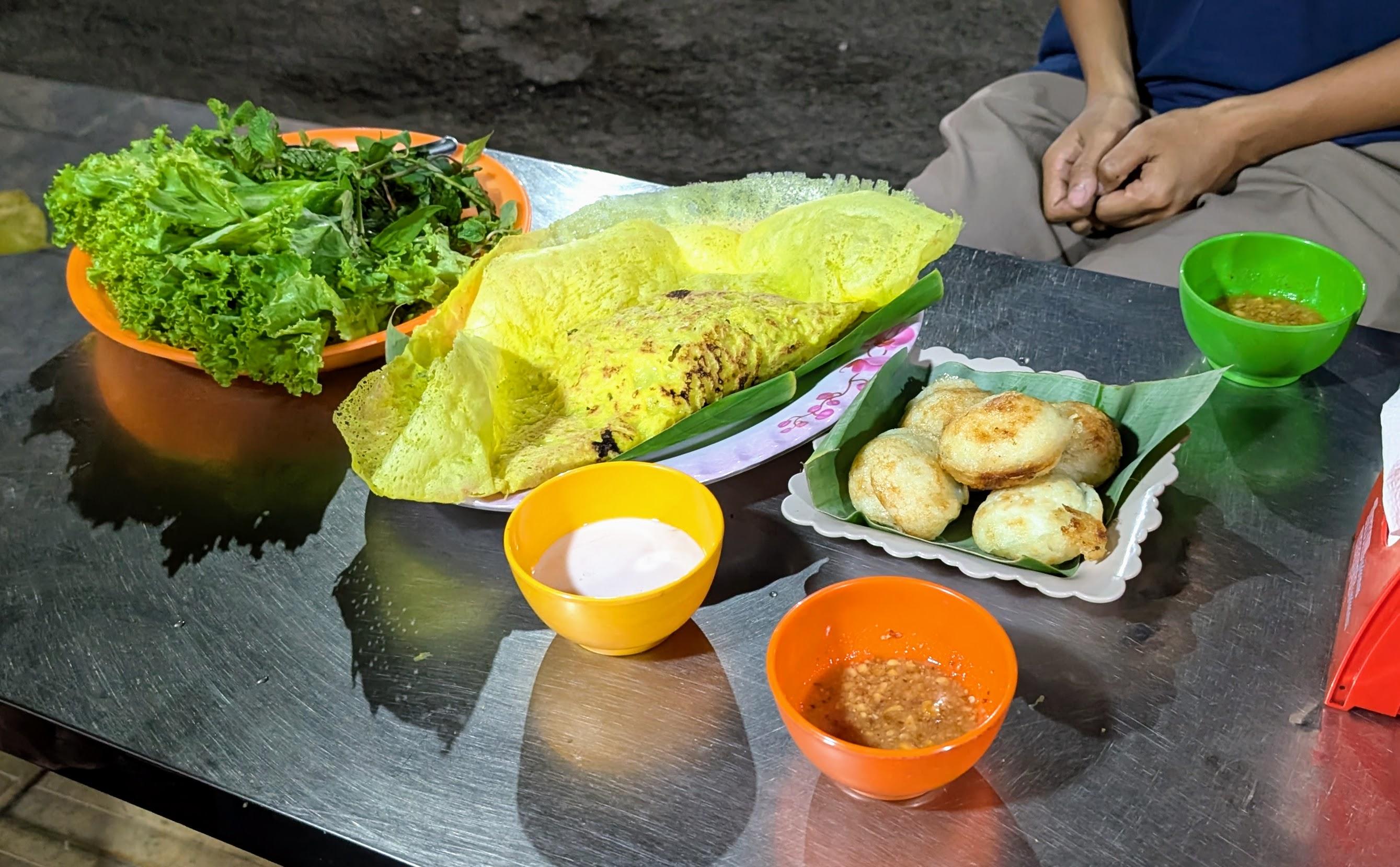
The second place was a sidewalk stand near Wat Botum Park. Rice crepe with turmeric, stuffed with chicken and sprouts, dipped in fish sauce / lime juice. Also a rice flour ball with chives in it, fried, dipped in coconut cream. it reminded me a lot of dosas and idlis. Very yummy and seemed like solid daily food.

Our third stop was for a baguette with crispy pork belly inside, some herbs, also a fresh carrot pickle. Similar to banh mi. We enjoyed it, all nice and fresh, but at this point we started to realize we were in for a long haul of lots of food.

The fourth place was in the Russian market and served barbeque. Various kinds of pork cuts, we had spare ribs. Very crispy fried and quite fat. Was too full to enjoy it all but it tasted great.

Fifth was 54ល្ងាចស្រស់ (on Facebook) a restaurant with general Khmer foods, lots of beer, and a live band. Food was a mix of things, all pretty good. My favorite was a squid salad-like dish. This was where we had the stunt food, insects. One big tarantula was OK but silly: legs were delicious like soft-shelled crab. The spicy crickets were pretty good beer snacks. The place was a bit touristy but honest, a place I could imagine going even without a guide.

Absolutely full of food and beer, sixth the guide took us to a roadside stall selling a sweet dish. A rice crepe stuffed with fresh coconut meat and a rice candy, some sweetened condensed milk. Quite tasty in its simple freshness. It was a little like this video labelled num lon ong chek.

Our final stop was a return to Western familiarity. The wild cocktail bar, a French-run place with coffee, drinks, and spring rolls. Good cocktails, nice outdoor seating.

Street food tours may be my favorite new tourist activity! We also did one in Saigon that was fun but not quite as good as this one in Phnom Penh. But in Saigon we also did a cocktail tour from this company, that was terrific.

Edmund White 1940-2025

Edmund White died June 3, after a long and much-loved life as one of America’s great gay writers. His 1982 autofiction novel A Boy’s Own Story is his best known, a frank and honest story of growing up gay in the 1950s. Many gay men (including myself) found themselves in that book and the ensuing trilogy. He published 36 books including memoirs, autofiction, novels, historical treatments, and the 1977 Joy of Gay Sex. He is a foundation stone of gay English writing.

He always saw himself as a gay writer for gay readers, the distinction he drew between his generation of queer writers and those who came earlier, like Gore Vidal and James Baldwin. They might write gay characters, but they never seemed to be writing for gay readers. Ed was.

… Edmund White had no use for shame, and in both life and work, he refused to sand down the edges of queer existence to make it palatable. Acceptance was never the point. Truth was.

I’ve been mourning his passing these past few days. I didn’t know him personally but his writing and presence have been meaningful to me, particularly as I evaluate my middle-aged gay life. Some suggested reading:

This was also posted to Metafilter

Angkor Wat resources

I took an amazing trip to SE Asia last month, including Angkor Wat. I had a hard time finding good reading or other resources to learn from before I went, in part because Amazon is awash in AI garbage. Here’s some books and podcasts I found useful about the Khmer empire in general and Angkor in particular:

Ancient Angkor by Michael Freeman and Claude Jacques. The closest thing to a coffee-table book to preview what you will see. The practical information is outdated but the pictures and descriptions are good.

Empire Podcast #185: The God Kings of Angkor Wat by William Dalrymple and Anita Anand. An entertaining and fully detailed account of the Khmer empire. It’s basically an excerpt from Dalrymple’s new book The Golden Road: How Ancient India Transformed the World.

Fall of Civilizations Podcast #5: The Khmer Empire by Paul Cooper. Another history, not quite as magically well told as Dalrymple but full of good information.

Angkor and the Khmer Civilization by Michael D. Coe. A highly recommended history of the Khmer region. Honestly I found this very dry and too detailed, but I did learn from it.

Lonely Planet Pocket Guide: Siem Reap & the Temples of Angkor. We didn’t use this much but it seemed like a useful practical guide. OTOH it dates to 2018 so things have changed.

My other advice for visiting Siem Reap and Angkor is: go. It is amazing. Plan for at least two full days of touristing there. Hire a private guide and driver if you can, it is absolutely worth it. (Email me for a recommendation.)

Non-alcoholic apéritifs

I’ve been doing Dry January this year. One thing I missed was something for apéro hour, a beverage to mark the start of the evening. Something complex and maybe bitter, not like a drink you’d have with lunch. I found some good options.

Ghia sodas are my favorite. Ghia is an NA apéritif based on grape juice but with enough bitterness (gentian) and sourness (yuzu) to be interesting. You can buy a bottle and mix it with soda yourself but I like the little cans with extra flavoring. The Ginger and the Sumac & Chili are both great.

Another thing I like are low-sugar fancy soda pops. Not diet drinks, they still have a little sugar, but typically 50 calories a can. De La Calle Tepache is my favorite. Fermented pineapple is delicious and they have some fun flavors. Culture Pop is also good.

A friend gave me the Zero book, a drinks cookbook from the fancy restaurant Alinea. This book is a little aspirational but the recipes are doable, it’s just a lot of labor. Very fancy high end drink mixing, really beautiful flavor ideas. The only thing I made was their gin substitute (mostly junipers extracted in glycerin) and it was too sweet for me. Need to find the right use for it, a martini definitely ain’t it.

An easier homemade drink is this Nonalcoholic Dirty Lemon Tonic. It’s basically a lemonade heavily flavored with salted preserved lemons, then mixed with tonic. I love the complexity and freshness of this drink and enjoy it on its own merits.

Finally, non-alcoholic beer has gotten a lot better in the last few years thanks to manufacturing innovations. I’ve been enjoying NA Black Butte Porter, Stella Artois 0.0, Heineken 0.0. They basically all taste just like their alcoholic uncles, no compromise.

One thing to note about non-alcoholic substitutes is they are not cheap. They’ve become a big high end business. Expect to pay the same for an NA drink as one with alcohol even though they aren’t taxed nearly as much.