
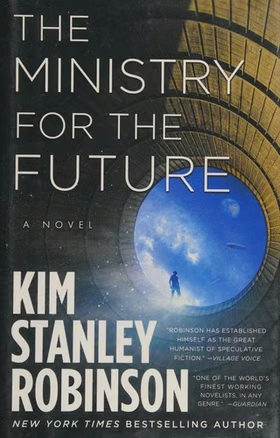
The Ministry for the Future
I waffled between 2 stars and 4 because I loved parts and didn't like other parts. I will say I was in such a hurry to finish reading the book, I must have liked it!
The best part of this book is a well told science fiction story about climate change and a global political response to it. Reading this I didn't realize how much I needed climate change fiction, need more of it. I don't think this book is the be-all-end-all of the genre but it's very good. I also want to call out in particular the first chapter, with its horrible and detailed narration of an extreme heat wave killing many people in India. It's terrifying and memorable.
That first chapter quickly leads to one of my problems with the book, a staccato of several short chapters with no narrative structure, just ideas writ quickly on the page. Some of these chapters work well. The best are like little short stories. Some are twee or bad experimental writing, particularly the bizarre childrens' book like chapters that end with sentences like "you guessed right, I am a photon".
A lot of the book's ideas are conveyed in these short chapters. Some of them work, many don't. Mostly it just felt a little lazy, like he had a bunch of ideas he wanted to get in the book and couldn't figure out how to tell a novel-length story with them so he just sort of inserted them on their own. But the ones that work are good.
The book reads in part like a political agenda, almost a roadmap for a better progressive future. At times KSR seems to be saying "see if we just did these obvious things look at the utopia that would result!". I'm OK with that, but...
The book ends up sprawling pretty far from climate change, into global solutions for economic inequality, refugee crises, extinctions, etc. A lot of these problems are solved with magic solutions. "We just passed a law you couldn't pay rich people too much and it worked!" This stuff undermines the interesting political agenda.
And the interesting core of the book, the climate change, also suffers from magic solutions. I'm not troubled by the various technologies that work, it is sci-fi afterall and he does a good job explaining the struggles of developing and testing technologies. But rather a key part of the solution is a series of benevolent terrorist acts, particularly assassinations. All private aviation ends because someone blew up a bunch of planes and everyone got too scared to fly. For that matter the titular Ministry only works because it has a secret black ops division that carries out various selective awful actions. In the real world terrorism and unregulated violence do not work as political solutions to global problems. It's offensive to read KSR suggest they would. Guess he couldn't fully escape the ecofascist ideal.
Two minor things I enjoyed quite a bit. One was the description of the town of Zürich, he must have spent a fair amount of time there. The Bay Area description also felt very like home. And I liked some of the gentle characters, particularly Mary and Art. Those recall the pleasant utopian days of the Mars trilogy.
So all in all a mixed bag. On the balance I think this book is important and novel and worth a read. But then it also had some real problems. I am glad I read it.