
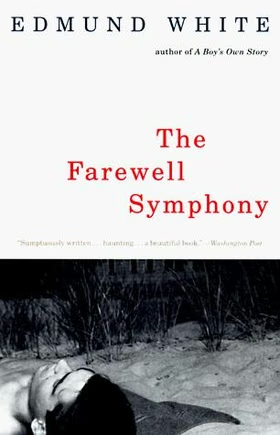
The Farewell Symphony
I am sad having finished White's trilogy of autobiographical novels. Right now, I'm sad because I wish there were a fourth book. So much of his three books have been like a manual for a gay life I never had. I grew up too late for what White describes, with different constraints and hangups on sexuality and relationships. I'm envious of his life, the "right to express ourselves sexually wherever, whenever and with whomever we chose." I'm envious of his clear ability to describe his experiences and connections to so many people. This book ends about when White becomes my age now. I'd be curious to read another novel in this vein of his life after age 50, maybe some advice on what's to come. (The hint he offers, "Now that I’m fat and in my fifties I go to bed only with men I pay or men who love me or fans", is a little discouraging although I admire his brashness of inserting the personal ad.)
I'm also sad because the book is quite melancholy. It begins and ends in death, particularly his partner Brice. And then the last chapter, the death of nearly everyone in White's social circle. The last thirty pages or so are a poignant catalog of reconnecting with old friends and lovers as they are dying. And hanging over it all is White himself having HIV, the fear of his own potential death and the constraints of that fear. AIDS narratives are still an incredibly raw subject in gay writing and I appreciate White's view of this (written in 1997).
These books were very emotionally affecting for me. The honesty and directness, the unapologetic descriptions of his life. It's also admirable to see how the writing improves with each book, gets more complex and self reflective. The tone of this third book is quite different from the first two, more self conscious and thoughtful. At times it's a little overwritten, but there's so many great turns of phrase (see my highlights) it's worth it. Also the gravitas of the book can bear the weight of a little too much word polishing.
One thing I'm curious about is just how much detail White is able to conjure. Remembering exact descriptions of how he felt about a meal he had 25 years ago, or the awkwardness of a particular trick. He says somewhere he didn't keep diaries and notes. And he was drunk or high for a lot of what he describes. Perhaps some of these details benefit from the status of this as a "fictional autobiography". It's remarkably effective writing.
These three books have left feeling a great empathy for White. And for all gay men, even myself.
Update: I wanted to quote this paragraph from a 1997 interview Edmund White did on Fresh Air, because it's White speaking to a central theme in his writing I find so appealing.
Nor did all this sex preclude intimacy. For those who never lived through that period, and most of those who did, are dead, the phrase "anonymous sex" might suggest unfeeling sex, devoid of emotion. And yet, as I can attest, to hole up in a room at the baths with a body, after having opened it up and wrung it dry, to lie, head propped on a guy's stomach just where the tan line bisects it, smoke a cigarette, and talk to him late into the night and early into the morning about your childhood, his unhappiness and love, your money worries, his plans for the future. Well, nothing is more personal, more emotional.