
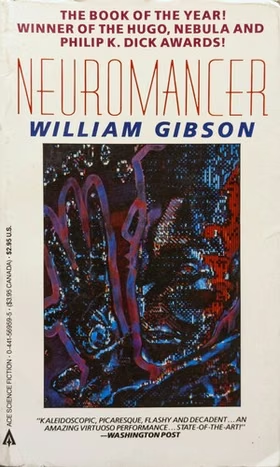
Neuromancer
I read this first in high school, back when it was new and hip. I didn't like it much, I think because of the plot problems in the second half of the novel. Now I'm reading good sci-fi as a fun alternative to stuff that's "good for me" and finding it incredibly entertaining, not to mention stimulating. I really enjoy the way Gibson puts words together, creates moods with inflection. And the way Gibson catches, and in some cases predicts trends is incredible. I can't help but be amused at the few anachronisms ("the clattering of printers", for instance), but in general he gets things right on.
I've been thinking some about virtual realities, and "cyberspace", and that sort of cruft. Neuromancer's view of VR provides a nice opposition to that in Stephenson's Snow Crash. Stephensonian cyberspace is very true to the physical world - hop on a motorcycle, go into a building, chat with people. In contrast, Gibson's cyberspace is much more natural to the computer: it matches the true organization of infostructures, multidimensional and probably non-Euclidean. As a computer geek, I find Gibson's conception more appealing. I want to use the binocular vision processing hardware in my brain to increase bandwidth, but I don't want to constrain my understanding of cyberspace to 3d physical reality.
Edit read this a third time with almost no memory of the first two readings. And struggled with the first half quite a bit, just following the plot. Gibson's writing is elliptical and the story is a little confusing. But then I synced in, and got some help from Wikipedia's plot summary, and I got to enjoy the ride and the sheer novel imagination of this invention of cyberpunk.
Reading it this time I picked up so much on how it was influenced by and then influenced so many things I like. Influenced by PK Dick's sci-fi detective stories and by William S. Burrough's malicious hallucinatory action. And influencing things, famously the novel that defined cyberpunk. Interesting to see all the specific bits of this book that made it into The Matrix, things like the razorgirl Molly. Also how very much the excellent writing of the Cyberpunk 2077 game follows the beats and tropes of the Neuromancer novel. It's not a retelling of the book but it sure has a lot of homage.
I hardly connect with that previous review I wrote up there as a much younger man. This time around what I see is the romantic part of the book, the adventure. That and the sheer novelty of inventing so many cyberspace ideas.