
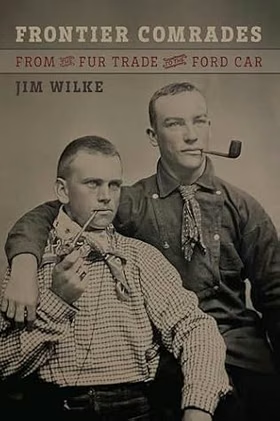
Frontier Comrades: From the Fur Trade to the Ford Car
Very solid and readable history, I'm glad I read it. Quite quickly too, it was a quick and fairly entertaining read.
I think the book is strongest at painting a picture of what life was like on the frontier in the American west. Daily life for folks fur trading or working in logging camps, mining camps, army camps. His writing is quite evocative. Maybe too much so: it felt a little embellished and a little too lengthy. But that made it an enjoyable read and his enhancements were responsible and narrative, not misleading.
The queer history part of the book is weaker. There's very little information about the sexuality of most of the subjects. How could there be? Many of them were living in a time before homosexuality or transgender identity were well defined. And to the extent it was known it was stigmatized or illegal. Of course there's little record. But then it's hard to tell a whole story of, say, a sheriff of Tombstone when the only evidence he was queer was a couple of close male friendships and some gossip from people after he died. I think the author is responsible here, I imagine that man really was homosexually inclined, but I'm not sure I learned a lot about what that was like for him.
The narrative is stronger in a couple of chapters that have written accounts of scandals. Mrs. Noonan's story is the best here, a transgender woman doing laundry for an army camp. Her story is a tragedy and the newspaper accounts are cruel. But they are well balanced by Elizabeth Custer's respectful recollection of the woman's life, some remarkable words of acceptance.
The Lesbian couple (Dietrich and Chatfield) is similarly well told through newspaper accounts. Alas, no sympathetic words and none of their own. I also loved the last chapter about a logger because it's all sourced to a Straight to Hell first-hand account written in 1975. I'd love to read that primary source!
Speaking of sources, I'm a bit confused on how much of this book is original research and how much is re-presented. The book itself is well footnoted, but a lot of the references are either to Jonathan Katz's Gay American history or else to Peter Boag's Same-Sex Affairs. Both great sources but I was unclear what scholarship Wilke added to their work. Certainly some, there's a lot more of Dietrich & Chatfield's story here.
Overall this is a good book of scholarship. I'm grateful for it because this historical record is so thin.