
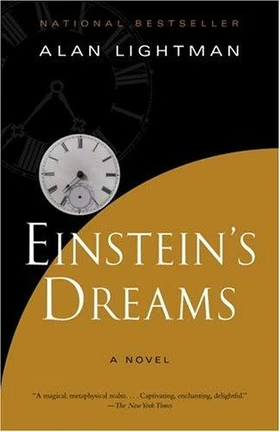
Einstein’s Dreams
I went into Einstein's Dreams not sure what to expect, but thought maybe it'd be a hard sci-fi exposition about relativity. So I was please to find a book that is only peripherally about science. Instead it's really a poignant book about the human experience, and emotion, and our perception of change over our lives. It's lovely.
The book doesn't have a traditional plot. Instead it's a series of parables, each one exploring how people might live if time worked differently. What struck me is how little Lightman belabors the science. I read a lot of speculative fiction where authors get very into the hard sci-fi details, and that's fun, but it usually gets in the way of the human story. Here the physics is underpinning everything but it never overwhelms the emotional core.
I couldn't stop thinking about Borges, that same moody, philosophical writing driven by big ideas. But Borges' Ficciones jumps all over a bunch of ideas, it's a collection of diverse short stories. Lightman's little novel explores variations on a single idea. (Lightman acknowledges the influence.) It's is a little exhaustive, I wouldn't have minded an even shorter book, but then I imagine which of the parables resonates depends on the particular reader. They're all pretty good, many suffused with an existential sadness. Occasionally sweetened with a little romance, or affection, or human kindness.
What I like most is that this book respects both ideas and feeling. It doesn't sacrifice one for the other. It's left me feeling a pleasant melancholy.