
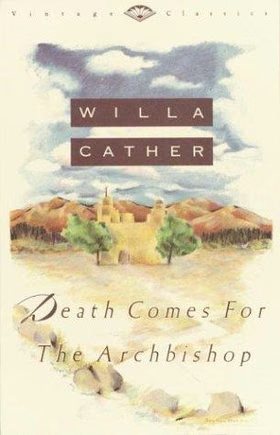
Death Comes for the Archbishop
Well this was lovely and a good reminder I should be reading more classic fiction. Remarkably well written and so gentle. I liked the depiction of close, non-romantic friendships between men. And the devotion to a religious life (surprised I liked that, given how problematic Catholic missionary activity can be.) And a meditation on the meaning of one's life in relationships and impacts on others. Timeless themes.
But what I really liked was the New Mexico setting. It made me homesick for when I lived in Santa Fe. The book is beautifully written and does a great job giving vignettes to smaller places like Acoma or Taos. Oddly Santa Fe itself doesn't get quite the same depth, I think because it was too complicated and modernized for the theme of the book. Fair enough.
(This is petty but what a terrible title for the book. I spent years thinking it was some cheesy murder mystery.)
I was really curious reading this how accurate it was. All the stories seemed true to me, like I remembered from living there. But then did I learn real true stories or was I getting Cather's fiction second-hand?
I'm sure the stories I learned in New Mexico were influenced by Cather. But I did a bit of research and she definitely did an enormous amount of research to write the book. The book is fiction but obviously heavily informed by real world events and people. More than just partly truthy. Some details on what I learned...
A big chunk of Cather's novel was informed by Life of the Right Reverend Joseph P. Machebeuf, a 1910 biography of the first Bishop of Colorado written in 1908 by a priest who knew him and had access to his letters after his death. Machebeuf becomes Vaillant in the book. On a quick skim it's clear many of Cather's specific stories, like the origin of the bells in one church, come straight from Howlett's biography. I'll take Howlett's work as historical truth or as close to it as is possible now.
Cather also travelled in the Southwest a fair amount. And was known for doing careful and extensive research. I'm less clear how much access she had to Bishop Lamy's historical life. There's a lot in her book about his thoughts and feelings and I don't know if those were the author's art or come from Lamy's letters.
I didn't go this deep but in 1955 Edward and Lillian Bloom wrote The Genesis of Death Comes for the Archbishop, a scholarly article with a lot of details on Cather's sources and writing. There's also a 1999 scholarly edition of the book that promises to "reveal Cather’s creative process and enable the reader to follow the complex history of the text".