
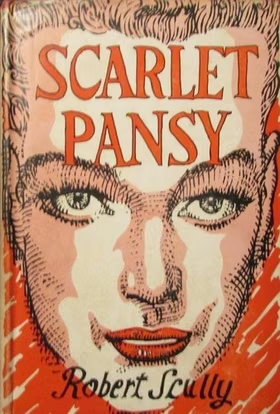
A Scarlet Pansy
What an astonishing novel! A 1932 gay novel, very queer, and quite modern. It seems quite an important book for how little it is known.
The main plot is an improbable rags to riches story of Fay Etrange as she works her way up from nothing to being a wealthy investor and doctor, culminating in her romantic and tragic death on the front of World War I. Honestly this plot is not very good but it's not the point of the book. The real story is a proud, unapologetic biography of a gay man living an absolutely queer life of high camp. The gender and sexual content is surprisingly relatable now, almost 90 years later.
First, to get the pronouns out of the way. Fay is referred to throughout the book as "she". But it's also clear she is a man, a gay man. My take on it is not that she's transgender in the contemporary sense, she does not live as a woman. We'd say she's "genderqueer" instead. Or in the language of its time it was the camp world of gay men referring to each other as "her" and "Miss Thing" and "girl". Anyway none of the pronoun stuff is very complicated but I like the editor's notes about how unusual the book is in directly challenging gender roles in a way that was not only atypical at the time, but also out of step with 1990s gay liberation as America normalized gay men as men. Fay is feminine but a man. Also a fairy at a time when being a fairy was a role with a place in society, not just despised.
Fay also is sexually voracious. And quite successful at picking up "real he-men". Some trade, but mostly men of some refinement and interest. The first part of the book has her being sadly self-loathing and avoiding her sexuality. A tiresome trope of its era. But then the book goes in a really wonderful and liberating direction as she embraces her sexuality and joins the queer demimonde. Much of the book is a mix of her escapades with her various tricks mixed with outrageous parties and drag balls. And a rotating cast of queens, fairies, bulldykes, men and women living outside the bounds of accepted society and absolutely proud and hilarious about it.
This transgressive glittering society is the gay world I feel I inherited. Growing up in the 80s my exposure to gay life involved a lot of thrilling hints of camp, promiscuity, and defiance. We've moved past that now in America. Now the stereotypical gay man is a slightly burly, competent and quiet couple who has dogs or maybe a child and lives a life in harmony with the expectations of ordinary straight society. And while I am grateful for that normalization I also find the demimonde depicted in A Scarlet Pansy appealing, a theatrical and brave society of queers living queer lives by their own rules. Some of that spirit today is captured in communities like the New York Ball Culture.
It's not all fun and parties though, particularly at the start of the book. I particularly touching bit of writing is Fay's relationship with her brother Bill. Who hates how faggy she is, criticizes her speech, and contributes greatly to Fay's self loathing. The author's portrayal of that felt very authentic to me. Happily Fay just decides Bill is boring and bad for her and moves on and doesn't see him again. It frees Fay to live the outrageous queer life that makes the book so fun.
I found this book in the most wonderful way. Finding it on a list of homophile publications in Swasarnt Nerf's Gay Guides for 1949, an authentic recommendation from 70 years ago.
I'm grateful to Robert Corber for producing this edition. The book went through a lot of edits and variations; a bowdlerized version in the 40s, an "updated" edition in the 90s to hew to modern political sensibilities (with Fay given the name "Randy" and masculine pronouns!) It's great to read the original version. And his preface is remarkably useful in contextualizing the novel. I particularly like his emphasis on how this book works outside expected gender norms, both in its time and now. It reads very queer and au courant in 2021.